
MotherToBaby Interactive Critical Periods of Pregnancy Tool

Understanding Critical Periods in Pregnancy

Kendra, newly pregnant at approximately 7 weeks along, contacted MotherToBaby late one afternoon with a question that had been causing her a lot of anxiety. Norovirus was running rampant in her home, and she was feeling extremely nauseous. Having found relief with it before, she explained that she had taken a single dose of Zofran (ondansetron) early that morning. She was certain this drug was ok to take during pregnancy, but after searching online, she became concerned. Kendra shared that she had read conflicting information about whether Zofran increased the risks for birth defects; with some studies showing an increased chance of heart defect and cleft palate, and other studies showing no increased risk. Feeling confused, Kendra reached out to MotherToBaby with her question to receive personalized information.

On the call, I first explained that birth defects can happen in any pregnancy for different reasons. Out of all babies born each year, about 3 out of 100 (3%) will have a birth defect. Pregnancy problems (like miscarriage) can also happen in any pregnancy. Sometimes, exposures like medications, drugs, alcohol, and infections can increase the chance for birth defects or pregnancy complications. However, for an exposure to cause a problem, it generally has to happen during the “critical period” when a body part is forming.

To help Kendra understand more about possible risk from her Zofran exposure, I used MotherToBaby’s new and interactive critical periods of pregnancy tool! This helpful pregnancy calculator and chart shows when different parts of a baby’s body form during pregnancy and when birth defects or pregnancy complications might happen. By entering the first day of your last menstrual period (LMP) or estimated due date (EDD), the calculator can estimate how far along you are today. Individuals who have questions about exposures in pregnancy can then go on to enter the specific date(s) when the exposure (such as medication use or alcohol consumption) occurred, and the chart will show the body parts that are developing during that time.

After entering the first day of Kendra’s last period, the interactive tool confirmed she was 6 weeks and 5 days pregnant. I then entered her Zofran exposure using today’s date, which resulted in a pink line popping up on the chart. Following this line down the chart, I could see all of the different body parts that were currently forming. I explained to Kendra that when she took the Zofran, the palate (roof of the mouth) had not yet started to form, meaning that the medication use was unlikely to increase the chance of cleft palate in the baby. The chart also helped me see that the baby’s heart was currently developing. I shared this with Kendra, but also reminded her that the latest research shows there is thought to be a less than 1% chance of heart defects from exposure to Zofran; meaning there is a more than 99% chance the heart will not be affected by her medication use. In other words, even when an exposure of concern takes place during the critical period, not every baby will be affected by that birth defect. 
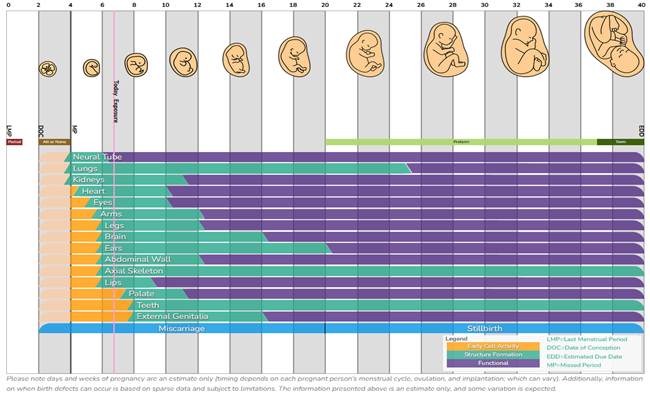
New Critical Periods of Pregnancy Interactive Tool

For Kendra, being able to understand which specific body parts were forming when she took the Zofran and whether she actually needed to be concerned helped decrease her anxiety significantly. Knowing that the heart was currently forming, she decided to reach out to her healthcare provider to discuss alternative treatment options for her nausea.  I was happy to have helped answer Kendra’s question using this visual tool and look forward to being able to use it again in the future when pregnant women have questions about the timing of their exposure.

Remember that our team is always available to help review any exposures you have had and provide a personalized risk assessment. Don’t hesitate to contact MotherToBaby by phone, chat, text, or email!


MotherToBaby Interactive Critical Periods of Pregnancy Tool

The arrival of spring and summer warmth spurs many of us to spend more time outdoors and make travel plans, be it for a honeymoon, babymoon, or other seasonal getaway. Such was the case with Yesenia, who contacted MotherToBaby with questions about her upcoming summer vacation after finding out she is pregnant. Yesenia knew that with warmer temperatures comes an increased chance of mosquito bites and the infections they can carry. Like Yesenia, as you engage in more outdoor activity and plan getaway time, you may also have questions about exposure to these infections and their possible effects on a pregnancy. Understanding the potential risks of these illnesses and ways to protect yourself may help you make better-informed decisions before you decide to travel. This month, MotherToBaby turns to our partner the Society for Maternal-Fetal Medicine (SMFM) to help answer some of Yesenia’s questions:

What are vectors and vector-borne illnesses?

Vectors are living organisms, such as mosquitoes, ticks, biting flies or fleas, that are capable of spreading diseases to humans through bites and other forms of contact. Some common examples of these diseases, called vector-borne illnesses, include Chikungunya, dengue, malaria, Oropouche, and Zika virus. While disease-carrying insects can bite year-round, they are most active during warm weather. Many vector-borne illnesses have no cure, and treatment is usually limited to just managing the symptoms. This is why it’s important to protect yourself from bites!

How can vector-borne illnesses affect a pregnancy?

There can be serious health complications for the mother with some vector-borne infections during pregnancy, such as severe anemia, bleeding, and the need for hospitalization. If the mother develops serious complications, it increases the chance of problems for the baby, such as low birth weight, preterm delivery, or stillbirth. Some vector-borne illnesses may be passed from mother to baby during pregnancy, which can lead to serious birth defects, such as microcephaly (a condition where the head is smaller than normal), other structural defects of the brain and eyes, and problems with long-term development and cognition (such as learning, understanding, and memory). For more information, see the MotherToBaby fact sheets on dengue, malaria, Oropouche, and Zika. The CDC also has information about chikungunya and other vector-borne diseases.

I am pregnant and I am planning to travel. How can I protect myself?

Here are some quick tips:

  • If traveling, check CDC’s Travel Health Notices (THN) page before booking your trip. Avoid nonessential travel to high-risk areas starting with a Level 2 or higher advisory on the THN board.
  • Use the Travelers’ Rapid Health Information Portal for destination-specific recommendations, such as which vaccines to get to prevent travel-related illness.
  • Wear long-sleeved shirts and long pants when spending time outdoors.
  • Apply Environmental Protection Agency (EPA) registered insect repellents to exposed skin and clothing.
  • Avoid outdoor activity during dusk and dawn when mosquitoes are most active.
  • Minimize exposure to open water sources, such as pools and lakes, which are breeding grounds for vectors.
  • Keep windows and doors closed or use fans, mosquito nets, and mesh screens on windows and doors.
  • Use the CDC’s Pregnant Travelers’ Health Guide for other general travel tips.

Which insect repellents are EPA-registered? And are they safe for me to use during pregnancy?

EPA-registered insect repellents include:

  • N, N-diethyl-meta-toluamide (DEET)
  • Picaridin
  • IR3535
  • Oil of lemon eucalyptus
  • Para-menthane-diol

The EPA has studied these insect repellents for their effectiveness and safety profile. When used as directed on the product label, there is no evidence to suggest that these insect repellents increase the chance of birth defects or other pregnancy-related complications. For additional information, please see the MotherToBaby fact sheet on insect repellents.

Are there alternative insect repellents I can use?

Other essential-oil-based insect repellent products, including disposable wristbands and patches, are often advertised as safer alternatives to EPA-registered products, but there is no scientific evidence that they effectively protect you and your baby against disease-carrying insects. In addition, the essential oils in these products, such as peppermint, citronella, and lemongrass, are not regulated by the EPA as pesticides. It’s better to steer clear of these products in favor of EPA-registered insect repellents.

I’ve read about “parasite cleanses.” Do they work on vector-borne illnesses?

Parasites are living organisms that live on or inside a host and can cause harm by damaging tissues or triggering severe immune responses. Vector-borne illnesses are different from parasitic infections. But you may have seen social media posts touting home parasite cleanses that claim to “detox the body” and “kill off parasites” and wonder whether they could help prevent these diseases. The answer is a decided “no.”

These cleanses, which contain a blend of herbs, have no proven record of efficacy (doing what the label claims they do) or safety (that they will not cause unwanted symptoms), especially for use during pregnancy. Although many of these products claim to target a wide range of parasites, they can have dangerous and unknown side effects for you and your baby.

Parasitic and vector-borne illnesses are serious conditions requiring proper medical attention. They cannot be cured by these products. If you suspect that you have a parasitic infection—or any other serious illness—it’s important to speak with a doctor as soon as possible, especially during pregnancy.

The bottom line

So, what’s SMFM’s advice to Yesenia for her upcoming travel? The bottom line for protecting herself this spring and summer from vector-borne illnesses: stay away from higher-risk areas, stick with proven, safe repellents recommended by the EPA, and get in touch with her healthcare provider if she has any questions. Safe travels to Yesenia and to you!

More about Our Guest Co-Authors from SMFM

Naima T. Joseph, MD, is Vice Chair of the Society for Maternal-Fetal Medicine (SMFM) Committee on Infectious Diseases and Emerging Threats. Dr. Joseph is an MFM subspecialist in the Department of Obstetrics and Gynecology at Boston Medical Center and an Assistant Professor at Boston University School of Medicine.

Hazel Salvador is an intern at the Society for Maternal-Fetal Medicine and a Master of Public Health (MPH) student at George Washington University. She is interested in health policy, maternal and child health, and epidemiology, and she hopes to pursue a Doctor of Public Health (DrPH) degree in the future. In her free time, she enjoys traveling and playing with her two parrots.