
Hit Me With Your Best Shot! COVID-19 Vaccines

Question 1: I work in healthcare and received the first dose of COVID vaccine. But after receiving the shot, I found out I was pregnant. I changed jobs so that I am not at significant risk anymore. Should I get the second shot?

Question 2: I’m pumping and supposed to get the COVID vaccine. I know there isn’t much to say on the COVID vaccine but wondering if you would recommend getting it or not?

These are just a sample of the questions that we have received from individuals who are trying to make the best decisions for themselves during pregnancy and breastfeeding. Juggling all of the information can be daunting and concerns about how quickly the vaccine came on the market and the lack of data for pregnant and breastfeeding individuals has caused a great deal of uncertainty. Well, it is for situations like this that MotherToBaby exists. We are here to help, so let’s get to it!

First, is the COVID-19 vaccine safe since it came on the market so fast?

There are many reasons why the vaccine was able to come to the market in a short period of time. One of the reasons is due to medical advances in vaccine development which allowed researchers to develop the vaccine in a shorter period of time than traditional vaccines. The technology used to develop the Pfizer and Moderna COVID-19 vaccines (mRNA) was not new and has been around for some time. While these are the first vaccines on the market using mRNA technology, mRNA was being used to study other viruses. Secondly, due to collaborative efforts, China promptly shared genetic information about the COVID-19 virus, so scientists could start working on vaccines pretty early.

Importantly, the criteria for evaluating vaccine safety did not change and had to be met regardless of the pandemic. According to Dr. Anthony Fauci, a respected infectious disease expert and the director of the National Institute of Allergy and Infectious Diseases, the process has been transparent and independent of the influence of pharmaceutical companies or politics. Each vaccine trial had a safety and data monitoring board of scientists that reviewed the data independent from any influence of the pharmaceutical companies. Once the data satisfied the requirements of the board, the companies submitted the data to the FDA (Food and Drug Administration) and a “premier” group of scientists along with their advisory committee worked together to make sure the data met the required standards. The process was transparent and independent and everyone can take a look at the data. Because COVID-19 is so contagious and widespread, it did not take long to see if the vaccine was effective in those who were vaccinated voluntarily. No corners were cut; it was still a thorough process to bring a vaccine to the market that was safe and effective.

Will it affect my ability to get pregnant?

Concerns about the vaccines’ impact on fertility were generated by false social media reports claiming that the vaccine would cause the body to falsely attack a protein that is needed to attach the placenta to the uterus and then develop properly. This is false because the COVID-19 vaccine triggers the body’s immune system to fight the specific protein on the coronavirus surface. It is a targeted response against the coronavirus and no other parts of the body. Therefore it will not affect fertility including those who go thru in-vitro fertilization methods (IVF). As a matter of fact, 23 women who were involved in the trials became pregnant. Only one individual suffered a pregnancy loss and she did not receive the vaccine but rather the placebo.

Is the vaccine safe for pregnant and breastfeeding women?

While there are no safety data specific to the use of the vaccine during pregnancy and breastfeeding, the American College of Obstetricians and Gynecologists (ACOG) recommend that COVID-19 vaccines should not be withheld from pregnant or breastfeeding individuals who meet the criteria for vaccination based on ACIP-(Advisory Committee on Immunization Practices) recommended priority groups. Based on the history of other similar vaccines (inactivated) in pregnancy and breastfeeding, experts do not believe that mRNA vaccines (like the Pfizer and Moderna vaccines) would increase the risk of harm to the fetus or to infants. It is encouraged that you talk with your healthcare provider about the risks and benefits of getting the vaccine during pregnancy.

Does the vaccine cause serious side effects?

 There have been claims on social media that the virus can cause severe shaking and convulsing from very convincing videos and that the government is not telling the truth about the safety of the vaccines.  The Centers of Disease Control (CDC) and the FDA report that the most common side effects are pain where the vaccine is injected, body aches, headaches or fever. These symptoms generally do not last more than two days. If they last longer, you can call your doctor. In regard to the shakes and convulsions, more than 51 million doses of the vaccine have been given globally so far and the data has not identified these symptoms as side effects of the vaccine.

You can report side effects and reactions using either of two systems:

  • V-safe is a new smartphone-based, after-vaccination health checker for people who receive COVID-19 vaccines.
  • Vaccine Adverse Event Reporting System (VAERS) is the national system that collects reports from healthcare professionals, vaccine manufacturers, and the public of adverse events that happen after vaccination

After receiving the vaccine, it is still important to wear face masks, wash your hands, and socially distance. The vaccine doesn’t make you immune, but it helps your body to fight off the effects to give you a fighting chance if you get infected. So please still follow all the guidelines after receiving the shot.

Myths about the vaccine

I have heard many falsehoods circulating on social media that have had many of my friends and family question getting the vaccine including but not limited to:

  • Getting the vaccine gives you COVID
  • The COVID vaccine enters cells and changes your DNA
  • COVID-19 vaccine was developed with or contains controversial substances such as implants, microchips or tracking devices.
  • More people will die from the side effects of the vaccine than the virus

These claims have no basis in fact; please check out these resources for more information: COVID-19 Vaccine Myths Debunked and COVID-19 Vaccines: Myth Versus Fact.

Please get your information from trusted scientific resources or institutions like the FDA, CDC, ACOG, Mayo Clinic, John Hopkins, Harvard Med or those that end with .org or .edu.

MotherToBaby also has a webpage devoted to COVID and the vaccine filled with information and resources that you can review for pregnant and lactating individuals:COVID 19: What You Need To Know

In addition, MotherToBaby is doing its best to gather information for pregnant and lactating individuals by conducting studies. If you’re pregnant or breastfeeding and tested positive for COVID-19, please consider enrolling in our observational study. You will not be asked to take or change any medications, and you can participate from the comfort of your home.

The Take Away

Overall, whether you are planning for pregnancy, pregnant or breastfeeding, based on the history of other vaccines, you do not have to be afraid to get the COVID-19 vaccine. The data from clinical trials has been reassuring and no corners were cut. Please seek out solid medical advice from trusted resources. The goal of the vaccine is to protect you and not harm you.

So if you make the decision to get the COVID-19 vaccine, roll up your sleeves with confidence and say, “Go ahead, hit me with your best shot!”

Hit Me With Your Best Shot! COVID-19 Vaccines

The year of the pandemic has not been easy. It has left most doctors and essential workers drained from the added stress. But I just got off a telehealth visit (sadly, a part of my new normal) with my long-standing patient and I am so excited! My patient (and myself) has struggled to lose weight for most of her life, but considering some of her chronic medical conditions, she was so motivated to lose weight prior to her pregnancy. I am so ecstatic because I love my patient! My patient, beautiful inside and out, has just made some lifestyle changes that will make her pregnancy that much safer for her and her baby.

Obesity and Its Impact during Pregnancy

Based on a large US survey, close to 60% of women are either overweight or obese. Unfortunately, obesity increases risks for both mom and baby during pregnancy. In early pregnancy, obese women have an increased risk of miscarriage and later in pregnancy an increased risk of stillbirth. There is also an increased risk of birth defects, most notably defects of the spinal cord, heart, face and limbs. Additionally, detecting these anomalies poses a greater challenge. Accounting for how ultrasound scientifically works, it is difficult for ultrasound detection of fetal abnormalities in obese women.  The higher the body mass index of a patient, the lower the anomaly detection rate. Compared to non-obese women, obese women also have higher risks of heart complications, diabetes in pregnancy, sleep apnea, blood pressure disorders such as preeclampsia and heart dysfunction. Our obese patients need to be closely monitored for possible complications throughout pregnancy.

At time of delivery, studies and clinical practice tell us that obese women have an increased risk of a cesarean section. After their delivery, they are more apt to struggle with an infection of the womb or infection of the cesarean incision.

Prepping Before Pregnancy

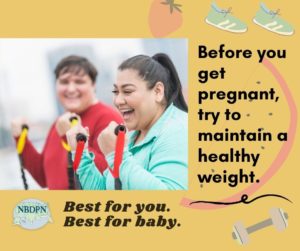
January is Birth Defects Prevention Month and this year’s theme is “5 Tips for Birth Defects Prevention,” which includes the following tip: Before you get pregnant, try to maintain a healthy weight.

Due to all the potential complications, the best time to address obesity is before becoming pregnant. This is where mom-to-be may need the greatest support in helping to optimize health and the health of baby. Weight loss is the one thing we can do to help change our health. I often tell my patients that we cannot change our genetics, our family or personal medical history, but we can make lifestyle changes that can make a lasting difference in our baby’s health and ours. Achieving optimal weight, or even just starting to work toward it, can be achieved through so many avenues such as nutrition and exercise, help with medication, or even surgery. The many approaches should be personally customized to mom-to-be.

During pregnancy, we recommend less weight gain for our overweight patients. Overweight and obese patients should gain between 15-25 lb (6.8-11.3 kg) and 11-20 lb (5.0-9.1 kg) respectively. Increased testing and monitoring in pregnancy is often recommended. A healthy diet in protein, fats and carbohydrates as well as exercise should be discussed with your doctor. What works for me may not work for some of my patients and that is important to know – Each of us are beautifully individual!


Hit Me With Your Best Shot! COVID-19 Vaccines

A Guest Blog by the Allo Hope Foundation’s Bethany Weathersby

I grew up in a large family, loving both the chaos and the built-in friendships that came with having four siblings. My mom had five normal pregnancies and five healthy children, and I always (naively) assumed my experience would be the same.

Seven weeks ago my dream of having five kids — just like my mom — became a reality when I delivered my fifth living child, a beautiful 8-pound boy we named August. But while my mom’s path to five children was smooth and uneventful, my journey to five kids was painful, rocky and tumultuous. I found myself faced with a question I never expected I would have to answer: what do I do when my baby is attacked by my own immune system?

The Diagnosis

My first two pregnancies were free of complications as I carried and birthed two healthy boys, Liam and Asher. It was when I was 9 weeks pregnant with my third child — our first girl — that my obstetrician gave me the news I was not expecting. My first trimester blood work came back positive for anti-Kell (or anti-K) antibodies, and I now had a condition called maternal alloimmunization.

Maternal alloimmunization, commonly known as Rh disease or isoimmunization, occurs when a woman makes red blood cell antibodies after being exposed to a blood type different from her own. This exposure to a foreign blood type usually occurs during a blood transfusion or a previous pregnancy. The woman’s immune system views the foreign blood as a threat and creates antibodies to destroy it. This can be a serious problem if the woman becomes pregnant with a baby who has the offending blood type. In these cases the antibodies can cross the placenta in the second or third trimester and destroy the baby’s red blood cells. This is called hemolytic disease of the fetus and newborn (HDFN). HDFN can have devastating consequences for the baby, including anemia, fetal hydrops and even death.

I knew about the more common anti-D antibodies or Rh disease, which can be prevented with the administration of Rhogam, but I had never heard of anti-Kell antibodies. Anti-Kell is one of the many other red cell antibodies that are similar to anti-D, but cannot be prevented. The more I learned about my diagnosis, the more discouraged I became. I realized that while my body was growing and nurturing my daughter, it was simultaneously trying to destroy her. I felt desperate to protect her from my antibodies.

Options and Questions

I immediately began researching treatment options. I learned that women with red cell antibodies should be closely monitored and treated by a maternal fetal medicine (MFM) specialist. Antibody titers show how many antibodies are in the mother’s blood. Titers are checked regularly until they reach the critical level. Once titers are critical it means that there is a risk of the baby developing severe fetal anemia. The baby can be monitored for anemia by special ultrasounds called MCA doppler scans. These scans measure how quickly the baby’s blood is flowing through the middle cerebral artery in the brain. If it is flowing too quickly, the doctors know the baby is anemic and in need of a blood transfusion. Blood transfusions can be done in utero if the baby becomes anemic before birth.

The critical titer for Kell is 4. My titer was 1,024 right from the start of the pregnancy. My husband and I were terrified thinking through the possibilities.

I was referred to an MFM an hour away. In the online research I’d done to try to understand my diagnosis, I came across information about treatments called plasmapheresis and IVIG. These treatments had been used in severe cases to protect the baby from the mother’s antibodies until the fetus was big enough for an intrauterine blood transfusion.

I printed off a copy of the study I found showing the efficacy of the treatments and brought it to my MFM appointment at 16 weeks. I asked if we should start the treatments to protect my baby in case she was becoming anemic. The MFM said the treatments were unnecessary and considered experimental. He also explained that they would not be checking the baby for anemia until further along in the pregnancy because nothing could be done to help anemic babies before 20 weeks. The smaller the baby, the more difficult and dangerous intrauterine blood transfusions are.

I left my appointment feeling uneasy, not knowing whether or not my baby was anemic. My mind buzzed with anxiety as I thought through my unanswered questions. I had read other women’s accounts of successful intrauterine blood transfusions as early as 16 and 17 weeks gestation. Why did my doctors think that nothing could be done for my baby before 20 weeks? Why couldn’t we be proactive and try the plasmapheresis and IVIG treatments I had read about online?

My fears grew day by day as I worried about my baby girl. I wanted to know exactly what was happening inside my body. Was my daughter safe and thriving? Or was my womb an unseen battleground where she fought for her life, unaided by all of us here on the outside?

I finally convinced my MFMs to do an MCA scan at 18 weeks to check our baby for fetal anemia. The results were devastating. The scan confirmed that our girl was extremely anemic and had started to develop fetal hydrops as a result. Our MFMs were not very hopeful about the outcome since the anemia was already so severe. They attempted an intrauterine blood transfusion the next day, but our little girl, Lucy Dair, died a week later at 19 weeks gestation.

Grief

Lucy was beautiful. She weighed one pound and was 9 inches long. My husband and I were completely overcome with grief. There is no pain in the world like losing a child.

To make matters worse, we not only lost our beautiful daughter Lucy; we also lost our hopes for future children all in one day. We were told that we could not have any more biological children since the antibodies tend to become more aggressive with each subsequent pregnancy.

Trying Again

Even after the doctors warned us of the dangers of future pregnancies, I could not let go of my dream for a big family. Five kids. How could we try again knowing that my own immune system would attack and possibly kill my next baby? I felt guilty for still wanting to grow my family despite having two living children while desperately wishing for better treatment options for alloimmunized women.

The plasmapheresis and IVIG treatments that we hadn’t tried during my pregnancy with Lucy kept coming to mind. Could they be effective in a future pregnancy?

After many months of research, discussion and prayer, my husband and I decided to try again for another baby. This time we had a plan: we would use a different team of MFMs in a different state, and we would start plasmapheresis and IVIG treatments early in the pregnancy. Intrauterine blood transfusions can actually be done as early as 15 weeks so we would start weekly MCA scans at 14 weeks to monitor for fetal anemia.

We traveled 11 hours to Houston, Texas to find an MFM who was an expert on alloimmunized pregnancies. It turns out many women have to travel to other cities, states and sometimes even other countries in order to find MFMs who have experience treating alloimmunization and HDFN.

Our new team of doctors was extremely cautious and proactive, monitoring the baby carefully week after week. Our hope grew as the treatments seemed to be working, and, we found out we were having another baby girl.

The treatments kept her safe from my antibodies until 24 weeks when she became anemic and needed her first intrauterine blood transfusion. In total, our daughter had five intrauterine blood transfusions and was born healthy at 38 weeks. We named her Nora Juliet, our little light bringing joy back into our family. But she was also a reminder of the outcome that we could have had with Lucy if we had received the same care during my first alloimmunized pregnancy.

We went on to have two more little boys with the help of plasmapheresis and IVIG treatments as well as the help of our incredible MFMs. Our third son, Callum, had 3 intrauterine blood transfusions and was born at 34 weeks and our fourth son, August, was born at 37 weeks after seven intrauterine blood transfusions.

Hope and Advocacy

Over the years I have become an advocate for other women around the world who are facing alloimmunization and HDFN. I have seen familiar stories play out in their families: the shock of the unexpected complication, the terror that comes with a new diagnosis and the fear of not knowing how to protect their children.

Unfortunately, due to the rarity of alloimmunization and the variation in care practices around the world, well-managed pregnancies and ideal infant outcomes are not universal, but I have hope that they can be. Treatment options are improving for families facing alloimmunization. New clinical trials are underway to hopefully provide less invasive treatments for babies threatened by HDFN. In 2019, I started a non-profit organization called The Allo Hope Foundation in order to bring awareness to the disease and provide support and education to families facing alloimmunization and HDFN.

If I could go back in time to the moment I first learned about my antibodies and if I could tell myself anything it would be this: You are your baby’s best advocate and you have to be her voice. With the right medical care there is hope for your baby and it is up to you to find the doctors who will provide that care. Research, learn and speak up. These antibodies do not have to determine the size of your family.

To learn more about maternal alloimmunization and HDFN visit https://allohopefoundation.org.


Hit Me With Your Best Shot! COVID-19 Vaccines

Holiday festivities sometimes include eating foods and drinks that might not be part of our everyday diet. During pregnancy and breastfeeding, we need to give a little more thought to what we should eat and drink. “Is it ok for the baby?” often goes through our minds during these times. As a teratogen information specialist at MotherToBaby who answers a lot of the questions we get via our texting service (855-999-3525), these types of questions ramp up during this time of year! So, here’s some insight…

Popular Holiday Food & Drinks

Eggnog & Other Holiday Beverages

Eggnog seems to be a part of many holiday parties. Always be sure to check if the eggnog is homemade or not. Does it contain raw eggs, which can carry bacteria such as salmonella? If the eggnog was commercially made and packaged, then usually the eggs have been pasteurized, and the product may even have been heated prior to packaging. Also, always remember to check if the eggnog contains a little “holiday cheer” (i.e., alcohol) or not. It is common to add rum to eggnog, and we want to avoid alcohol when pregnant or breastfeeding (see our Alcohol Fact Sheet for more info). Other common holiday beverages include mulled wine, wassail, hot buttered rum, and of course wine and champagne. All of these contain alcohol as well, so it is best to avoid them and just stick with mocktails and non-alcoholic punch.

Smoked Salmon & Fruit

“Smoked salmon tastes wonderful on crackers with cream cheese! But is it ok during pregnancy?” one woman texted me. Here’s what I told her. Smoked salmon is still considered raw fish as it is cured rather than cooked, so should be avoided during pregnancy due to the risk of foodborne illnesses. If the salmon has been heated to steaming, any concern for bacteria has been reduced. See our Fact Sheet on Eating Raw, Undercooked, or Cold Meats and Seafood for more info. Sometimes you will find foods that contain meats that have been dried, such as beef jerky. Although beef jerky is high in salt, there are not any other known risks to eating this tasty food during pregnancy.

“What about a fruit plate containing papaya and pineapple? Are there some worries about eating those fruits during pregnancy?” another texter wrote. Both fruits do contain enzymes that have been thought to induce labor. Papaya contains papain, while pineapple contains bromelain. Yet when eaten at normal levels (not daily!), these delicious fruits have not been shown to have any negative effect on a pregnancy. Of course, we hope the fruit has been well-washed before cutting and serving!

Eggplant Parmesan

“When the main dish is served, can we enjoy the amazing eggplant parmesan? Or what about eggplant ratatouille?” Eggplant is low in calories and high in fiber. Do avoid eating it raw, but cooked eggplant can be an occasional part of your diet. The concern is that eggplant is part of the Nightshade family and contains alkaloids in the leaves and tubers that can be toxic. But eating the fruit alone has not been shown to have any risks during pregnancy, especially when cooked.

Tiramisu

“Will rounding out our holiday meal with a delicious dessert such as tiramisu need to wait until after pregnancy and breastfeeding?” Traditional tiramisu contains two forms of alcohol, both Marsala wine and rum. Plus, liberal amounts of caffeine in the form of coffee and espresso. We have already mentioned that alcohol should be avoided if pregnant or breastfeeding, but what about the caffeine? Low to moderate levels of caffeine use (200 to 300 mg per day) has not been shown to increase any risks during pregnancy. See our Caffeine Fact Sheet for more info.

Who knew that holiday menus could need extra thought and consideration during pregnancy and breastfeeding?! Plus, with the added stress of COVID-19 this year, and the warnings to avoid large gatherings, you may have even more questions now than ever. Hopefully, this information will equip you to sit back, relax, and enjoy the festivities!


Hit Me With Your Best Shot! COVID-19 Vaccines

Chelsea’s chat came through late on a Wednesday afternoon: “Hi, I’m 23 weeks pregnant and have plans to visit my family in a different state this holiday season. My sister just had a baby and is breastfeeding, and my grandparents will also be there, so I want to be as safe as possible with COVID-19 still spreading. What do you think I should do?”

With Thanksgiving, Hanukkah, Christmas, and Kwanzaa all quickly approaching, questions like this are coming into our chat service more frequently. We’re living in a new normal, and in the midst of rising COVID-19 case counts throughout much of the country, we’re all trying to figure out the safest way to celebrate with our loved ones this year. 

I told Chelsea there were many individual factors that go into a decision like hers, but we could go over a few guiding principles to help her make an informed choice. 

Stay Home When Possible

Staying local and celebrating in-person only with other members of your household is the safest approach this year. This is especially true for pregnant individuals, who the Centers for Disease Control and Prevention (CDC) considers a group that is at “increased risk of severe illness” from COVID-19. While celebrating in such small numbers is certainly not how any of us want to spend the holidays, it’s the best way to keep everyone safe. And if someone from outside of your immediate family really wants to join in on the fun – virtual get togethers are a great option!

Preparing to Travel

If it’s not possible for you to stay home, then prepare, prepare, prepare! One of the most important things individuals can do this holiday season is prepare for their trip ahead of time. Most importantly, this means taking precautions to limit your own exposure to the virus that causes COVID-19 for 14 days before you plan to depart. This may include things like less frequent trips to the grocery store, keeping kids home and socially distancing them from their friends, working remotely when possible, and avoiding any pre-holiday gatherings. If you have to go on an important outing (such as a prenatal visit), keep in mind the prevention basics: wash your hands, maintain distance, and wear a mask. 

Getting tested for COVID-19 is another way to reduce risk prior to gathering. This is especially important to do if you develop any symptoms that could be COVID-19 (fever, cough, shortness of breath, loss of taste or smell, etc.). The test itself is not perfect and any interaction you have after the test is completed would put you at risk of exposure again, but for some families having a negative COVID-19 test can be a helpful tool in the preparation toolbox. 

Choosing how you travel will also be important this year. Driving to your destination is one way to limit your exposure to others and reduce the risk of getting sick in transit. If you have to fly, take a bus, or get on a train, you will likely be surrounded by many other people, which is more of a potential risk. Get your hand sanitizer and mask ready if you have to go this route!

One other important thing you can do before traveling? Get a flu shot (ideally at least 14 days ahead of time)! While it won’t protect you from COVID-19, it will help prevent the flu, which can be serious for pregnant women. It will also help keep you from needing medical care, which is important since some communities are reaching max capacity in their hospitals and may not have room to admit you for treatment. 

Think about Grandma

Next, you want to think about who you will be traveling to see. We know that certain individuals are more likely to get very sick and/or die from COVID-19. This includes older adults (with risk increasing with age) and those with underlying medical conditions such as type 2 diabetes, severe obesity, cancer, or pregnancy. Chelsea’s grandparents were in their late 80’s, and her grandma was also a smoker. She also had her new nephew to think about, and her sister who was breastfeeding. What seemed like a simple family gathering quickly became a lot more complex when everyone’s health was assessed. 

If you have a high-risk individual in your family, it’s important that you consider their health when planning holiday travel. For some families, this may mean making the decision to break the wishbone virtually over FaceTime or Zoom. For others, it could mean a strict 14 day quarantine for all who will be gathering (discussed above) before any interactions take place.

Celebrating Safely

Whether Chelsea chooses to travel or stay close to home during the holidays, she can reduce the chance of coming into contact with the virus by continuing to take precautions while celebrating with others. Limiting activities to people in your own household obviously presents the least risk since you’re already together anyway. But if you do host or attend gatherings with others, keep in mind that smaller groups in outdoor spaces where everyone wears a mask, stays at least 6 feet apart, and practices good hand hygiene is a much safer option than attending large indoor gatherings where not everyone wears a mask or follows other common sense precautions. Your decision to spend time around others should also consider the current spread of COVID-19 in the community where you live or where you will be traveling. I encouraged Chelsea to check the state department of health website for guidelines and recommendations for her destination.

What would a holiday celebration be without FOOD? You can still enjoy your favorite pregnancy-safe foods and beverages (no soft cheeses! no alcohol!), but you want to do what you can to reduce the chance of contact with any foodborne germs. Even though the chance of getting COVID-19 from contact with food or serving utensils is probably low, it’s important that everyone wash their hands before preparing, serving, or eating food. Having only 1 or 2 people serve the food to everyone else while wearing a mask is a better choice than having lots of people handle the serving utensils or food containers. As yummy as potlucks or buffets can be, at least for this year it might be safer if each guest brings food and drinks for themselves and their own household members only, or picks up ready-to-serve items. In addition, since people clearly can’t be masked and eat at the same time, plan ahead and get creative to create space between people when they sit down to eat – this year is definitely not the time to pile 12 people around a 6-person table! And as always, be sure that hot items are consumed hot, and cold items are consumed cold – no one wants a food-borne illness like E.coli or salmonella

When the Party’s Over

After attending any gatherings (even small ones) or staying with relatives, Chelsea will need to pay attention to any symptoms that could suggest possible COVID-19 infection. If she, or anyone else she spent time with, has symptoms or tests positive for COVID-19, she should contact her healthcare provider right away about testing and/or follow any instructions from her local health department. She will most likely need to self-isolate at home for 14 days. In addition, she should contact her hosts as soon as possible to let them know, so they can inform other guests and family members that they might have been exposed to the virus. Not fun, but a necessary part of helping keep us all healthy and safe throughout the holiday season.

Chelsea has a lot to consider this holiday season, as we all do. For more tips on celebrating safely during the holidays, visit the CDC’s website on COVID-19 and holiday celebrations. And for more information about COVID-19 and pregnancy and breastfeeding, see our MotherToBaby fact sheet. However you choose to celebrate, we wish you a happy and healthy holiday season!