
Critical Periods of Development

This fact sheet is about the critical periods of development and the birth defects or complications that can happen from exposures at different times in a pregnancy. This information is based on published research studies. It should not take the place of medical care and advice from your healthcare providers.

What are critical periods of development?

Critical periods of development are times during pregnancy when the fetal organs and body parts are forming. During these times, the fetus is especially sensitive to things that could cause harm, like toxins or infections.

Birth defects can happen in any pregnancy for different reasons. Out of all babies born each year, about 3 out of 100 (3%) will have a birth defect. Pregnancy problems (like miscarriage) can also happen in any pregnancy. Sometimes, exposures like medications, drugs, alcohol, and infections can increase the chance of birth defects or pregnancy complications. However, for an exposure to affect a pregnancy, it generally has to happen during the “critical period” when a body part is forming. The dose (how much), frequency (how often), and the way the exposure enters the body (swallowed, breathed in, put on the skin, etc.) can also play a role.

What are birth defects?

Birth defects are differences in how a body part looks or works. Birth defects can be called “major” or “minor”. Major birth defects, like heart problems or spina bifida (when the spine does not close as it should), might need surgery or treatment. Minor birth defects (such as wide-set eyes or large ears) do not usually need treatment.

In the chart below, the green bars refer to timing of when fetal body parts are forming. During the critical time of development for the body parts, they can be more sensitive to exposure.   

What are functional defects?

Functional defects change how a part of the body works without changing how it looks. Examples of a functional defect are some types of intellectual disability and hearing loss. Intellectual disability can occur at any point during pregnancy, but most functional defects usually develop after the first trimester.

The critical period for when different functional defects can occur is shown on the chart below in purple.

When can birth defects happen?

Most birth defects happen in the first trimester of pregnancy, which ends at 13 weeks and 6 days since a person’s LMP (last menstrual period). This is because the major structures of the body (including the heart, arms, legs, lips, and palate) form in the first trimester.

For an exposure to cause a birth defect, the body part must be developing at the time. For example, if a woman takes a medication that can increase the chance of cleft lip (when the top lip does not close correctly), the risk is higher if the exposure happens when the lip is forming (around 6 to 9 weeks). Once a body part has finished forming, exposures are less likely to cause defects. So, if the medication is taken at 20 weeks, the risk of cleft lip is very low because the lip is already formed.

As the fetus continues to grow and develop in the second and third trimesters, some exposures can cause problems with how the body part works (functional defect). The ears, for example, are formed in the first trimester. However, problems with how the ears work (e.g. hearing loss) can happen in the second and third trimester. Problems with fetal growth or preterm delivery (before week 37 of pregnancy) might also happen.

The chart below gives an overview of when different body parts are thought to be most sensitive to exposures during pregnancy. For an interactive version, where you can enter your information and receive a personalized view, please visit: https://mothertobaby.org/critical-periods-pregnancy-development-tool/ . If you have other questions after using the tool, please reach out to a MotherToBaby specialist for more information.
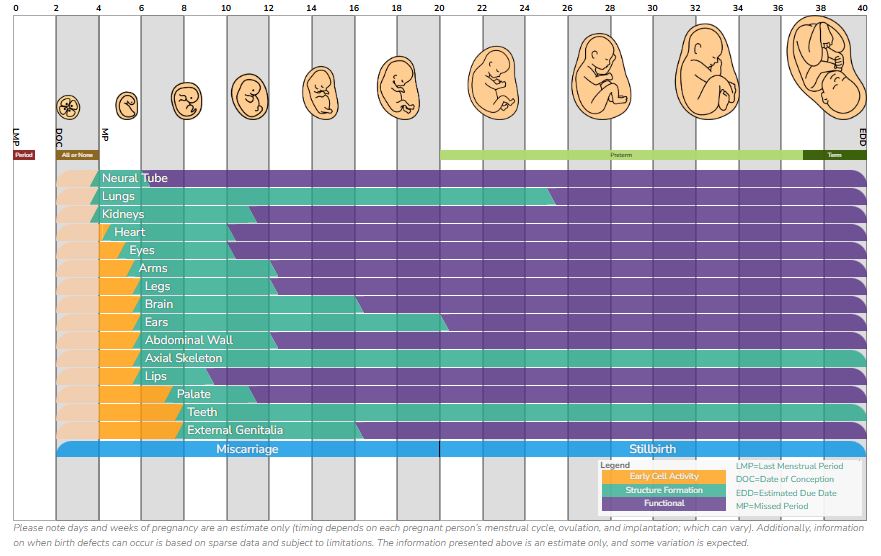
Download the image.

Pregnancy dating:

The chart shown above dates a pregnancy by last menstrual period (LMP). Dating by LMP is also known as gestational age, and this is the type of dating that most healthcare providers use. Gestational age begins with the first day of a person’s last menstrual period. This day is usually about two weeks before pregnancy is conceived.

What is the “all or none period”?

The first 2 weeks after conception (weeks 3 and 4 since first day of LMP) is known as the “all or none period”. During this time, the sperm and the egg have met and formed an embryo which then makes its way down the fallopian tube toward the uterus. During this time, the embryo is not implanted in the uterus, and it is not sharing a blood supply with the person who is pregnant.

The “all” part of this theory refers to very harmful exposures during this time that might be able to stop the embryo from attaching to the uterus or would be able to damage many of the embryo’s cells. Problems with uterine attachment and severe cell damage can both result in miscarriage. Sometimes a miscarriage happens before a person even realizes that they are pregnant. “None” refers to exposures that are not high enough to have a significant effect on the pregnancy. If a few cells are damaged early on, the embryo has a greater ability to recover at this early stage than later in pregnancy. If a woman does not have a miscarriage from this early exposure, birth defects are not expected.  

The all or none period can be used to understand the chance of many different types of exposures. However, there are some important exceptions to this rule. Please contact MotherToBaby to discuss your specific exposure with our experts.

Please click here for references.


Critical Periods of Development

This sheet is about exposure to Vibrio in a pregnancy or while breastfeeding. This information is based on published research studies. It should not take the place of medical care and advice from your healthcare provider. 

What is Vibrio?  

Vibrio is a bacteria that lives in warm coastal seawater. There are many different kinds of Vibrio bacteria. Each kind can cause a different illness. Sometimes the illness related to vibrio infection is called Vibriosis. It is commonly called Vibrio for short.  

Some Vibrio bacteria will cause only mild stomachaches and mild diarrhea. This type of infection is not usually dangerous. However, it is important to drink plenty of fluids to help prevent side effects of dehydration (not having enough water in the body). See a healthcare provider if symptoms become severe or last a long time.  

Other Vibrio bacteria can cause severe diarrhea, vomiting, fever, and/or wound infections that can be life-threatening. If a wound is infected with Vibrio, the area around the wound can become red and swollen. The bacteria from the wound can enter the blood and cause fevers, chills, and blisters. If this infection is not treated, it could turn into a serious infection.  

Cholera, a very severe form of diarrhea, is caused by two specific groups of Vibrio cholerae. These groups of Vibrio cholerae are not usually found in the United States, so the chance of someone in the United States getting cholera is very low. 

How do you get a Vibrio infection? 

Most people get Vibrio by eating raw or undercooked shellfish. MotherToBaby has a fact sheet on this topic here: https://mothertobaby.org/fact-sheets/eating-raw-undercooked-or-cold-meats-and-seafood/. Other people can get infected if an open wound comes into contact with water that contains Vibrio bacteria.   

People usually get sick from Vibrio 1 to 3 days after exposure. People who have liver disease or a weak immune system are much more likely to become very ill from a Vibrio infection.  

How can I protect myself from a Vibrio infection?  

Seafood: 

Eating raw or undercooked seafood and shellfish (like oysters) has been associated with vibrio infection. Fully cooking seafood before eating it is a good way to prevent infection. Keep other foods away from raw seafood/shellfish and its juices/drippings to avoid possible contamination. If you are at increased risk for infection, wear gloves when handling raw seafood/shellfish.  

Open Wounds: 

If you have an open wound or cut, stay out of coastal (beach) water if possible. If you must enter the water, cover the wound with a bandage. Even a scrape in the skin can be an opening for the Vibrio bacteria to enter. If a wound is exposed to coastal water, wash the area with soap and clean water as soon as possible. If Vibrio bacteria are active in floodwater, the bacteria can no longer survive once the waters have dried.  

How can I find out if I have a Vibrio Infection? 

A healthcare provider can test a sample of stool (poop) for Vibrio. Vibrio infection can also be confirmed by testing the blood or wound. 

I have Vibrio. Can it make it harder for me to get pregnant?  

Studies have not been done to see if Vibrio can make it harder to get pregnant. 

Does having/getting Vibrio increase the chance of miscarriage?  

Miscarriage is common and can occur in any pregnancy for many different reasons. Studies have not been done to see if Vibrio increases the chance of miscarriage. 

Does having/getting Vibrio increase the chance of birth defects?  

Birth defects can happen in any pregnancy for different reasons. Out of all babies born each year, about 3 out of 100 (3%) will have a birth defect. We look at research studies to try to understand if an exposure, like Vibrio, might increase the chance of birth defects in a pregnancy. Studies have not been done to see if Vibrio can increase the chance of birth defects. 

Fever is a possible symptom of Vibrio. A high fever in the first trimester can increase the chance of certain birth defects. For more information see the MotherToBaby fact sheet about on Fever/Hyperthermia at: https://mothertobaby.org/fact-sheets/hyperthermia-pregnancy/. 

Would having/getting Vibrio increase the chance of other pregnancy related problems?  

Studies have not been done to see if Vibrio increases the chance for pregnancy-related problems such as preterm delivery (birth before week 37) or low birth weight (weighing less than 5 pounds, 8 ounces [2500 grams] at birth).  

Some symptoms of a Vibrio infection, like diarrhea and vomiting, can lead to dehydration. Dehydration during pregnancy can increase the chance for low amniotic fluid and preterm delivery (birth before week 37). 

Does having/getting Vibrio in pregnancy affect future behavior or learning for the child?    

Studies have not been done to see if Vibrio infection in pregnancy can cause behavior or learning issues for the child. 

Breastfeeding while I have Vibrio: 

Breast milk may help protect babies from many kinds of bacteria like Vibrio. One study has suggested that breastfeeding helped to reduce the risk of cholera, an infection caused by Vibrio bacteria, in the infant whose mom was sick with a Vibrio infection. Another study suggested that a common probiotic (bacteria) in breast milk helped to reduce the growth of Vibrio cholerae. Therefore, it may not be necessary to stop breastfeeding with a Vibrio infection. 

If you are breastfeeding and think you have a Vibrio infection, or think your baby has symptoms (fever, vomiting, or diarrhea) please speak with your and your child’s healthcare providers. Be sure to talk to your healthcare provider about all of your breastfeeding questions. 

If a man has Vibrio, can it affect his fertility or increase the chance of birth defects?   

Studies have not been done to see if Vibrio could affect a man’s fertility (ability to make healthy sperm) or increase the chance of birth defects. In general, exposures that men have are unlikely to increase the risks to a pregnancy. For more information, please see the MotherToBaby fact sheet Paternal Exposures at https://mothertobaby.org/fact-sheets/paternal-exposures-pregnancy/.  

Please click here for references.


Critical Periods of Development

This sheet is about exposure to metronidazole in pregnancy and while breastfeeding. This information is based on published research studies. It should not take the place of medical care and advice from your healthcare providers.

What is metronidazole? 

Metronidazole is an antimicrobial medication that has been used to treat infections, including vaginal infections. Metronidazole is available in oral, rectal, topical, vaginal, and intravenous (IV) forms. Flagyl®, Metrogel®, Metrolotion®, and Noritate® are some brand names for metronidazole.  

Sometimes when women find out they are pregnant, they think about changing how they take their medication, or stopping their medication altogether. However, it is important to talk with your healthcare providers before making any changes to how you take your medication. Your healthcare providers can talk with you about the benefits of treating your condition and the risks of untreated illness during pregnancy. 

I take metronidazole. Can it make it harder for me to get pregnant? 

It is not known if metronidazole can make it harder to get pregnant. 

Does taking metronidazole increase the chance of miscarriage? 

Miscarriage is common and can occur in any pregnancy for many different reasons. It is unlikely that metronidazole would increase the chance of miscarriage. A study that looked at over 4,000 pregnancies with exposure to metronidazole early in pregnancy did not find an increased chance of miscarriage. A smaller study with 53 pregnancy exposures to metronidazole suggested a greater chance of miscarriage. It is not clear if the miscarriage risk in this study was from the medication or related to the underlying infection that was being treated. Because miscarriage can happen for many reasons, it is hard to know whether a medication, the condition being treated, or other factors such as age or health are the cause. 

Does taking metronidazole increase the chance of birth defects?  

Birth defects can happen in any pregnancy for different reasons. Out of all babies born each year, about 3 out of 100 (3%) will have a birth defect. Research involving over 5,000 women who took metronidazole in pregnancy did not find an increased chance for birth defects.  

Does taking metronidazole in pregnancy increase the chance of other pregnancy-related problems? 

Metronidazole is not expected to increase the chance for other pregnancy-related problems, such as preterm delivery (birth before week 37) or low birth weight (weighing less than 5 pounds, 8 ounces [2500 grams] at birth). 

Does taking metronidazole in pregnancy affect future behavior or learning for the child? 

Studies have not been done to see if metronidazole can cause behavior or learning issues for the child. 

Breastfeeding while taking metronidazole: 

Metronidazole passes into breastmilk. The amount of metronidazole that passes into breastmilk can depend on the dose and how the medication is taken (by mouth, by IV, vaginally, or topically). With oral or IV use, the amount of metronidazole in breast milk can be similar to the dose given to infants for treatment. The amounts in breastmilk might be lower with vaginal or topical use, but this is not known. Most babies exposed to metronidazole through breast milk have not had any side effects. If your baby shows symptoms like loose stools, diaper rash, or thrush, contact their healthcare provider. 

Some metronidazole product labels have suggested not to breastfeed during treatment and for two days after the last dose. But the benefit of using metronidazole may outweigh possible risks. Your healthcare providers can talk with you about using metronidazole and what treatment is best for you. Be sure to talk to your healthcare provider about all of your breastfeeding questions. 

If a man takes metronidazole, could it affect his fertility or increase the chance of birth defects? 

It is not known if metronidazole could affect male fertility (ability to get a woman pregnant) or increase the chance of birth defects in a partner’s pregnancy. In general, exposures that men have are unlikely to increase the risks to a pregnancy. For more information, please see the MotherToBaby fact sheet Paternal Exposures at https://mothertobaby.org/fact-sheets/paternal-exposures-pregnancy/. 

Please click here for references.  


Critical Periods of Development

This sheet is about exposure to molnupiravir in pregnancy and while breastfeeding. This information is based on available published literature. It should not take the place of medical care and advice from your healthcare provider.

What is molnupiravir?

Molnupiravir is an antiviral medication that has been given emergency permission by the U.S. Food and Drug Administration (FDA) to treat mild to moderate COVID-19 in certain patients. Molnupiravir must be started within 5 days of having symptoms of COVID-19 in order to be effective. A brand name for molnupiravir is Lagevrio®.

The FDA emergency use guidelines for molnupiravir recommend that women who are pregnant not use this medication unless there are no other treatment options and treatment is clearly needed. This is because there is not enough information available on the use of molnupiravir to know if/how it could affect a pregnancy. However, the benefit of using molnupiravir may outweigh possible risks. Your healthcare provider can talk with you about using molnupiravir and what treatment is best for you. For more information about COVID-19, please the see the MotherToBaby fact sheet at https://mothertobaby.org/fact-sheets/covid-19/.

I am taking molnupiravir, but I would like to get pregnant after taking it. How long does the drug stay in my body?

People eliminate medication at different rates. In non-pregnant adults, it takes up to 1 day, on average, for most of the molnupiravir to be gone from the body. The FDA emergency use guidelines recommend that women avoid trying to get pregnant while they are taking molnupiravir and for 4 days after the last dose.

I take molnupiravir. Can it make it harder for me to get pregnant?

It is not known if molnupiravir can make it harder to get pregnant. The FDA emergency use guidelines recommend that women who can get pregnant use effective contraception correctly and consistently while they are taking molnupiravir and for 4 days after the last dose.

Does taking molnupiravir increase the chance of miscarriage?

Miscarriage is common and can occur in any pregnancy for many different reasons. Studies have not been done in women to see if molnupiravir can increase the chance of miscarriage.

Does taking molnupiravir increase the chance of birth defects?

Every pregnancy starts out with a 3-5% chance of having a birth defect. This is called the background risk. Studies have not been done in women to see if molnupiravir can increase the chance of birth defects above the background risk.

Does taking molnupiravir in pregnancy increase the chance of other pregnancy-related problems?

Studies have not been done in women to see if molnupiravir can increase the chance of pregnancy-related problems such as preterm delivery (birth before week 37) or low birth weight (weighing less than 5 pounds, 8 ounces [2500 grams] at birth). Having COVID-19 during pregnancy can increase the chance of preterm delivery, stillbirth, and other pregnancy complications.

Does taking molnupiravir in pregnancy affect future behavior or learning for the child?

Studies have not been done to see if molnupiravir can cause behavior or learning issues for the child.

Breastfeeding while taking molnupiravir:

The FDA emergency use guidelines for molnupiravir recommend that women who are breastfeeding not use this medication unless there are no other treatment options and treatment is clearly needed. But the benefit of using molnupiravir along with the benefits of breastfeeding your baby may outweigh possible risks. Women who are breastfeeding can consider pumping and discarding breast milk during treatment with molnupiravir and for 4 days after the last dose. Your healthcare providers can talk with you about using molnupiravir and what treatment is best for you. Be sure to talk to your healthcare provider about all your breastfeeding questions.

If a man takes molnupiravir, could it affect fertility or increase the chance of birth defects?

Studies have not been done to see if molnupiravir could affect a man’s fertility (ability to get a woman pregnant) or increase the chance of birth defects above the background risk. The FDA emergency use guidelines recommend that men use a reliable method of contraception correctly and consistently during treatment and for at least 3 months after the last dose of molnupiravir. In general, exposures that men have are unlikely to increase risks to a pregnancy. For more information, please see the MotherToBaby fact sheet Paternal Exposures at https://mothertobaby.org/fact-sheets/paternal-exposures-pregnancy/.

Please click here for references.


Critical Periods of Development

This sheet is about exposure to Escherichia coli (E. coli) in pregnancy or while breastfeeding. This information is based on published research studies. It should not take the place of medical care and advice from your healthcare provider. 

What is Escherichia coli? 

Escherichia coli (E. coli) are a group of bacteria that naturally live in the intestines and vagina. There are many different types (strains) of E. coli bacteria. Most strains of E. coli are harmless to humans, but some can cause severe illness and infection. The most common ways people can get infected with E. coli are by:  

  • Eating raw and unwashed fruits and vegetables that are contaminated with E. coli
  • Drinking unpasteurized milk, fruit juices, or cider (pasteurization involves heating liquids to kill any bacteria contamination)
  • Eating soft cheeses made from unpasteurized milk 
  • Eating raw or undercooked meat 
  • Drinking or swimming in infected water 
  • Coming into contact with feces from infected farm or petting zoo animals 

How can I find out if I am infected with E. coli? 

Eating or drinking contaminated products might cause some people to have stomach cramps, fever, diarrhea, and/or vomiting. In severe cases, there can be bloody diarrhea, which requires medical care right away. Rarely, people with E. coli infection can develop a form of kidney failure called hemolytic uremic syndrome. This condition is serious and can lead to kidney damage and death.  

If you have symptoms of an E. coli infection, a healthcare provider will likely need a stool sample (feces) from you to test for E. coli. Most healthy people recover in a couple of days without the need for medications. If you are very ill your healthcare provider might prescribe medications including antibiotics.   

I have E. coli. Can it make it harder for me to get pregnant?

E. coli might increase the chance of inflammation in the reproductive tract and intestines, blockages in the fallopian tubes, or endometriosis (when tissue that usually lines the uterus grows outside the uterus). It might also affect fertilization (when the egg and sperm join to create an embryo). These issues can make it harder to get pregnant.

Does getting an E. coli infection increase the chance of miscarriage?

Miscarriage is common can occur in any pregnancy for many different reasons. Having an E. coli infection in the stomach or urine would not be likely to directly cause a miscarriage. An E. coli infection in the uterus might increase the chance of miscarriage. If you think you have an E. coli infection, talk with a healthcare provider right away so that you can be diagnosed and treated, if needed.  

Does getting an E. coli infection increase the chance of birth defects?

Birth defects can happen in any pregnancy for different reasons. Out of all babies born each year, about 3 out of 100 (3%) will have a birth defect. We look at research studies to try to understand if an exposure, like E. coli, might increase the chance of birth defects in a pregnancy. 

Studies have not been done to see if an E. coli infection can increase the chance of birth defects.  

Would having an E. coli infection increase the chance of other pregnancy-related problems? 

An E. coli infection in the vagina or uterus might increase the chance of pregnancy-related problems, such as preterm delivery (birth before week 37) or low birth weight (weighing less than 5 pounds, 8 ounces [2500 grams] at birth). There might be an increased chance for bleeding, preterm rupture of membranes (a breaking of the amniotic sac, which holds the amniotic fluid around the fetus), or stillbirth with severe E. coli infection. Sepsis (serious widespread bodily infection) during pregnancy has also been reported. Babies born with E. coli infections are sometimes very sick. 

Does having an E. coli infection in pregnancy affect future behavior or learning for the child?  

Studies have not been done to see if E. coli in pregnancy can increase the chance of behavior or learning issues for the child.  

How can I prevent getting an E. coli infection? 

To help prevent eating or drinking contaminated food and/or drink products: 

Wash your hands with soap and water often. Always wash your hands after handling raw meat, using or cleaning the bathroom, changing diapers, handling dirty towels or linens, and touching animals or items in the animals’ setting.  

Clean any surface touching raw meat with a disinfectant or bleach and water solution.  

Cook meat thoroughly, especially ground beef, to 160°F. 

Wash all vegetables and fruits before eating.  

Drink only pasteurized (not raw) milk, juice and ciders.  

Avoid swallowing water when swimming.  

Breastfeeding with an E. coli infection:

The E. coli bacteria do not get into the breast milk, so breastfeeding can be continued. There are important immune factors in breast milk that can help protect your baby from infections. Having diarrhea and other symptoms of E. coli infection might cause a decrease in your milk supply, so drink plenty of fluids. Make sure that you wash your hands well before you hold or breastfeed your baby. If your baby gets diarrhea or other symptoms of E. coli infection, contact your pediatrician right away. Be sure to talk to your healthcare provider about all your breastfeeding questions.   

If a man has an E. coli infection, can it affect fertility or increase the chance of birth defects?  

E. coli can be passed from person to person. Wash your hands often to help lower the chance of passing the infection to others in your home. E. coli infections of the genital tract might cause inflammation and problems with sperm. This could affect men’s fertility (ability to get a partner pregnant). For more information on paternal exposures in pregnancy, please see the MotherToBaby fact sheet here https://mothertobaby.org/fact-sheets/paternal-exposures-pregnancy/. 

Please click here for references.