
RSV in Infants: Prevention Options Every Parent Should Know About

Can you guess the leading cause of infant hospitalizations in the United States? You might think accidents, allergic reactions, or the flu, but the answer is actually respiratory syncytial virus (RSV). Every year, RSV sends 58,000 to 80,000 children under the age of 5 to the hospital.

Having a baby in the fall or winter has always meant that parents need to be extra careful about RSV. Fortunately, in 2023 two new ways to protect infants against this virus became available: a vaccine given to women between 32 and 36 weeks of pregnancy and an antibody (passive immunization) that is given directly to babies after birth. Today, we’re covering some of the most common questions we get at MotherToBaby about RSV prevention.

Q: What is the maternal RSV vaccine? When is it given?

The maternal RSV vaccine (brand name Abrysvo®) is a protein subunit vaccine (it contains proteins the body needs to make antibodies against RSV). The vaccine does not contain live virus that can cause RSV. When a woman gets the RSV vaccine during pregnancy, the antibodies she makes can also pass to the developing fetus. These antibodies can help protect the baby from RSV during the first 6 months of life.

The Abrysvo® RSV vaccine can be given to women who are 32 to 36 weeks pregnant who have not received a maternal RSV vaccine in a previous pregnancy. The RSV vaccine is only recommended for use during pregnancy between September and January in most of the United States. 

Q. What is an infant RSV antibody? When is it given?

Infant antibodies, also called passive immunizations, are another effective way to help protect babies from RSV. Two RSV antibodies are currently available: nirsevimab (Beyfortus®) and clesrovimab (Enflonsia®). The RSV antibody is recommended for infants younger than 8 months who are entering their first RSV season if their mothers did not receive the maternal RSV vaccine during pregnancy. Infants and children ages 8 to 19 months who are at high risk for severe RSV illness and entering their second RSV season may also be eligible for the antibody. The RSV antibody is available between October and March for most of the United States and starts working immediately after it is given.

For more information about timing, eligibility, and benefits of infant RSV antibodies, talk with your child’s pediatrician.

Q: Is one of these options better than the other?

Patients can choose either the maternal vaccine or the infant antibody. Both are great options for protecting infants against RSV, and there is currently no preference for one over the other. A slight benefit of getting the RSV vaccine during pregnancy is that most babies will be born with immediate protection if the vaccine is given at least 2 weeks before delivery. Some parents might also prefer the maternal vaccine because it avoids an extra injection (shot) for the baby.

Q. How do we know the RSV vaccine is ok to get in pregnancy?

Studies on the Abrysvo® RSV vaccine have not found a higher chance of birth defects. It’s also reassuring to note that the vaccine is given in the third trimester (between 32 and 36 weeks), which is past the critical period when most birth defects could happen.

Early clinical trials on the vaccine observed slightly more preterm births in women who received the Abrysvo® RSV vaccine than in those who did not (5.7% in the vaccinated group vs. 4.7% in the placebo group). However, newer data from larger studies has not found a higher chance of preterm birth following RSV vaccination in pregnancy. Check out the MotherToBaby RSV vaccine fact sheet for more information on this topic.

Q. If I got an RSV vaccine in my last pregnancy, do I need to get it again in my next pregnancy?

The simple answer is no. At this time, the maternal RSV vaccine is only recommended for women who have not gotten it in a previous pregnancy. Researchers need time to determine if getting the vaccine once can provide ongoing protection for future pregnancies, or if a booster dose is needed in every pregnancy.

If you received the RSV vaccine during a previous pregnancy and are pregnant again, your baby can get an infant RSV antibody to help ensure they are protected.

Making Your Choice

No matter whether you decide on the maternal RSV vaccine or an infant RSV antibody, you’re making a great choice to protect your baby from RSV! Still have questions? Remember that MotherToBaby can be reached by chat, text, phone, or email with questions about the RSV vaccine or any other exposure in pregnancy or while breastfeeding.

RSV in Infants: Prevention Options Every Parent Should Know About

Having worked as a Teratogen Information Specialist at MotherToBaby for close to 10 years, I have become well versed in the different exposures people commonly ask about. Allergy medications in the spring, sunscreen and bug spray in the summer, and cough and cold medications all winter long. So, when I logged onto our live chat service at mothertobaby.org on a Tuesday morning, I was surprised to see a question that doesn’t come up very often. Natalie, pregnant with her first child, asked: “I’m 24 weeks pregnant and my midwife says I need a RhoGAM shot at my next appointment. What could happen to the baby if I do not get this shot?”

Blood Type Basics

Blood type is hereditary, which means it is passed down from your parents. There are 8 common blood types: A+, A-, B+, B-, O+, O-, AB+, and AB-. If your blood type ends in a minus sign (like A- or O-), you are Rh negative. If it ends in a plus sign (like A+ or B+), you are Rh positive. Most people in the United States are Rh positive, but about 15 out of every 100 people (15%) are Rh negative. A blood test early in pregnancy will tell you your blood type.

What is Rh Incompatibility?

During pregnancy, if a woman who is Rh negative is pregnant with a fetus that is Rh positive, a condition called Rh incompatibility can happen. Rh incompatibility becomes an issue if any of the Rh positive red blood cells from the fetus get into the mom’s Rh negative bloodstream. This is most likely to occur during a miscarriage, certain prenatal tests (like amniocentesis or CVS), a fall, labor and delivery, or if the placenta separates from the wall of the uterus. When this happens, the mom’s immune system might treat the fetus’ red blood cells as something that shouldn’t be in the body (like an infection) and start making antibodies against them. In most cases, these antibodies will not negatively affect the current pregnancy, but they might affect future pregnancies.

When Antibodies Attack

Once the mom’s body makes anti-Rh antibodies, they stay in her system for life. If she becomes pregnant again with another Rh positive fetus, the antibodies can cross the placenta and attack the fetus’ red blood cells. This can lead to a condition called hemolytic disease of the fetus and newborn (HDFN). Without enough red blood cells, the fetus cannot carry enough oxygen during development and complications such as jaundice (yellowing of skin and eyes), hemolytic anemic (low red blood cell count), hydrops fetalis (fluid buildup in the baby), high bilirubin levels, kernicterus (brain damage from the bilirubin), and even death can occur.

RhoGAM to the Rescue

Fortunately, there is a way to lower the chance of HDFN: The RhoGAM shot. Typically given around 28 weeks of pregnancy (and again within 72 hours of birth if the baby is confirmed to be Rh positive), RhoGAM is an antibody that helps stop the Rh negative mom from making antibodies that could attack a future fetus’ red blood cells and cause HDFN. Before RhoGAM was available, thousands of babies died from the condition every year. Nowadays, the chance of HDFN is less than 0.1% when the shot is given, making RhoGAM a remarkable intervention.

Protecting Your Future Babies

After sharing this information with Natalie, I summarized our conversation with a quick recap. Since she is Rh negative, her midwife was recommending a RhoGAM shot at 28 weeks to prevent the development of antibodies that could negatively affect a future pregnancy. An increased risk for miscarriage or birth defects is not expected since the shot is given later in pregnancy and Natalie is past the “critical period” for those outcomes to occur. Pregnancy complications, like preterm delivery and low birth weight, have not been reported in the available studies examining the use of RhoGAM in pregnancy. Natalie felt reassured after receiving this information and decided to proceed with the RhoGAM shot at her next midwife appointment.

If you have questions about the RhoGAM shot or any other exposures in pregnancy, please feel free to reach out to MotherToBaby by phone, chat, text, or email to receive evidence-based information that can help you make an informed decision.

References:

  • Bowman J. Thirty-five years of Rh prophylaxis. Transfusion. 2003;43(12):1661-1666. doi:10.1111/j.0041-1132.2003.00632.x

RSV in Infants: Prevention Options Every Parent Should Know About

Understanding Critical Periods in Pregnancy

Kendra, newly pregnant at approximately 7 weeks along, contacted MotherToBaby late one afternoon with a question that had been causing her a lot of anxiety. Norovirus was running rampant in her home, and she was feeling extremely nauseous. Having found relief with it before, she explained that she had taken a single dose of Zofran (ondansetron) early that morning. She was certain this drug was ok to take during pregnancy, but after searching online, she became concerned. Kendra shared that she had read conflicting information about whether Zofran increased the risks for birth defects; with some studies showing an increased chance of heart defect and cleft palate, and other studies showing no increased risk. Feeling confused, Kendra reached out to MotherToBaby with her question to receive personalized information.

On the call, I first explained that birth defects can happen in any pregnancy for different reasons. Out of all babies born each year, about 3 out of 100 (3%) will have a birth defect. Pregnancy problems (like miscarriage) can also happen in any pregnancy. Sometimes, exposures like medications, drugs, alcohol, and infections can increase the chance for birth defects or pregnancy complications. However, for an exposure to cause a problem, it generally has to happen during the “critical period” when a body part is forming.

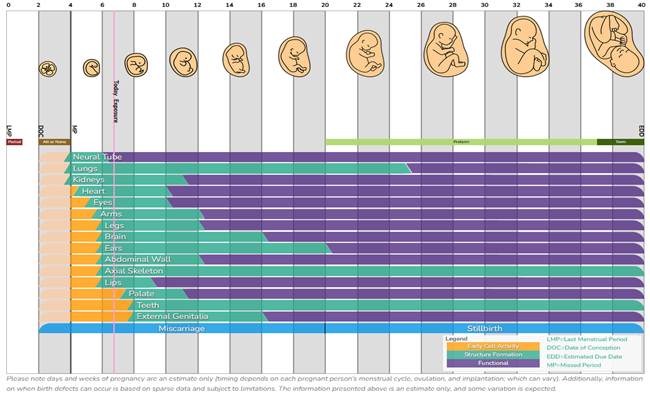
To help Kendra understand more about possible risk from her Zofran exposure, I used MotherToBaby’s new and interactive critical periods of pregnancy tool! This helpful pregnancy calculator and chart shows when different parts of a baby’s body form during pregnancy and when birth defects or pregnancy complications might happen. By entering the first day of your last menstrual period (LMP) or estimated due date (EDD), the calculator can estimate how far along you are today. Individuals who have questions about exposures in pregnancy can then go on to enter the specific date(s) when the exposure (such as medication use or alcohol consumption) occurred, and the chart will show the body parts that are developing during that time.

After entering the first day of Kendra’s last period, the interactive tool confirmed she was 6 weeks and 5 days pregnant. I then entered her Zofran exposure using today’s date, which resulted in a pink line popping up on the chart. Following this line down the chart, I could see all of the different body parts that were currently forming. I explained to Kendra that when she took the Zofran, the palate (roof of the mouth) had not yet started to form, meaning that the medication use was unlikely to increase the chance of cleft palate in the baby. The chart also helped me see that the baby’s heart was currently developing. I shared this with Kendra, but also reminded her that the latest research shows there is thought to be a less than 1% chance of heart defects from exposure to Zofran; meaning there is a more than 99% chance the heart will not be affected by her medication use. In other words, even when an exposure of concern takes place during the critical period, not every baby will be affected by that birth defect. 

New Critical Periods of Pregnancy Interactive Tool

For Kendra, being able to understand which specific body parts were forming when she took the Zofran and whether she actually needed to be concerned helped decrease her anxiety significantly. Knowing that the heart was currently forming, she decided to reach out to her healthcare provider to discuss alternative treatment options for her nausea.  I was happy to have helped answer Kendra’s question using this visual tool and look forward to being able to use it again in the future when pregnant women have questions about the timing of their exposure.

Remember that our team is always available to help review any exposures you have had and provide a personalized risk assessment. Don’t hesitate to contact MotherToBaby by phone, chat, text, or email!


RSV in Infants: Prevention Options Every Parent Should Know About

In recent years, plant-based diets have become more and more popular. People choose to go vegetarian for a variety of reasons including health benefits, sustainability concerns, and ethical motivations. Whatever the reason, this type of diet can be healthy and nutritionally adequate, even during the reproductive years. However, during pregnancy, a bit of planning may be required to make sure the developing baby is getting all the nutrition necessary from a plant-based mom.

First, let’s talk about different plant-based diets. Some people choose to avoid meat on occasion such as those who participate in “Meatless Mondays.” Others commit fully to a vegetarian lifestyle, which means avoiding all forms of meat. Lacto-vegetarians also exclude eggs from their diet, while ovo-vegetarians also avoid dairy. Vegans have more restrictions, avoiding any products that come from animals such as eggs, dairy, gelatin, and honey. The good news is that there are still many food groups available to vegetarians and vegans. Fruit, vegetables, grains, nuts, legumes, meat substitutes, and dairy alternatives are all still on the table.

During pregnancy, nutritional requirements change to meet the needs of the developing baby. Most women can easily meet these new requirements by taking a prenatal vitamin with 100% of the daily value (DV) to get all the important vitamins and minerals. However, vegans and vegetarians may require a different approach to keep mom and baby as healthy as possible.

Let’s take a look at B12 first. Vitamin B12 is involved in the development and function of the central nervous system, formation of red blood cells, and DNA synthesis. During pregnancy the recommended dietary allowance (RDA) for B12 is 2.6 mcg for everyone. However, vegetarians and vegans are at risk of deficiency since this vitamin only occurs naturally in products that come from animals. To ensure that enough is consumed, plant-based moms-to-be should focus on eating foods fortified with B12. Blood work can also help to identify any deficiencies, and if a woman is found to have low B12 during pregnancy, a higher dose supplement may be recommended by the health care provider.

Iron is another vitamin that requires a second look for those with a veggie diet. During pregnancy, iron requirements increase due to a rise in plasma volume and red blood cell concentration. For women who eat meat, an RDA of 27 mg is advised. However, for vegetarians the RDA is 1.8 times higher, meaning 48.6 mg per day is needed. Iron can be obtained from plant-based foods but it is not as bioavailable as iron from meat, so supplementation is usually required.

Around 90-95% of pregnant women don’t consume enough choline, regardless of what diet they follow. An RDA for choline of 450 mg is suggested for every pregnant woman. Soybeans, wheat germ, kidney beans, and eggs are some of the best plant-based forms of choline, but this vitamin can also be obtained from a dietary supplement. Choline has been shown to improve liver health, memory, mood, and other brain and nervous system functions.

What about calcium? Vegetarians who still consume milk, cheese, and yogurt may not be too worried about this one. However, it’s known that certain plant foods contain large amounts of oxalates, a naturally occurring compound that can reduce the amount of calcium absorbed from food. For example, a cup of spinach contains about 30 mg of calcium, however because this food has a high oxalate content, the calcium is not well absorbed by the body. Another interesting point about calcium is that smaller doses are better absorbed. This means that spacing out a supplement and calcium rich foods throughout the day may be a better approach than taking it all at once. Lastly, it’s important to note that calcium should always be taken with vitamin D since the body needs vitamin D to absorb calcium. An RDA for calcium of 1,000 mg/day is advised for women over the age of 18 during pregnancy, regardless of diet type.

The term “Omega 3s” commonly refers to alpha-linolenic acid (ALA), eicosapentaenoic acid (EPA), and docosahexaenoic acid (DHA). It is suggested thaf pregnant women get 1.4 grams/day of ALA, however, there is no official dose for DHA or EPA that has been established for pregnancy. ALA is present in plant oils, such as flaxseed, soybean, and canola oils. Walnuts and chia seeds are also good sources of ALA. The problem is that ALA does not easily convert to DHA in the body, so even when a woman who is plant-based consumes a good amount of ALA they can still have low DHA levels. Although there is no official recommendation in place to take a DHA supplement during pregnancy, vegetarians and vegans can talk to a health care provider to determine if it makes sense to take an algae based one.

A blog about nutrition wouldn’t be complete without talking about folic acid, especially during January’s National Birth Defects Awareness Month. When folic acid is taken for at least one month prior to pregnancy, this important vitamin reduces the chance of neural tube defects (a type of birth defect affecting the baby’s brain and spinal cord) by as much as 50-70%! Like everyone else, vegetarians and vegans should get 400 mcg/day prior to pregnancy and 600-800 mcg/day during pregnancy from a supplement.

As a vegetarian myself, if I had a dollar for every time someone asked me about protein I’d be a millionaire by now! For some reason, well intentioned friends and family seem to be very concerned about this topic – especially during pregnancy! A general recommendation of 71 grams of protein/day is currently in place for everyone during pregnancy. Vegetarians can easily meet this requirement by consuming foods like yogurt, chia seeds, quinoa, beans, eggs, and certain vegetables. Vegans can focus on many of the above foods as well as tofu, lentils, soy milk, and nut butters. Although most women can meet the RDA with the right attention to diet, if you’re concerned about not getting enough protein during pregnancy, your health care provider can refer you to a nutritionist to help further.

Pregnancy as a vegetarian or vegan doesn’t have to be stressful, but some additional planning may be needed. When possible, focus on getting nutrients from your diet. However, to meet RDAs during pregnancy, or if a deficiency is noted by blood work, supplementation can be beneficial. If you ever have any questions about vitamins, minerals, omega 3s, or protein during pregnancy, contact a MotherToBaby specialist to receive individualized counseling. With the right approach, a plant-based mom and baby can get all the nutrients they need!

References:

Melina V, Craig W, Levin S. 2016. Position of the Academy of Nutrition and Dietetics: Vegetarian Diets. Journal of the Academy of Nutrition and Dietetics, 116(12), 1970–1980. https://doi.org/10.1016/j.jand.2016.09.025

National Institute of Arthritis and Musculoskeletal and Skin Diseases. May 2023. Bone Health and Osteoporosis. Available at: https://www.niams.nih.gov/health-topics/bone-health-and-osteoporosis

National Institutes of Health. June 2022. Choline Fact Sheet for Health Professionals. Available at: https://ods.od.nih.gov/factsheets/Choline-HealthProfessional/

National Institutes of Health. July 2024. Calcium Fact Sheet for Health Professionals. Available at: https://ods.od.nih.gov/factsheets/Calcium-HealthProfessional/

National Institutes of Health. October 2024. Iron Fact Sheet for Health Professionals. Available at: https://ods.od.nih.gov/factsheets/Iron-HealthProfessional/

National Institutes of Health. December 2024. Omega-3 Fatty Acids Fact Sheet for Health Professionals. Available at: https://ods.od.nih.gov/factsheets/Omega3FattyAcids-HealthProfessional/


RSV in Infants: Prevention Options Every Parent Should Know About

By Kirstie Perrotta, MPH and Sonia Alvarado, MotherToBaby California

With wildfires seemingly becoming a year-round problem, pregnant women have more questions than ever before about exposure to smoke and lingering poor air quality. Understanding the possible risks from a fire during pregnancy or while breastfeeding can help people make informed decisions when the unthinkable happens. Here are some commonly asked questions we receive at MotherToBaby about wildfires.

Q. What is in the air from the fires?
A wildfire produces particulate matter (a combination of dirt, soil dust, pollens, molds, ashes, and soot), in addition to other chemicals. The particulate matter can be different sizes. Particles less than 10 micrometers in diameter pose the greatest problems, because they can get deep into your lungs, and some may even enter your bloodstream. Contents of the smoke can vary based on what is being burned. In some instances, wildfire smoke can contain heavy metals such as lead. Wildfire smoke also contains carbon monoxide.

Q. I’m pregnant. How does the particulate matter affect my pregnancy? What about the carbon monoxide?
Experts tell us that the smaller the particulate matter, the worse the effects on health, including difficulty breathing, aggravated asthma, and increased risk of heart attack and death due to respiratory and cardiovascular problems. Although we do not know enough about how exposure to particulates can impact a pregnancy, it makes sense for all individuals to take extra precautions to reduce their exposure to wildfire smoke.

Carbon monoxide is a gas that enters into the lungs and blood and displaces oxygen to both mom and baby. The greater the exposure and the longer the exposure, the higher the risk. Studies suggest that there may be a higher chance of birth defects when a woman is exposed to carbon monoxide in the first trimester, but more studies are needed. Other studies have found that exposure to wildfire smoke can increase the risk for preterm delivery and low birth weight. However, this finding may be more related to the stress a woman experiences during a fire, or a combination of factors, than the actual smoke exposure. Again, more research is needed.

Q. I have asthma and I’m pregnant. Do I have added risks?
Yes. Studies in non-pregnant women tell us that exposure to particulate matter of 10 micrometers in diameter or less can make asthma symptoms worse. Pregnancy would not protect you and it may even put you at higher risk of having an asthma attack depending on how far along you are. See our fact sheet on asthma here.

Depending on your proximity to the fire zone, it may be difficult to get help if your symptoms worsen. First responders may be busy fighting the fires and evacuating residents and may not get to you as quickly as you need. Emergency rooms may be overrun. For this reason, it is very important to always have your asthma medication with you so that if the smoke exacerbates your symptoms you can start to treat yourself. You also want to be in contact with your doctor and move away from the source of the wildfires as soon as possible.

Q. I’m pregnant and work outdoors. Do I need a mask?
The U.S. Environmental Protection Agency (EPA) has recommendations about what masks to use to protect against particulate matter entering the lungs. The goal is to prevent or reduce exposure as much as possible. If you work indoors, for the most part you are protected. If you work outdoors, you may want to consider using a mask that fits correctly and has two head straps to hold it in place. It should be labeled “particulate respirator” and it should have been tested or approved by the National Institute for Occupational Safety and Health (NIOSH). Learn more here. Since pregnancy can alter your lung function, pregnant women may have a harder time breathing to begin with. For that reason, it’s important to check in with your healthcare provider before using a particulate respirator.

If you are concerned about your work conditions, NIOSH offers a program called The Health Hazard Evaluation Program. This program helps employees learn whether health hazards are present at their workplace and recommends ways to reduce hazards and prevent work-related illness. Learn more here.

Q. I live about 50 miles from the wildfires. Do I still have to be concerned about being outdoors?
Depending on where you live and the direction of the wind, the air quality in your area may be poor due to the wildfire, even if the fire isn’t that close to you. Listen to the local health and environmental officials, and avoid exercising outdoors, gardening, or performing other activities that may cause you to exert yourself and inhale more of the particulates in the air. If you have any doubts, wait until the wildfires have been extinguished and the air quality is back to normal.

Q: Can fires cause other problems for pregnant women?
Depending on weather conditions, wildfires can spread rapidly. The stress of having to make life and death choices, or the decision to leave your home and decide what items to take with very short notice, all produce tremendous stress. It is absolutely normal to feel sad, stressed, anxious, or scared. In pregnancy, depending on how long the stress is present and the level of stress, it is possible that there could be impacts on the developing baby, so anything you can do to try to reduce stress is always a good idea. Take a look at our fact sheet on stress for more information:

Q: I’m pregnant. What if I have to evacuate?
The best thing that you can do is have a plan in place ahead of time. Make a checklist of items to take with you should you need to evacuate your home. Assemble an emergency supply kit and store it in a location where you can easily get to it, and create a family communication plan.

When the time comes to evacuate, stay calm. Be sure to bring any medications that you take on a daily basis (including your prenatal vitamins). Stay well hydrated, continue to eat, and rest as much as you can. If you have to check into a shelter, tell the staff there that you are pregnant so they can make any necessary accommodations.

While making it to your prenatal check-up is probably the last thing on your mind in the midst of an evacuation, it’s important that you continue to be seen by your OB/GYN or midwife. Some individuals may be displaced from their homes for an extended period of time, however, it’s important to keep attending your prenatal care visits to make sure that baby is growing and developing properly.

If you’re close to your due date, check to make sure your hospital or birthing center is not in the mandatory evacuation zone. If it is located close to the fires, the staff and patients there may be asked to evacuate, and you may need to deliver at a different hospital. Knowing this information before you go into labor will reduce any unnecessary stress.

Q: What other steps can I take to minimize my exposure to smoke from a fire?
Stay indoors when possible, and keep your windows and doors closed. If available, an air purifier can help with indoor air quality. If you have to drive somewhere, keep your windows rolled up and use the air conditioner to stay cool. If your car has a button that recirculates air internally, make sure it is turned on. Pregnant women who must venture outdoors may also consider wearing a mask. Although any protection is helpful, a N95 particulate respirator works best to filter out harmful particulate matter.

Q. I’m breastfeeding and I’m concerned about the wildfires in my area
Breastfeeding moms can also face challenges of their own when they have to evacuate their homes. When possible, follow the steps outlined above to reduce exposure to the wildfire smoke for both you and baby.

The benefits of breastfeeding are well known, and in most cases individuals are encouraged to continue to breastfeed their babies even when faced with an emergency like a fire. Women who are nursing should focus on staying well hydrated and continue to feed baby on demand.

For moms that choose to pump breast milk, extra batteries may be something worth packing in your emergency supply kit in case the power goes out. For babies that are formula fed, it’s important to bring bottled water.

Q: Where can I learn more about fires currently happening and about air quality where I live?

The U.S. Department of Agriculture (USDA) Forest Service reports on large fires nationally. The EPA also has a website where you can check the air quality index in your local area. Pregnant women should follow instructions laid out for “sensitive individuals.” Lastly, the Centers for Disease Control and Prevention (CDC) has more helpful information about wildfire exposure during pregnancy here.