Birth Defects Prevention? There’s an App for That

MotherToBaby Launches Free App Connecting Moms with Experts in Real-time

BRENTWOOD, TN – What if you could find out the potential effects of a medication during pregnancy by asking a real-life expert instead of unreliable “Dr. Google?” Now you can. In fact, there’s an app for that, according to MotherToBaby, a service of the international non-profit Organization of Teratology Information Specialists (OTIS). As January’s Birth Defects Prevention Month kicks off, MotherToBaby has launched a free, one-of-a-kind app to bring the most accurate, evidence-based information to pregnant and breastfeeding women.

“Information and research about the risks of medications, vaccines, chemicals or diseases during a woman’s pregnancy are constantly changing and can be confusing, or misrepresented in regular internet searches,” said Stephen Braddock, MD, MotherToBaby President who serves as the Director of Medical Genetics at Saint Louis University. “That’s where our new app comes in to help.”

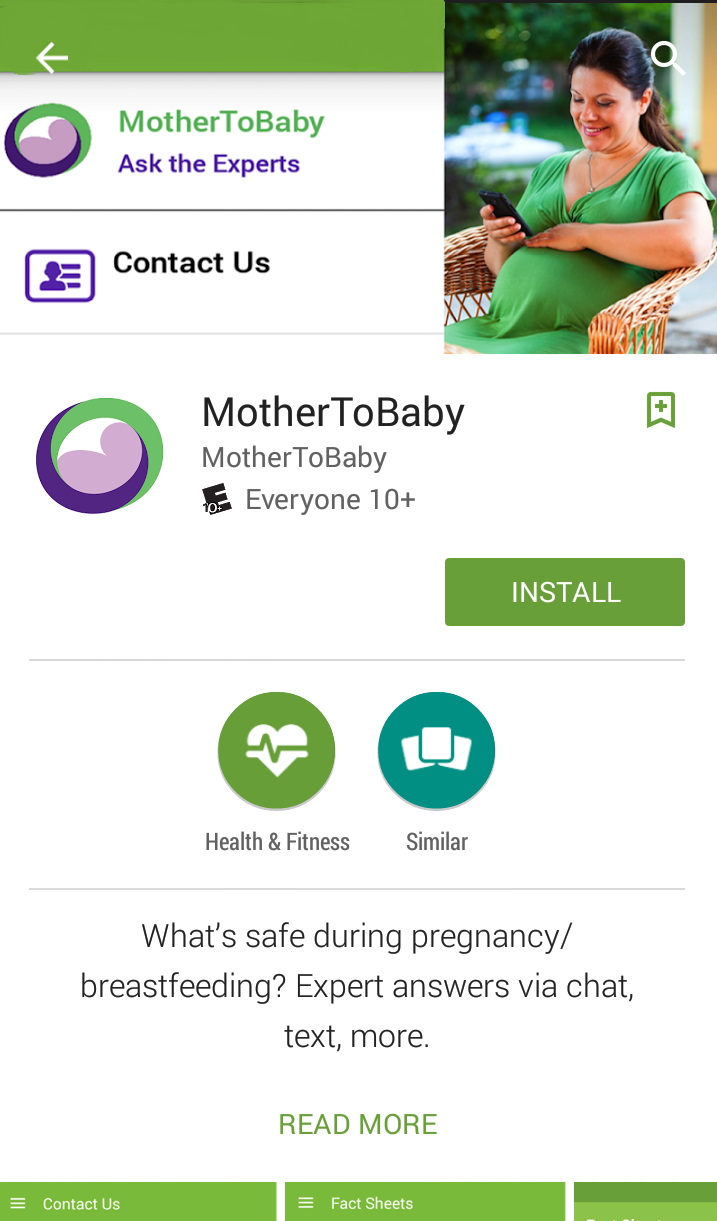
The MotherToBaby app is available on the Android and iOS markets and features the non-profit’s renowned up-to-date library of fact sheets on more than 100 exposures during pregnancy and breastfeeding. Perhaps, its most unique feature is the app’s ability to link the public directly through live chat, email, text and phone with a teratogen information expert (someone who specializes in providing personalized information about the risks of birth defects) so a user can get answers to questions in real-time without ever leaving the app.

Jennifer Zellner, PhD, who is based at UC San Diego and directed the development of the app, hopes this innovative service will fit a need within the health care professional community too, especially when it becomes overloaded during emergency situations such as the Flint, Michigan water crisis and the Zika virus outbreak. “We recognize that health care providers have limited time in a managed care setting to research the questions they or their patients may have about how a particular exposure may affect a pregnancy, or a breastfeeding infant,” said Zellner. “With the MotherToBaby app, providers will now have this information quite literally at their fingertips.”

The app also features a way for a pregnant woman to easily contribute information to the research by sharing her pregnancy. “Including information about our MotherToBaby Pregnancy Studies program in the app is one more way of reaching women and letting them know about this incredible opportunity to make a difference in the lives of future pregnant women by participating in research,” explained Zellner.

More About MotherToBaby
MotherToBaby is a suggested resource by many agencies including the Centers for Disease Control and Prevention (CDC) and the Food and Drug Administration’s (FDA) Office of Women’s Health. More than 100,000 women and their health care providers seek information about birth defects prevention from MotherToBaby every year. MotherToBaby has been able to embark on new outreach efforts to reach underserved populations and launch new communication technologies through a cooperative agreement with the U.S. Health Resources and Services Administration, as well as through the generous donations made by the public. To learn more about MotherToBaby, the ways to contact its network of experts, or how to support its services, please visit www.MotherToBaby.org.

# # #
Media Contact: Nicole Chavez, 619-368-3259, nchavez@MotherToBaby.org. Interviews in Spanish can also be arranged.

# # #


Birth Defects Prevention? There’s an App for That
BRENTWOOD, TN – MotherToBaby Pregnancy Studies, conducted by the Organization of Teratology Information Specialists (OTIS), has launched a new observational study of mepolizumab (Nucala®) in pregnancy, a new medication for the treatment of severe asthma. This study aims to provide crucial information on the safety of this medication in pregnancy by following asthmatic women during their pregnancy and following their child up to one year of age. Given that untreated asthma can put both the mother and pregnancy at risk, the need for rigorous and ongoing research of new medications and their effects during pregnancy becomes vitally important. This study will expand efforts to better understand safety of asthma medications in pregnancy

Mepolizumab (Nucala®), launched by GlaxoSmithKline (GSK) in November 2015, was the first IL-5 inhibitor approved by the U.S. Food and Drug Administration (FDA) for as an add-on treatment for severe asthma with an eosinophilic phenotype. Similar to inhaled steroids, mepolizumab provides a preventative approach to asthma control; it is thought to act by inhibiting interleukin 5 (IL-5), a group of proteins and signal molecules produced by white blood cells. This may decrease inflammation in the lungs and the number of subsequent severe asthma attacks in persons with eosinophilic asthma. Mepolizumab is administered as an injection under the skin (subcutaneously) once every 4 weeks. It is not intended to treat active asthma symptoms.

“We know that asthma in pregnancy, especially poorly controlled asthma, is associated with higher rates of pregnancy complications, like placental problems, premature delivery, and low birth weight. With this reality, it is especially important that a woman’s asthma be carefully managed prior to and during a pregnancy,” said Christina Chambers, PhD, MPH, MotherToBaby Pregnancy’s Studies lead investigator and world-renowned perinatal epidemiologist at UC San Diego. “Yet medications that are newly approved by the FDA have little to no information about how safe they are for a pregnant woman and her developing baby. Our research aims to fill this critical gap.”

In addition to mepolizumab, MotherToBaby Pregnancy Studies are also enrolling pregnant women who are using other medications for the treatment of their asthma including, but not limited to albuterol, formoterol, salmeterol, and/or inhaled steroids, as well as pregnant women who do not have asthma. These studies are coordinated by the University of California, San Diego, and are in collaboration with the American Academy of Allergy, Asthma & Immunology as part of the Vaccines and Medications in Pregnancy Surveillance System (VAMPSS).

Women who are pregnant and who reside in the U.S. or Canada may be eligible to participate. Participants are not asked to take or alter any medications, do not need to travel, and are not asked to make any changes to their normal routine.

To join or for more information on MotherToBaby Pregnancy Studies, call toll-free 877.311.8972, visit MotherToBaby.org or email MotherToBaby@ucsd.edu.

If you are pregnant or planning a pregnancy and have questions about asthma and the medications used to treat asthma in pregnancy, MotherToBaby Fact Sheets are available in both English and Spanish and can be downloaded for free. MotherToBaby experts are also available to provide free personalized risk assessments via phone, email, text, or live-chat.

More about MotherToBaby

MotherToBaby is the nation’s leading authority and most trusted source of evidence-based information on the safety of medications and other exposures during pregnancy and while breastfeeding.

The Centers for Disease Control and Prevention (CDC) and the Food and Drug Administration (FDA) Office of Women’s Health have recognized OTIS and MotherToBaby as a recommended resource for information on exposures during pregnancy and lactation.


Birth Defects Prevention? There’s an App for That

water-dropA statement issued by the MotherToBaby Public Affairs Committee

Recently, the issue of lead in drinking water has become a topic of great concern nationally. While there is much news coverage of this issue and of the experts working toward ensuring that these communities have safe drinking water, there has been very little data reported or resources identified specifically for women who are pregnant or breastfeeding.

Here is what we do know: Lead can get into your body through the gut if you swallow or inhale tiny particles of paint chips, medications, soil, water, or other items that contain lead. Because lead is naturally found in many places in the environment, most people have small amounts of lead in their blood and do not usually experience problems. When a person is exposed to lead over a long period of time or at a high level, the body will store lead in the bones and teeth. Lead can stay in the bones and teeth for many years. During pregnancy and breastfeeding, lead can leave bone and move back into the bloodstream. A blood lead test can be done to see how much lead is present in the blood. Although most people will have some lead in their blood, levels greater than 10 micrograms per deciliter (μg/dl) indicate that there is some exposure at home or in the workplace that needs to be addressed. While there is no clear safe level of lead in the body, the goal is to have the lowest level possible. Women who had exposure to lead in the past should have levels checked before and during pregnancy. The Centers for Disease Control and Prevention recommend that public health actions (such as a search for the source of the lead) be initiated when blood lead levels are above 5 μg/dL. Lead can cross into the baby starting at about the 12th week of pregnancy. The amount of lead in the blood of the mother and baby are almost the same, as are the levels in breast milk. Lead may also be found in infant formulas prepared at home, particularly if the local water supply contains high levels of lead. A mother should not stop breastfeeding unless her blood lead levels are above 5 μg/dL. Be sure to talk to your health-care provider about all your choices for breastfeeding.


Birth Defects Prevention? There’s an App for That

MotherToBaby Creates Zika Fact Sheets, Launches New Media (Scroll down for additional resources, video)

BRENTWOOD, TN – As information surrounding the Zika virus continues to evolve, MotherToBaby, a service of the international non-profit Organization of Teratology Information Specialists (OTIS), unveils new tools to bring the most accurate, evidence-based information to pregnant and breastfeeding women. Easy-to-understand fact sheets regarding Zika, as well as insect repellant use during pregnancy, are now available on www.MotherToBaby.org. Additionally, teratogen information specialists (experts trained in the field of birth defects) have begun taking questions about exposures from the general public and health care providers beyond its traditional telephone line – through private, live chat, text messaging and e-mail.

MotherToBaby, a suggested resource by many agencies including the Centers for Disease Control and Prevention (CDC) and the Food and Drug Administration’s (FDA) Office of Women’s Health, recognizes the urgent need for providing pregnant women, those planning a pregnancy, as well as breastfeeding moms with the most up-to-date information about the Zika virus and other potential causes of preventable birth defects. MotherToBaby is an official supporter of World Birth Defects Day, which is recognized by more than 50 international organizations each year on March 3rd.

“With the information and research about Zika changing on an almost daily basis, it can be confusing and, potentially, cause unnecessary anxiety for a pregnant woman,” said Stephen Braddock, MD, incoming president of MotherToBaby who serves as the Director of Medical Genetics at Saint Louis University. “That’s why MotherToBaby’s specifically-trained teratogen experts are here to sift through and interpret the evolving Zika-related research, putting it into perspective so a woman can make informed health decisions in collaboration with her health care provider,” added Dr. Braddock.

The challenges of staying up-to-date on the changing Zika information are lessened since OTIS, the professional society which provides the MotherToBaby service, includes members and researchers currently in the thick of the Zika outbreak. Lavinia Schuler-Faccini, PhD, lead author of one of the first ground-breaking studies to examine the association between the Zika virus in pregnant women and microcephaly (small head and brain) in their babies, is part of the MotherToBaby/OTIS network. Dr. Schuler-Faccini is President of the Brazilian Society of Medical Genetics (Sociedade Brasileira de Genetica Medica).

“Being based in Brazil, one of the countries where Zika has been declared an ‘outbreak,’ has allowed me to communicate the very latest research to my American colleagues,” said Dr. Schuler-Faccini. “For example, I was able to provide region-specific information where infected mosquitos are currently located to a worried American traveler who had contacted MotherToBaby,” she added.

More about Zika
On February 1, 2016 the World Health Organization (WHO) declared a global public health emergency over Zika virus, due to its suspected ability to cause microcephaly in unborn babies. Zika virus was first identified in Africa in 1947. In 2013, there were outbreaks in islands in the Pacific, and now outbreaks are being reported in many Central and South American countries. Isolated cases have also been reported in the U.S. in people who have recently traveled to South American countries, and in Puerto Rico, over the last few weeks. Additionally, just last week, federal health officials reported strong evidence that more than a dozen people have caught the virus through sexual transmission.

About MotherToBaby
MotherToBaby provides free, evidence-based, personalized risk assessments, education and counseling regarding the effects of exposures during pregnancy and while breastfeeding. Examples of exposures include the Zika virus, prescription and over-the-counter medications, alcohol, tobacco, illicit drugs, vaccines, beauty products, herbal supplements, chemicals and more. The public, as well as health care providers, can be connected with a MotherToBaby expert through its traditional toll-free phone line, 866-626-6847, via text message at 855-999-3525, or through live chat and email on www.MotherToBaby.org.

More than 100,000 women and their health care providers seek information about birth defects prevention from MotherToBaby every year. MotherToBaby has been able to launch new outreach efforts to reach underserved populations and launch new communication technologies through a cooperative agreement with the U.S. Health Resources and Services Administration.

00-wbddlogo-CDC

About World Birth Defects Day
Along with more than 50 birth defects-related organizations around the world, MotherToBaby is helping to raise awareness of this critical global issue by participating in World Birth Defects Day, which is observed yearly on March 3. The commemorative day not only helps to raise awareness of the problem of birth defects, but also the importance of improving prevention strategies and research that will ultimately lead to fewer birth defects and a healthier society.

More Resources

  • Health care providers interested in viewing the recording of a National Society for Genetic Counselors joint webinar on research surrounding Zika, click here.
  • MotherToBaby’s Dee Quinn, MS, CGC provides the latest Zika research on “The Vibrant Gene” program:
  • MotherToBaby’s Public Affairs Committee has also issued an official statement about the Zika virus, which can be read here.
  • Our sister society, the Teratology Society, has recently published a blog looking closely at the science needed to learn more about Zika as well. Read its latest Birth Defects Insights blog here.

# # #
Media Contact: Nicole Chavez, 619-368-3259, nchavez@MotherToBaby.org. Interviews in Spanish can also be arranged.


Birth Defects Prevention? There’s an App for That

SaltBy Kiran Thanigasalam, BPharm, MPH, MotherSafe (MotherToBaby’s Australian partner)

As Birth Defects Prevention Month came to a close last month, I thought it was crucial I keep the momentum going by talking about Iodine with every patient I come across as a pharmacist and counselor. Why? When planning for baby, you and your prenatal vitamin need to be on the same team when it comes to health. While there may be no “i” in team, there is an “i” in both iodine and iron. When the topic of iodine supplementation is raised with pregnant women, I can tell you that a lot of women confuse iodine with iron when searching for the perfect prenatal vitamin.

What is iodine?
Iodine is a naturally-occurring trace element which is vital for thyroid function. It is an essential component of the thyroid hormones T4 and T3. Some common food sources include seaweed, fish, egg and iodized salt.

Misconception
The total recommended daily intake in pregnancy ranges from 220 micrograms (U.S. RDA) to 250 micrograms (W.H.O, Unicef, ICCIDD). While many women report that they have “tested within normal limits for everything” and have a balanced diet, the American Thyroid Association, American Academy of Pediatrics and the Endocrine Society recommend a prenatal supplement of at least 150 micrograms of elemental iodine per day for every pregnant woman. This recommendation assumes that the woman is also getting 70-100 micrograms of iodine in her daily diet.
The only exceptions to this recommendation are women with pre-existing thyroid conditions such as Graves’ disease who have been advised by their treating specialists to avoid iodine supplements.

Dietary iodine intake in the US has generally been considered adequate since the fortification of table salt and other foods. However, since routinely testing iodine concentrations in urine is not practical and since supplementation is cheap, safe and effective, the preventative approach of a one-size-fits-all supplement in pregnancy provides peace of mind – especially for at-risk groups like vegetarians or those who do not consume dairy products or iodized salt.

Getting enough iodine is crucial for a developing baby’s brain and skeleton.

In its most extreme form, iodine deficiency can result in maternal goiter (a condition in which the thyroid gland becomes enlarged), miscarriage and stillbirth. However an underactive thyroid gland in the mother, even if she is not having any symptoms, can cause the baby to have neurodevelopmental problems such as a reduced IQ.

Clearly, not all prenatal vitamins are the same.

A 2009 paper published in the New England Journal of Medicine surveyed 223 prenatal multivitamins marketed in the United States and found that only 51% contained iodine, and 37% of those products contained kelp as the iodine source. Unfortunately, wide variations in the iodine content of kelp make this an unreliable choice of supplement. Potassium iodide is preferred.

As a result, it is crucial to check that the prenatal vitamin you are contemplating buying contains not only folic acid (which is important to prevent birth defects of the spine, called neural tube defects), but also iodine at the recommended amount and in the right form. Here’s to a winning team when it comes to iodine and health for you and baby!
MotherSafe logo
About the Author

Kiran Thanigasalam, BPharm MPH, is a pharmacist and teratogen information specialist at MotherToBaby’s international affiliate, MotherSafe, which is based at the Royal Hospital for Women, Randwick in Australia.

MotherToBaby is a service of the international Organization of Teratology Information Specialists (OTIS), a suggested resource by many agencies including the Centers for Disease Control and Prevention (CDC). If you have questions about nutritional supplements, alcohol, medications, vaccines, diseases, or other exposures, call MotherToBaby toll-FREE at 866-626-6847 or try out MotherToBaby’s new text counseling service by texting questions to (855) 999-3525. You can also visit MotherToBaby.org to browse a library of fact sheets, chat live or email an expert.