
MotherToBaby Interactive Critical Periods of Pregnancy Tool

Understanding Critical Periods in Pregnancy

Kendra, newly pregnant at approximately 7 weeks along, contacted MotherToBaby late one afternoon with a question that had been causing her a lot of anxiety. Norovirus was running rampant in her home, and she was feeling extremely nauseous. Having found relief with it before, she explained that she had taken a single dose of Zofran (ondansetron) early that morning. She was certain this drug was ok to take during pregnancy, but after searching online, she became concerned. Kendra shared that she had read conflicting information about whether Zofran increased the risks for birth defects; with some studies showing an increased chance of heart defect and cleft palate, and other studies showing no increased risk. Feeling confused, Kendra reached out to MotherToBaby with her question to receive personalized information.

On the call, I first explained that birth defects can happen in any pregnancy for different reasons. Out of all babies born each year, about 3 out of 100 (3%) will have a birth defect. Pregnancy problems (like miscarriage) can also happen in any pregnancy. Sometimes, exposures like medications, drugs, alcohol, and infections can increase the chance for birth defects or pregnancy complications. However, for an exposure to cause a problem, it generally has to happen during the “critical period” when a body part is forming.

To help Kendra understand more about possible risk from her Zofran exposure, I used MotherToBaby’s new and interactive critical periods of pregnancy tool! This helpful pregnancy calculator and chart shows when different parts of a baby’s body form during pregnancy and when birth defects or pregnancy complications might happen. By entering the first day of your last menstrual period (LMP) or estimated due date (EDD), the calculator can estimate how far along you are today. Individuals who have questions about exposures in pregnancy can then go on to enter the specific date(s) when the exposure (such as medication use or alcohol consumption) occurred, and the chart will show the body parts that are developing during that time.

After entering the first day of Kendra’s last period, the interactive tool confirmed she was 6 weeks and 5 days pregnant. I then entered her Zofran exposure using today’s date, which resulted in a pink line popping up on the chart. Following this line down the chart, I could see all of the different body parts that were currently forming. I explained to Kendra that when she took the Zofran, the palate (roof of the mouth) had not yet started to form, meaning that the medication use was unlikely to increase the chance of cleft palate in the baby. The chart also helped me see that the baby’s heart was currently developing. I shared this with Kendra, but also reminded her that the latest research shows there is thought to be a less than 1% chance of heart defects from exposure to Zofran; meaning there is a more than 99% chance the heart will not be affected by her medication use. In other words, even when an exposure of concern takes place during the critical period, not every baby will be affected by that birth defect. 
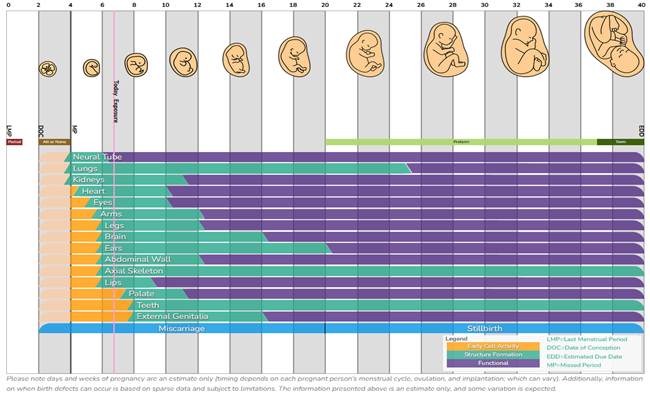
New Critical Periods of Pregnancy Interactive Tool

For Kendra, being able to understand which specific body parts were forming when she took the Zofran and whether she actually needed to be concerned helped decrease her anxiety significantly. Knowing that the heart was currently forming, she decided to reach out to her healthcare provider to discuss alternative treatment options for her nausea.  I was happy to have helped answer Kendra’s question using this visual tool and look forward to being able to use it again in the future when pregnant women have questions about the timing of their exposure.

Remember that our team is always available to help review any exposures you have had and provide a personalized risk assessment. Don’t hesitate to contact MotherToBaby by phone, chat, text, or email!

MotherToBaby Interactive Critical Periods of Pregnancy Tool

By Lori Wolfe, Certified Genetic Counselor and Teratogen Information Specialist, MotherToBaby North Texas
It’s pretty much a fact – ALL pregnant women worry…about what they eat, what they do, what they breathe. Basically, they worry about everything. That’s simply because every expectant mother wants to do the very best she can for her developing baby. As a genetic counselor who runs the North Texas affiliate of MotherToBaby, I get calls every day from pregnant woman who want to know what to do and what not to do in order to have the best chance of having a heathy baby without birth defects.

Recently I was having lunch with my friend, Amber, who is expecting her first babies…Yes… plural! In seven short months, she’ll become the mother of twins! As a first time mom-to-be, Amber is always full of questions when we get together. Nothing like having a friend who is an expert in the pregnancy exposure field, right?! “Lori, is it true that since I eat lots of dark green veggies, and breads and cereals, that my babies will not have spina bifida? I remember hearing something about how good folic acid is for developing babies. Is that true?” asked Amber. “Yes!” I enthusiastically replied. “Having enough folic acid in the first two months of your pregnancy is very important to help prevent birth defects in your developing babies. In fact, studies have shown that if you are getting at least 400 mcg of folic acid during your early pregnancy through the foods you eat, as well as your prenatal vitamin, then your babies have up to a 70% less chance of having a spinal cord defect such as spina bifida.” The look on her face was priceless…pure shock! “70%? Really?! Wow, I had no idea it could be so effective,” Amber answered. “Yes, I have been taking a daily prenatal vitamin since before I became pregnant. I am always careful to take one every day. So what else can I do to help my babies be born without birth defects?”

Let me break it down for all of the “Ambers” out there. What’s thought to be the most common preventable cause of mental retardation in a baby? The answer – drinking alcohol during pregnancy. “And what is so crazy is that women do not need to drink alcohol when they are trying to become pregnant, and definitely not once they have a confirmed pregnancy,” I explained. About one in every 100 babies born in America is affected by prenatal alcohol exposure and it is totally preventable by simply avoiding alcohol during pregnancy. “Amazing!” replied Amber. “I never realized so many kids were affected by their moms’ drinking alcohol during pregnancy. That is sad. But I am good on this count as I have not had any alcohol at all during the last few months,” Amber said.

“So is there anything else I can or can’t eat or drink, or something else I can avoid that could make a difference in my babies not having birth defects?” she went on to say. “You are about eight weeks pregnant now, right Amber?” I asked her. “Yes. I am now about eight and one half weeks. Why?” she asked. “Well, another thing we worry about is hyperthermia,” I told her. “Hyperthermia means increasing your internal or core body temperature up to 102 degrees Fahrenheit or more. When you become that hot, the baby inside of you becomes hot too. When the baby’s temperature becomes too hot, especially in weeks five and six of a pregnancy, there is an increased chance that the spinal cord will not close, and your baby can be born with an open spinal cord defect like spina bifida. So we always caution pregnant women not to sit in hot tubs that are heated over 100 degrees, or to be careful to watch their temperature if they become ill with a fever during early pregnancy,” I said.
“All of this is really good to know,” Amber answered, as we wrapped up lunch. “I’m lucky I have you as a friend!”

I love making sure women have someone to turn to for answers when they have questions about exposures while pregnant or breastfeeding. In fact, during March when the world will commemorate the first-ever World Birth Defects Awareness Day, my lunch with Amber serves as a great reminder that my colleagues and I are there for all pregnant and breastfeeding women across North America.
If you have a question during pregnancy and breastfeeding about something you ate, drank or medication you took, call MotherToBaby at 866-626-6847. I may not be able to meet you for lunch, but a main course of free expertise over the phone, followed by a huge helping of cutting edge research to support that expertise, will certainly be exactly what you ordered in your search for answers. And who knows? Your kids might even thank you for having such an appetite for knowledge one day!

loriwolfe
Lori Wolfe is a board certified Genetic Counselor and the Director of MotherToBaby’s North Texas affiliate. MotherToBaby aims to educate women about medications and more during pregnancy and breastfeeding. Along with answering women’s and health professionals’ questions regarding exposures during pregnancy/breastfeeding via MotherToBaby’s toll-free number and by email, Wolfe also teaches at the University of North Texas, provides educational talks regarding pregnancy health in community clinics and high schools, and counsels adoptive parents.
MotherToBaby is a service of the international non-profit Organization of Teratology Information Specialists (OTIS), a suggested resource by many agencies includingthe Centers for Disease Control and Prevention (CDC). If you have questions about vaccines, medications or other exposures, call MotherToBaby toll-FREE at 866-626-6847 or visit MotherToBaby.org to browse a library of fact sheets and find your nearest affiliate


MotherToBaby Interactive Critical Periods of Pregnancy Tool

By Patricia Olney, MS, CGC

“I think I’ll go out to the garage and work on the car for a while.” This was Daniel’s reaction after the birth of his second child with spina bifida. His wife, Rebecca, cried uncontrollably.
Sarah was born in 1989 after a healthy pregnancy, filled with the anticipation of first time parents. The nursery was decorated, the crib was set up, and an overnight bag packed. The only thing Rebecca didn’t anticipate was a preterm delivery, c-section, and a baby born with a severe birth defect.

My oldest son was also born in 1989. Rebecca and I shared the same excitement, dreams, and hopes for a healthy baby. We ate a balanced diet, took our prenatal vitamins, exercised regularly, and attended childbirth classes. We talked about whether we wanted an epidural or not, a home birth, or delivery by a midwife. Our husbands advocated for a hospital birth…just in case there was a problem during delivery.

Rebecca remembers the details as if it happened yesterday. On the eve of March 24th, Rebecca’s amniotic sac ruptured. Her first thought was “Oh no, I wet the bed!” She didn’t realize it was not her urine, but amniotic fluid. She woke Daniel and frantically called her OB. On the way to the hospital, Rebecca was sobbing. She was scared, and worried. What if all the amniotic fluid leaked out? Daniel tried to be reassuring—her OB was a very competent doctor. Sarah was born the next morning by c-section at 34 weeks and quickly whisked away to the NICU by the neonatologist. The preterm delivery was now the least of their worries. Their baby was born with spina bifida.

Rebecca and Daniel were shocked, then angry, and found themselves searching for answers. The book “What to Expect When You’re Expecting” didn’t cover having a baby with a birth defect. After a long discussion with the neonatologist, they learned Sarah had a type of neural tube defect called myelomeningocele. They heard the words…”she may have neurologic deficits below the level of the defect, and may develop hydrocephalus.” Sarah eventually developed hydrocephalus, wasn’t able to walk, and didn’t have bowel or bladder control.

Spina bifida is a type of neural tube defect (NTD) that affects the spine, or spinal cord. With this condition, the neural tube does not close completely. Myelomeningocele is the most serious type of spina bifida—a sac of fluid with part of the spinal cord comes through an opening in the baby’s spine damaging the nerves. Neural tube defects happen in the first month of pregnancy, often before a woman even knows that she is pregnant.

At first, Rebecca and Daniel couldn’t imagine having another child since Sarah required so much care, but two years after Sarah’s birth, Rebecca and Daniel decided they wanted Sarah to have a sibling. They consulted their OB and decided to have a blood test that screens for neural tube defects called maternal serum AFP. They didn’t want to have an amniocentesis, a more sensitive test for NTDs, because of the small chance of miscarriage. Plus, they never thought it could happen twice.

Emma was born in June of 1991 with a less severe type of spina bifida, lower on her spine than Sarah’s. At that time, the maternal AFP blood test detected about 80-85% of NTDs. Prenatal ultrasound may not detect one that is small, and covered with skin. In general, when the opening is lower along the spine, fewer nerves are damaged, resulting in less serious disability.

A worldwide effort to prevent recurrence and occurrence of neural tube defects began in the early 1990’s. Women who had a pregnancy that resulted in a baby with an NTD have an increased risk of 2-3% to have another affected pregnancy. In August 1991, U.S. Public Health Service provided guidelines for women who already had a pregnancy affected with a NTD. The guidelines called for consumption of 4 milligrams (4000 micrograms) of folic acid daily beginning one month before trying to get pregnant and continuing through the first three months of pregnancy (CDC: MMWR; Aug. 2, 1991).

Folic acid is a water-soluble B vitamin. Foods that are naturally high in folic acid include leafy vegetables, fruits (such as bananas, melons, and lemons) beans, yeast, mushrooms, meat (such as beef), orange juice, and tomato juice. Most women would not consume enough folic acid by diet alone.

In order to reduce the frequency of NTDs and their resulting disability, in September, 1992, the U.S. Public Health Service recommended:

“All women of childbearing age in the United States who are capable of becoming pregnant should consume 0.4 mg (400 micrograms) of folic acid per day for the purpose of reducing their risk of having a pregnancy affected with spina bifida or other NTDs. Because the effects of higher intakes are not well known but include complicating the diagnosis of vitamin B12 deficiency, care should be taken to keep total folate consumption at less than 1 mg per day, except under the supervision of a physician. Women who have had a prior NTD-affected pregnancy are at high risk of having a subsequent affected pregnancy. When these women are planning to become pregnant, they should consult their physicians for advice (CDC MMWR: September 11, 1992).”

In 1998, the Institute of Medicine’s Food and Nutrition Board added this to the recommendation:

“To reduce their risk for an NTD-affected pregnancy, women capable of becoming pregnant should take 400 micrograms of synthetic folic acid daily, from fortified foods or supplements or a combination of the two, in addition to consuming food with folate from a varied diet.”

Since 1998, folic acid has been added to cold cereals, flour, breads, pasta, bakery items, cookies, and crackers, as required by federal law. CDC reports that fortification is now mandatory practice in 57 countries and voluntary in many others. Three key results are:

• World-wide, at least 22,000 fatal or disabling birth defects such as spina bifida are prevented annually. That’s 60 babies a day.
• Countries around the world report 30% to 70% declines in NTDs after fortification begins.
• Countries save millions of dollars in healthcare cost when spina bifida is prevented.

Since one-half of U.S. pregnancies are unplanned and because these birth defects occur very early in pregnancy (3-4 weeks after conception), CDC recommends all women of childbearing age consume folic acid daily. CDC estimates that most of these birth defects could be prevented if this recommendation were followed before and during early pregnancy. Rebecca and Daniel could never change what happened to their babies, but sharing their story may help spread the word about the benefits of folic acid.

Questions? For your FREE personalized risk assessment, call MotherToBaby toll-FREE (866) 626-6847 or email an expert here. MotherToBaby is a service of the international non-profit Organization of Teratology Information Specialists (OTIS), a society that supports and contributes to worldwide initiatives for teratology education and research. MotherToBaby affiliates and OTIS are suggested resources by many agencies, including the Centers for Disease Control and Prevention (CDC), and are dedicated to providing evidence-based information to mothers, health care professionals, and the general public about medications and other exposures during pregnancy and while breastfeeding. Learn more at MotherToBaby.org.

Pat Olney

Patricia Olney, MS, is a certified genetic counselor and pregnancy risk specialist at MotherToBaby Georgia, Emory University. She received her masters degree at the University of California, Berkeley and has practiced genetic counseling for more than 25 years. MotherToBaby GA is funded by the Georgia Department of Behavioral Health and Developmental Disabilities.