
A Closer Look at Controlling Cholesterol during Pregnancy

By Mara Gaudette, MS, CGC, Teratogen Information Specialist, MotherToBaby California

The chat message came through promptly at my morning start time. The words and exclamation marks clearly highlighted worry. “Just found out I’m pregnant! Taking a statin medication to lower cholesterol since 6th grade! Talked to my doctor and stopped taking it yesterday. But what damage have I already done? I know it’s a class X drug! Need info – please help!” Mae agreed to a phone call, and I logged off from our MotherToBaby live chat service and phoned Mae.

First, you may wonder why someone would be on a cholesterol-lowering medication since late elementary or middle school. Isn’t that extreme? Actually no- in Mae’s case she has an inherited condition called familial hypercholesterolemia – or “FH” for short. This is a condition that occurs in about 1 in every 250 persons but is underdiagnosed and therefore undertreated. A simple blood test checking cholesterol levels and a review of your family history (such as checking for heart attacks at younger ages) can help determine if you have FH. Much less common, a more severe form of FH, inherited from both parents, can occur.

To back up a bit, cholesterol is that fatty substance in our bodies that is needed in some amount, but too much cholesterol increases our chance for early heart disease. The lifestyle changes that are recommended to all of us, such as exercising regularly, avoiding smoking, and eating a healthy diet are also part of the treatment plan for FH (and Mae had been working hard to follow these guidelines). But, cholesterol lowering medications are still often a needed part of treatment because lifestyle alone won’t lower cholesterol levels enough in persons with FH. For some with FH, statin medications might be prescribed starting at 8-10 years old.

But what about the “category X” classification Mae mentioned-does this mean that statin medications are absolutely proven to increase birth defects? Fortunately, for Mae the answer is a resounding “no!” Many persons are not aware that the FDA decided in 2014 to phase out their letter category rating system. While an easy system to use, it was not a reliable system to predict pregnancy risk (see our January 2015 blog for more information).

So why were statins assigned that old category X? Well, the developing baby needs cholesterol to form properly so there is a theoretical concern that cholesterol-lowering medications could pose a pregnancy risk. Also, for many persons, particularly those without FH, stopping a cholesterol-lowering medication in the short term of a pregnancy is thought unlikely to significantly increase their heart disease risks. However, for some persons, avoiding all cholesterol treatments might pose concerns for both the pregnant woman and baby. So, if you have FH, talking with your cardiologist and obstetrician about a cholesterol treatment plan is important when planning a pregnancy or when you learn of your pregnancy.

Most studies with the class of medications called “statins” have not found an increase in birth defects with accidental use early in pregnancy. This should provide some reassurance to pregnant women who were taking statins before they realized they were pregnant, like Mae. (For more info, see our fact sheet on Statins in pregnancy.)

“I feel a little better. But, I wish there were more pregnancies that were studied. We need more info about medications we might have to take during pregnancy,” Mae said. At MotherToBaby, we completely agree! And I appreciated her lead to bring up our optional follow-up program. I let Mae know that in addition to providing information, we have a study team that follows pregnancy outcomes. This will allow us to provide more information to worried parents and their healthcare providers. So, if you find yourself like Mae drawn to the importance of this information and wondering how you can contribute, call 877-311-8972, email mothertobaby@ucsd.edu or you can volunteer for a study through our website. There is no cost to participate and pregnant women are never asked to take a medication.

Mara Gaudette

Mara Gaudette is a genetic counselor and received her Masters Degree from Northwestern University. Drawn to the satisfaction of providing immediate reassurance to worried women, she began educating the public about teratogens at MotherToBaby’s Illinois affiliate more than a decade ago. Today, she not only continues to counsel for MotherToBaby via phone, but also on live chat and email as part of MotherToBaby California’s team of experts.

MotherToBaby is a service of OTIS, a suggested resource by many agencies including the Centers for Disease Control and Prevention (CDC). If you have questions about exposures like cholesterol medication, please call MotherToBaby toll-FREE at 866-626-6847 or try out MotherToBaby’s text information service by texting questions to (855) 999-3525. You can also visit MotherToBaby.org to browse a library of fact sheets about dozens of viruses, medications, vaccines, alcohol, diseases, or other exposures during pregnancy and breastfeeding.

A Closer Look at Controlling Cholesterol during Pregnancy

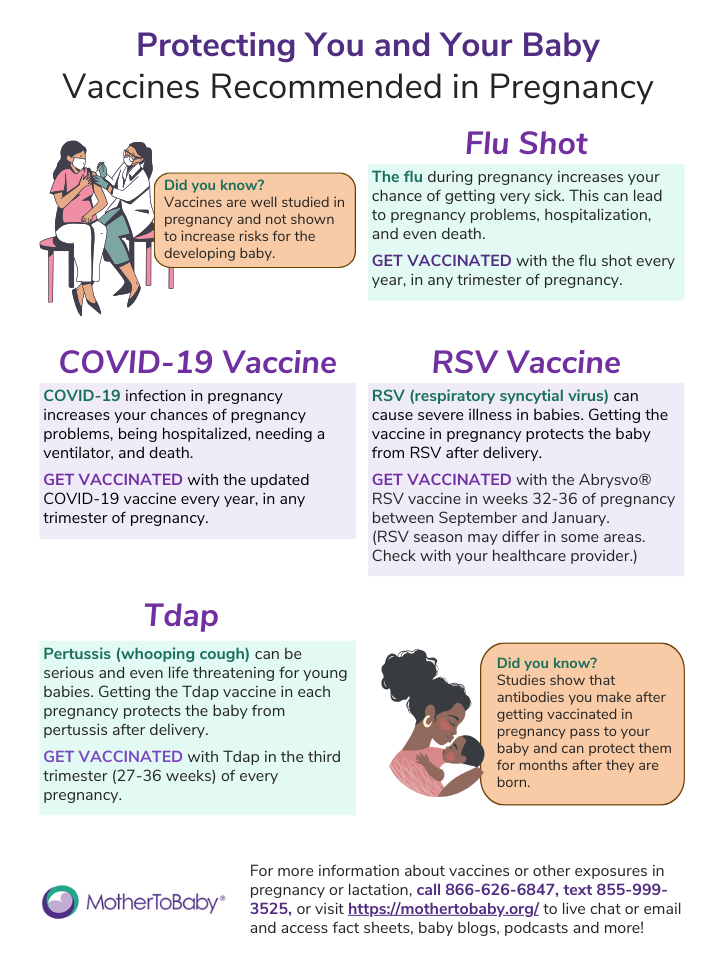
As we enter the 2024-2025 respiratory virus season, MotherToBaby wants to highlight the importance of vaccinations during pregnancy. All pregnant people are recommended to receive the annual flu shot and an updated 2024-2025 COVID-19 vaccine. Tdap, and the Abrysvo® RSV vaccine are recommended in the third trimester. These vaccines are well studied in pregnancy and not expected to increase risks for the developing baby. Furthermore, by protecting the pregnant person from diseases like the flu, COVID-19, pertussis, and RSV, vaccinations can help reduce the risk of pregnancy complications and ensure babies are born with protection against serious illnesses.

MotherToBaby knows that people who are pregnant have a lot to remember. Between taking a prenatal vitamin every day, getting blood work done, attending prenatal visits, and preparing for baby’s arrival, the pregnancy to-do list can feel never-ending. In an effort to provide a simplified reminder about the four vaccines recommended in pregnancy and why they are each so important, MotherToBaby has created a helpful infographic available for download below.

“This infographic is a great reminder of the many benefits vaccinations offer during pregnancy” shared Kirstie Perrotta, MPH, co-chair of MotherToBaby’s Emerging Issues Task Force. “Getting these vaccines on time is one of the most important things a pregnant person can do for their health and the health of their baby.”

For a PDF version of the infographic, click here.

MotherToBaby also has other resources available on the topic of vaccination in pregnancy.

Be sure to subscribe to The MotherToBaby Podcast so you don’t miss our upcoming episode series on vaccination. The podcast is available on iTunes, Amazon Music or wherever you listen to podcasts. 

Past vaccine-related podcast episodes:

RSV Vaccine in Pregnancy

Vaccine Questions during Pregnancy Answered

Vaccine Questions during Breastfeeding Answered

COVID-19 Vaccine in Pregnancy

Read our recent Baby Blogs discussing vaccination here:

And check out our vaccine fact sheets here:

Still have more questions? MotherToBaby specialists are happy to assist you further. Please feel free to call, chat, text, or email for more information: https://mothertobaby.org/contact/


A Closer Look at Controlling Cholesterol during Pregnancy

by Sarah Obican, MD, MotherToBaby President

Though I wish I didn’t remember the day well, I do. I was a maternal fetal medicine fellow in NYC and I was sitting with my two beautiful co-fellows. When I say my co-fellows were beautiful, I mean that inside and out. We were an odd pairing of three musketeers. Young, bright, professional women, training to take care of women with high-risk pregnancies… and all three of us were pregnant. It was completely unplanned and highly unusual for all three of us to conceive, all within a few short weeks of each other. But there we were one day, sitting at our desks, talking about our individual research projects and occasionally interjecting in each other’s conversations with excitement about our future babies. I loved my two colleagues so much, and I was so excited to imagine that we would follow each other’s careers and see our children grow up, all similar in age.

In the middle of this conversation, something made me just get up and say to them “I’ll be right back!” I still don’t know what made me do it. I had a feeling hard to describe, but it made me walk over to our ultrasound unit and ask my sonographer colleague to please do an ultrasound.

I was on the examining table within minutes. But her silence after she put the probe down on my ultrasound gooped-up belly felt like an eternity. Another sonographer came into the room. I knew. That’s when the world went dark.

Now, I am physician and I cannot explain this. For a few moments, quite literally, the bright NYC day, the room, the people in the room, went completely dark. I couldn’t see. I didn’t lose consciousness, but I couldn’t see.  In my career, I sadly had to care for countless women who went through a miscarriage and in that darkness, I wondered if they had experienced the same. A few moments later I was back in the ultrasound room, now with an overcoming wave of sadness which made me wish I was in the numbing darkness again.

The American College of Obstetricians and Gynecologists estimates that 26% of all pregnancies end in a miscarriage and a significant proportion of those are in already clinically recognized pregnancies (when the pregnant woman already knows she is pregnant).

Miscarriage vs. Abortion

The words miscarriage and abortion are often used interchangeably. For example, a missed abortion in the world of obstetrics means that pregnancy stopped naturally and that there is no heartbeat or if early enough in the pregnancy, that there is no continuation of fetal growth or development. These pregnancies can pass naturally with bleeding or can be aided by a physician by giving medication of performing a procedure. During this time, there is a lot in terms of discussion of possible contributing factors including abnormal genetics and counseling on recurrence for the next pregnancy. It’s a tough, sensitive time for patients. I know it from both sides.

Ectopic Pregnancy

Sometimes desired pregnancies present themselves as ectopic pregnancies. An ectopic pregnancy is when an already fertilized egg implants and begins to grow outside of the uterus in an area that cannot adequately support the pregnancy. Most of the ectopic pregnancies (>90%) occur in the fallopian tube, but no matter where the pregnancy implants, it can be life threatening for the pregnant woman. This is because the location in which the ectopic pregnancy has implanted cannot grow, expand and adequately support the pregnancy nutritionally and can result in the structure rupturing and causing internal bleeding. While all miscarriages can feel devastating, an ectopic pregnancy is an emergency that requires immediate treatment by a physician. Depending on the size and development of the ectopic pregnancy and the patient’s symptoms, the ectopic pregnancy can be treated with medication or by surgery. This too gives a great sense of loss for patients because often these pregnancies were highly desired.

It is important to note that being treated for a miscarriage or an ectopic pregnancy either by the use of medications or surgery is not considered a termination. As a high-risk obstetrician, I know that providing great medical care for a miscarriage, an ectopic pregnancy or providing access to desired abortion care is essential for the pregnant woman’s health and safety.

Shedding Light on the Darkness

With my personal journey of years of infertility and in vitro fertilizations, there are not many positives from that sunny day in NYC. However, that personal darkness shed light on all of what my patients in similar situations had to go through. I talk about my history openly, if asked. When appropriate, I share with my patients about my loss and about infertility. I am reminded by my patients that we have to speak more about these human experiences. To normalize them, to not feel alone.  As for the experience of that day, I am thankful for that knowledge and when I have to be the first to tell my patient that she just had a pregnancy loss, I get close to her and I hope that my words, my actions and my demeanor show them what I am thinking inside…. I see you and I’ve got you.

References/Resources

https://www.acog.org/advocacy/abortion-is-essential

https://www.acog.org/advocacy/facts-are-important/understanding-ectopic-pregnancy

https://www.ncbi.nlm.nih.gov/books/NBK532992/#:~:text=The%20American%20College%20of%20Obstetricians%20and%20Gynecologists%20%28ACOG%29,early%20pregnancy%20loss%20occurs%20in%20the%20first%20trimester


A Closer Look at Controlling Cholesterol during Pregnancy

Did you know that 70% of pregnant women take at least one prescribed medication? And that 90% take any medication during pregnancy? How do you know if it is safe for a pregnant woman to take these medicines?

MotherToBaby Teratogen Information Specialists (TIS) are experts at answering questions about any possible increased risk of taking an over-the-counter (OTC) or prescribed medication, as well as any other exposures! A teratogen is something that can increase the risk for birth defects to the developing baby, and other problems such as a smaller baby or early delivery, when exposure occurs during pregnancy. Special intensive training is required to become a TIS, before we are able to answer the questions of healthcare providers, pregnant and lactating women, their relatives and partners, prospective adoptive parents, and the public. We get calls from people of all ages, teens up to older adults, even prospective grandparents. Teratogen specialists learn how to investigate the question, summarize the data, and then communicate it in a way that is easily understood. Every contact is a little different because each scenario is different, but that makes each day endlessly fascinating for those at MotherToBaby who respond to your inquires.

This work is different than the work of other healthcare providers such as a genetic counselor, midwife or obstetrician – we don’t generally delve into family history, and we don’t make direct recommendations. We try to be reassuring as we give you the most up-to-date exposure information. We consider the potential effects of taking AND not taking a medication, herbal supplement, or OTC drug. There are important considerations when someone is planning a pregnancy, facing a newly discovered pregnancy or an unanticipated pregnancy, dealing with worsening mental or physical health conditions, or with the sudden diagnosis of a birth defect or pregnancy loss.

We answer questions from prospective adoptive parents who may only have 36 hours to decide if they will accept a baby whose biological mom used heroin, methamphetamine or alcohol in pregnancy. We listen to pregnant callers worried about the substantial alcohol they drank or the marijuana they used before getting a positive pregnancy test. We also answer questions from people worried about Zika virus exposure on their honeymoons. And common questions these days involve the COVID-19 virus and the COVID vaccines and booster shoots given at any time in pregnancy or while breastfeeding.                                                  

Teratogen specialists also get calls about the potential consequences of pain medications for those who are pregnant and facing surgery such as a pre-op visit for a herniated disc – and are in excruciating pain. We have numerous conversations with lactating women who were advised to “pump and dump” after dental work or general anesthesia, or CT scans and we are able to discuss why this dated practice is usually unnecessary. Some women call repeatedly due to anxiety or simply because our TIS team has reliable expertise. We also answer breastfeeding questions about COVID-19 and the vaccines, prescriptions and OTC medications, or how much of a drug gets into breastmilk.  And we get questions from pregnant and postpartum individuals who are trying to avoid using inhalers or taking their anxiety/nausea/ADHD medications. We share the research and reassure them that some health conditions need to be treated with medications because it’s best for mom and baby. Some conversations are more sensitive – such as women with a history of multiple miscarriages, IVF, or other high-risk pregnancies who are trying to make only the best choices in a high-stakes stressful time. Sometimes there are tears, and that’s OK.

Often, we talk about the benefits to the individual of taking/using the medication or other product, versus any possible risks to the pregnancy or the baby. We tell them to consider the long view, that as a parent, you will be making “risk vs. benefit” decisions for nearly the next two decades for the child growing inside you. So, it’s important for you to make a choice now that gives you a good quality of life, and also to consider every aspect of the consequences for you both mentally and physically. In addition, it is in the important input of your partner and your healthcare providers.

It is a privilege to be part of the lives of all those who come to MotherToBaby for information. We are sensitive to different cultures, backgrounds, sexual orientation, and gender identification. We have 12 affiliate offices in the US and one in Canada. We provide information by phone, text, email, and live chat, and because we work across three times zones, we can respond quickly!

Affiliate offices are based in universities, academic medical centers, or health departments. Our multi-disciplinary team of Teratogen Information Specialists includes genetic counselors, nurses, doctors, and others with a master’s degree or Master of Public Health specifically. We also provide services in Spanish. We meet at least annually for training plus more often within our own institutions to discuss new publications and developments in the field.

Please spread the word. We welcome your inquiries!


A Closer Look at Controlling Cholesterol during Pregnancy

OTIS Teams Up with Sister Societies to Address Rising Opioid Abuse Trends in Developing Babies

BRENTWOOD, TN –“On an almost daily basis I take care of women struggling with opioid addiction or dependency in pregnancy and the post-partum period.” Sarah Obican, MD, Maternal-Fetal Medicine Subspecialist at the University of South Florida, knows she’s not alone as the opioid epidemic rages on in America. “I actively screen patients in early pregnancy and see them on our antepartum units.” It’s a crisis she and other birth defects experts from the Organization of Teratology Information Specialists (OTIS) are trying to curb by offering the latest data surrounding opioid exposure in pregnancy and lactation during a free webinar on January 24, 2018 at 11a Pacific/2p Eastern.

“The Opioid Epidemic: Its Impact on Pregnancy and Breastfeeding” webinar is a joint collaboration with the National Society of Genetic Counselors (NSGC) and, in addition to OTIS, will include presenters representing the Teratology Society and the Society of Maternal-Fetal Medicine. The webinar will cover an overview of the association of opioid use in late pregnancy and the risk of Neonatal Abstinence Syndrome (NAS), the risk for malformations and adverse neurobehavioral effects in fetuses exposed to opioids in-utero, as well as the effects of opioid exposure on the breastfed infant. The webinar is free, aimed at health care providers and researchers, but registration is required at the following link: http://bit.ly/OpioidWeb

“Being a part of the Utah Department of Health with access to its data, we are very much aware that overdoses and deaths from opioids have significantly increased over the past decade,” said Lynn Martinez, a teratogen information specialist with MotherToBaby Utah, an affiliate of the free service OTIS provides that answers the public’s questions about exposures during pregnancy and breastfeeding. Martinez, one of the webinar speakers, plans to address specific opioids clearly rising in popularity. “Fentanyl and buprenorphine have become more common exposures among those who contact us through MotherToBaby, so it’s important we take a closer look at what research is showing about their effects.”

Additionally, the risks from chronic use of opioids may not be the same as short term use, according to Beth Conover, APRN, CGC at the University of Nebraska Medical Center who is also one of the webinar presenters representing OTIS as well as the NSGC. “This is true for both pregnancy and breastfeeding,” she explained. “This is why it’s critical more health care providers recognize pregnancy risks seen with short-term and long-term use associated with opioid treatment in pregnancy,” she added.

The opioid webinar is expected to run approximately an hour and presenters will be available to answer questions from attendees.

More about OTIS

The Organization of Teratology Information Specialists (OTIS) is a professional scientific society made up of individuals engaged in assessing and evaluating risks to pregnancy and breastfeeding from environmental exposures. Members include, but are not limited to, specialists in the fields of: obstetrics and gynecology, pediatrics, genetics, dysmorphology, perinatal epidemiology, teratology, behavioral teratology, pharmacy, genetic counseling, nursing, midwifery, maternal and child health, public health, and includes experts that provide MotherToBaby services and researchers that conduct MotherToBaby Pregnancy Studies. MotherToBaby is a suggested resource by many federal agencies including the Centers for Disease Control and Prevention (CDC). To be connected with a MotherToBaby expert, please call (866) 626-6847, text questions to (855) 999-3525 (standard messaging rates might apply, check with your carrier) or visit www.MotherToBaby.org.

# # #
Media Contact: Nicole Chavez, 619-368-3259, nchavez@MotherToBaby.org.