
MotherToBaby Interactive Critical Periods of Pregnancy Tool

Understanding Critical Periods in Pregnancy

Kendra, newly pregnant at approximately 7 weeks along, contacted MotherToBaby late one afternoon with a question that had been causing her a lot of anxiety. Norovirus was running rampant in her home, and she was feeling extremely nauseous. Having found relief with it before, she explained that she had taken a single dose of Zofran (ondansetron) early that morning. She was certain this drug was ok to take during pregnancy, but after searching online, she became concerned. Kendra shared that she had read conflicting information about whether Zofran increased the risks for birth defects; with some studies showing an increased chance of heart defect and cleft palate, and other studies showing no increased risk. Feeling confused, Kendra reached out to MotherToBaby with her question to receive personalized information.

On the call, I first explained that birth defects can happen in any pregnancy for different reasons. Out of all babies born each year, about 3 out of 100 (3%) will have a birth defect. Pregnancy problems (like miscarriage) can also happen in any pregnancy. Sometimes, exposures like medications, drugs, alcohol, and infections can increase the chance for birth defects or pregnancy complications. However, for an exposure to cause a problem, it generally has to happen during the “critical period” when a body part is forming.

To help Kendra understand more about possible risk from her Zofran exposure, I used MotherToBaby’s new and interactive critical periods of pregnancy tool! This helpful pregnancy calculator and chart shows when different parts of a baby’s body form during pregnancy and when birth defects or pregnancy complications might happen. By entering the first day of your last menstrual period (LMP) or estimated due date (EDD), the calculator can estimate how far along you are today. Individuals who have questions about exposures in pregnancy can then go on to enter the specific date(s) when the exposure (such as medication use or alcohol consumption) occurred, and the chart will show the body parts that are developing during that time.

After entering the first day of Kendra’s last period, the interactive tool confirmed she was 6 weeks and 5 days pregnant. I then entered her Zofran exposure using today’s date, which resulted in a pink line popping up on the chart. Following this line down the chart, I could see all of the different body parts that were currently forming. I explained to Kendra that when she took the Zofran, the palate (roof of the mouth) had not yet started to form, meaning that the medication use was unlikely to increase the chance of cleft palate in the baby. The chart also helped me see that the baby’s heart was currently developing. I shared this with Kendra, but also reminded her that the latest research shows there is thought to be a less than 1% chance of heart defects from exposure to Zofran; meaning there is a more than 99% chance the heart will not be affected by her medication use. In other words, even when an exposure of concern takes place during the critical period, not every baby will be affected by that birth defect. 
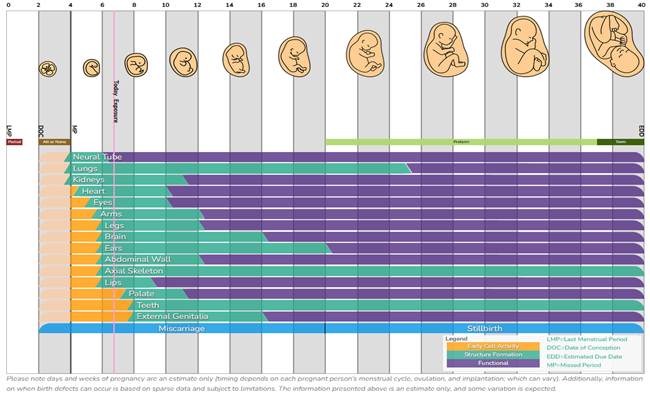
New Critical Periods of Pregnancy Interactive Tool

For Kendra, being able to understand which specific body parts were forming when she took the Zofran and whether she actually needed to be concerned helped decrease her anxiety significantly. Knowing that the heart was currently forming, she decided to reach out to her healthcare provider to discuss alternative treatment options for her nausea.  I was happy to have helped answer Kendra’s question using this visual tool and look forward to being able to use it again in the future when pregnant women have questions about the timing of their exposure.

Remember that our team is always available to help review any exposures you have had and provide a personalized risk assessment. Don’t hesitate to contact MotherToBaby by phone, chat, text, or email!

MotherToBaby Interactive Critical Periods of Pregnancy Tool

As it turns out, I’m not crazy nor am I a hypochondriac! After decades – and I mean more than 30 years – of bouts of severe constipation and diarrhea, fatigue, joint pain, migraines, skin rashes and infertility, I finally received the news that I have celiac disease. Oddly enough, it was only after adopting a sickly cocker spaniel named “Peanut” from the Humane Society that the mystery of my symptoms was solved. When our vet suggested that Peanut eat gluten-free food, I bought her some gluten-free pretzels as a treat. After eating some myself, I noticed fewer tummy issues; that feeling of the “kink” in my intestine and the bloating pain didn’t happen!

I contacted my physician, whose first response was, “You don’t have celiac disease, you would have already known it by this time.” She tested me anyway and, when the blood test for transglutaminase antibodies (tTG-IgA) was positive, she sent me to a gastroenterologist for an endoscopy (a scope of the intestines), which also indicated celiac disease. It had taken countless trips to countless physicians, but at the age of 55, my health took a turn for the better after starting a diet without gluten.

In my case, it was unfortunate that the diagnosis took so long because for years I struggled to have children. I feel lucky to have gotten pregnant five times and was able to carry two pregnancies to term. My boys are now wonderful adult men and I feel blessed to have them in my life! I’ll never know if my undiagnosed celiac disease contributed to my pregnancy losses or my harder time in getting pregnant, but as an information specialist with the MotherToBaby Utah program and over 20 years’ experience talking to mothers and health care providers, here’s what I do know from reviewing the published information about celiac disease…

What is Celiac Disease?

Celiac disease is inherited, meaning it runs in families. When people with this auto-immune disease have contact with gluten, it causes inflammation or swelling and can damage the small intestine. Over time, the damage to the intestine causes serious health concerns, including an increased risk of colon cancer and lymphomas (cancer of the lymphatic system, such as Hodgkin’s). It is estimated that 1 in 100 people worldwide have celiac disease. Many are never diagnosed.

With celiac disease, food that is eaten is quickly released from the body with little time for nutrients to be absorbed by the body. That’s because the finger-like tubes in the small intestine, called villi, are flattened from the swelling.

Celiac Disease and Pregnancy

For women who want to get pregnant or who are pregnant with celiac disease, it can be a nutritional nightmare and may lead to anemia (low iron) and other vitamin deficiencies, lactose intolerance (unable to eat dairy), and osteoporosis (weak and brittle bones). It is rare that people have only one autoimmune problem and, for many people with celiac, thyroid disorders and diabetes go hand-in-hand. A recently published study looking at 24 articles on ‘reproductive’ issues found women with celiac disease have a harder time getting pregnant, as well as a higher risk for miscarriage, prematurity, babies born small for their age and with low birth weight. With other autoimmune disorders, such as rheumatoid arthritis, multiple sclerosis, and Lupus, we see the same types of negative pregnancy outcomes. More studies are needed to confirm if celiac disease increases any risks.

Hope

The good news is that studies also show that when moms stay on their gluten free diets, the problems almost always go away! So, to my ‘Celiac Sisters’ there is hope! Here are a few suggestions to have a healthy pregnancy:

  • Avoid gluten, of course! Not only is gluten in foods, but gluten hides in make-up (be extra careful with lipsticks), hair products, soap and even in sheetrock. Never lick an envelope or a stamp, because there is gluten in glues!
  • Take your Multivitamin Before, During and after Pregnancy. A multivitamin will help balance nutritional deficiencies from celiac disease. Make sure your vitamin has at least 400mcg of folic acid.
  • Control the Other Maladies that Come with Celiac Disease. Rarely will someone just have celiac disease. If you have thyroid problems, diabetes or hypertension, it is important to stay on your medications and control these issues before you try to have a baby.

Ultimately, if you control the symptoms from celiac disease, you can be healthy during your pregnancy. It takes some work to avoid gluten, but I promise you will feel better! In retrospect, the veterinarian really saved two lives that day…Peanut is also doing great on a gluten-free diet!

Julia Robertson, CPM, is the program manager for MotherToBaby’s Utah affiliate, a program with the Utah Department of Health and University of Utah that aims to educate women about medications and more during pregnancy and breastfeeding. Along with answering questions from women and health providers regarding exposures during pregnancy/breastfeeding via MotherToBaby’s toll-free hotline (866-626-6847) and email counseling service, Julia has authored several peer-reviewed publications focusing on maternal medication consumption and the effect on the developing fetus.

MotherToBaby is a service of the international non-profit Organization of Teratology Information Specialists (OTIS), a suggested resource by many agencies, including the Centers for Disease Control and Prevention (CDC) and the Food and Drug Administration’s (FDA) Office of Women’s Health. If you have questions about medications, diseases, vaccines or other exposures, call MotherToBaby toll-FREE at 866-626-6847 or visit www.MotherToBaby.org to browse a library of fact sheets and to find your nearest affiliate.

References:

  1. Mahadoy S, Green P. Celiac Disease: A Challenge for All Physicians Gastroenterol Hepatol (N Y). 2011 Aug; 7(8): 554–556
  2. Tersigni C, Castellani R, de Waure C et al. Celiac disease and reproductive disorders: Meta-analysis of epidemiologic associations and potential pathogenic mechanisms. Human Reproduction Update. 2014 Vol.20, No.4; 582–593.

MotherToBaby Interactive Critical Periods of Pregnancy Tool

By Sonia Alvarado, Senior Teratogen Information Specialist, MotherToBaby CA

Unless you don’t own a television and never listen to the radio, you know that marijuana has been in the news a lot lately and for marijuana users who have had to smoke in illegally, it appears societal attitudes about pot smoking may be changing. Twenty states have laws legalizing some form of marijuana use. Two states, Colorado and Washington, have legalized its recreational use. In an interview, the NFL Commissioner seemed to leave open the possibility that medicinal use could be considered for NFL players if there was scientific evidence that it was helpful to treat injuries and pain. Even President Obama has said that he doesn’t believe marijuana is any more dangerous than alcohol. Marijuana is currently listed as a Schedule I drug. Other Schedule I drugs include heroin, lysergic acid diethylamide (LSD), 3,4-methylenedioxymethamphetamine (ecstasy).

What The Research Shows Us

According to studies, pregnant women who use illicit substances are more likely to use marijuana compared to other drugs. This is often due to the belief that marijuana is less harmful to the developing embryo and fetus, compared to other drugs such as cocaine or heroin.

Marijuana is Cannabis. The delta-9-tetrahydrocannabinol (THC) in the Cannabis plant produces the psychoactive effect or “high.” Marijuana can be smoked in a joint, inhaled through a bong or vaporizer, eaten in food and teas/beverages, used in tinctures, and topical balms. Smoking and ingestion exposes the user to THC, producing the high. When smoked in a joint, the user is exposed to carbon monoxide from the burning of the leaf as well as tar, which can stay behind in the lungs.

Marijuana use during pregnancy has been studied since the 1960’s. Like all studies, there are weaknesses that have been pointed out. For example, asking women about past drug use may not be the most accurate way to make a connection between the dose of the drug and the adverse effects because the women may have forgotten. Also asking women to volunteer information about drug use, which they may fear disclosing even in a confidential setting, may make it difficult to know how frequently pregnant women use drugs overall. Still, a number of experts have reviewed hundreds of reports in humans and animals. At least to this point, the studies do not support an association between marijuana smoking and birth defects. One large study of 12,825 interviews done after delivery, did not find a statistical association between marijuana use and birth defects.

However, the studies also show that marijuana is not risk free. Studies have reported associations between marijuana smoking and growth restriction and lower birth weight, particularly in women who keep smoking through delivery or late in pregnancy. An Australian study of almost 420,000 live births reported a higher risk for neonatal intensive care admission for newborns exposed prenatally to pot. Also, there are reports of abnormal responses or behaviors in the newborn period and this suggests a toxicity or withdrawal. The symptoms include exaggerated and prolonged startle reflexes (sleep cycle disturbances with high-pitched crying.) In a Brazilian study, exposed newborns were “more irritable and less responsive to calming, cried more during the examination, and exhibited more jitteriness and startles than the non-exposed neonates.” Pregnant women who smoke daily and/or through delivery, have a higher risk for complications in their pregnancy compared to women who quit in the first trimester.

Researchers have attempted to assess the long-term effects of prenatal marijuana exposure. Studies of 3, 10 and 14-year old prenatally exposed children suggest that the prenatal exposure to high doses of marijuana may make it harder for children to learn and may affect their emotions (increased aggression) and increase depression symptoms. Studies are needed to assess which prenatally exposed children are most at risk. Its important to note that the children in these studies often have had prenatal exposure to other drugs as well, struggles with poverty and other life challenges, making it difficult to know that the findings are due to a single drug exposure.

So Where Does Marijuana Rank Compared To Other Drugs?

Alcohol: Specific to use during pregnancy, marijuana is not alcohol. Alcohol is still the drug with the highest risk and the widest range of birth defects, including physical, mental and behavioral. Alcohol is a drug with the highest use throughout the world, easy legal access, and social acceptance.

Cocaine: Cocaine, by comparison, is associated with a small risk for birth defects, and a higher risk for admission to newborn intensive care for withdrawal and toxicity. Additionally, cocaine is associated with prenatal growth retardation, lower birth weight, shorter length, and smaller head circumference. Studies suggest the effects on height extend into childhood.

Heroin: Heroin has not been associated with an increased risk for birth defects, however, is associated with a higher risk for withdrawal and admission to newborn intensive care and sudden infant death syndrome.

Bottomline: Snuff Out Smoking It

Clearly, marijuana use in pregnancy is not preferable, nor less risky, compared to most other drugs when a side-by-side comparison is made. Changing societal attitudes doesn’t change the fact that the developing embryo (and fetus) is dependent on the mother for oxygen, nutrients and a balance of hormones, chemicals and other substances to grow normally. Disrupting the normal fetal environment, through the introduction of marijuana or other recreational drugs, puts the pregnancy at risk in the short-term and possibly the long term as well.

Sonia

Sonia Alvarado is a bilingual (Spanish/English) Senior Teratogen Information Specialist with MotherToBaby California, a non-profit that aims to educate women about medications and more during pregnancy and breastfeeding. Along with answering women’s and health professionals’ questions regarding exposures during pregnancy/breastfeeding via MotherToBaby’s toll-free hotline, email and private chat counseling service, she’s provided educational talks regarding pregnancy health in community clinics and high schools over the past decade.

MotherToBaby is a service of the international Organization of Teratology Information Specialists (OTIS), a suggested resource by many agencies including the Centers for Disease Control and Prevention (CDC). If you have questions about beauty products, medications or other exposures, call MotherToBaby toll-FREE at 866-626-6847 or visit MotherToBaby.org to browse a library of fact sheets and find your nearest affiliate.


MotherToBaby Interactive Critical Periods of Pregnancy Tool

At MotherToBaby we receive all kinds of questions about exposures during pregnancy. Most often, we teratogen information specialists get similar questions no matter what state or part of the country we work in. Commonly asked questions cover topics like medications, supplements, and alcohol. We also get questions about less common exposures too, such as someone taking their pet’s medication or a chemical spill in the workplace. Working in Arizona, we sometimes get questions that specialists in other parts of the country do not get- such as what happens if a woman is bitten by a rattlesnake during pregnancy.

Get Medical Care Right Away

Anyone who is bitten by a rattlesnake should seek medical care immediately—even if they do not notice symptoms at first. This is especially important during pregnancy.

Symptoms can include:

  • Pain and swelling at the bite site
  • Nausea
  • Swelling of the mouth or throat
  • Trouble breathing
  • Bleeding or blood clotting problems

People should not try to treat a snake bite themselves. Quick and appropriate medical care can lower the risk of serious complications.

Complications

Blood clots are one serious complication that is possible from a rattlesnake bite. Although anyone can develop a blood clot, pregnancy increases the risk by about five times.  Clots can reduce blood flow to the fetus or travel to the lungs (pulmonary embolism), which can be life-threatening. Complications related to blood clots include miscarriage, stillbirth, reduced fetal growth, thrombosis (clots blocking veins or arteries), placental insufficiency (reduced oxygen and nutrients reaching the fetus), changes in blood pressure, preterm delivery (before week 37), heart attack, stroke, and death.

It is important to remember that birth defects and miscarriage can happen in any pregnancy for many reasons. About 3 out of 100 babies (3%) are born with a birth defect each year, and miscarriage is common. Information on snake bites during pregnancy is limited. Case reports describe hydrocephalus (fluid buildup in the brain), intracranial hemorrhage (bleeding in the skull), reduced fetal movement, placental abruption, miscarriage, stillbirth, and maternal death. While case reports cannot prove that venom caused these outcomes, they show that snake bites can be serious and require prompt treatment. Outcomes may depend on the amount of venom, the stage of pregnancy, how quickly treatment begins, and the type and quality of care received.

Treatment During Pregnancy

Treatment for rattlesnake bites may include:

  • Antivenom (medicine made of antibodies that helps neutralize venom)
  • Blood tests to monitor clotting
  • Monitoring fetal movement and/or fetal heart rate

There are reports of healthy babies being born after treatment with antivenom. Although information is limited, experts believe that treating a rattlesnake bite with antivenom is safer than leaving the bite untreated during pregnancy. In the small number of babies followed after exposure to antivenom during pregnancy, no long-term health problems have been reported.

Final Thoughts

A rattlesnake bite during pregnancy is a medical emergency. Immediate treatment and careful monitoring are likely to be recommended to protect both the mother and fetus. While there are still gaps in what we know, prompt medical care offers the best chance for a healthy outcome.

More information on rattlesnake bites can be found at the Arizona Poison and Drug Information Center website here.

Originally published 12/20/22. Updated 2/17/26.


MotherToBaby Interactive Critical Periods of Pregnancy Tool

It’s that time of year again, when the holidays invite family gatherings, and colder, shorter days make us long for sunny destinations. Yes, the winter travel season is upon us! Remember winters past when COVID-19 wasn’t around and we’d never heard of Zika? When we didn’t give much thought to health concerns related to hopping on a plane or going to busy holiday venues? Things are different now. If you’re pregnant, you might pause before booking airline tickets or RSVPing “yes” to that extended family reunion. Take a moment to consider the possible risks associated with your plans, and how you might reduce them (by taking precautions) or eliminate them (by making alternate plans instead). Here are a few things to think about:

COVID-19:

Try as we might, we can’t escape it or wish it away. We are, in fact, still in the middle of a pandemic, with new variants appearing and cases still rising and falling unpredictably in most places. Traveling on public transportation (such as airplanes, ships, trains, subways, taxis, and ride shares) can make getting and spreading COVID-19 more likely. So can being in crowded indoor spaces, especially if not everyone in those spaces is fully vaccinated against COVID-19 and/or wearing a mask. Having COVID-19 in pregnancy can increase pregnancy risks such as stillbirth and preterm delivery. So, how can you eliminate or reduce your chance of exposure to the virus?

  • Avoid public transportation. If you must travel, using your own vehicle with members of your own household is the safest bet. Using drive-thrus or packing your own food to stop and eat along the way is safer than eating in crowded restaurants full of other holiday travelers.
  • If you must travel on a plane or use other public transportation, wear a well-fitting mask the whole time (this is required), stay at least 6 feet away from other travelers when possible, and wash your hands/use an alcohol-based hand sanitizer frequently. Most importantly, make sure you’re fully vaccinated before you travel, including getting a booster dose when you’re eligible.
  • Did I mention making sure you’re FULLY VACCINATED before travel? It’s the single best way to reduce the chance of getting very sick if you’re exposed to the virus that causes COVID-19. Pregnancy and being very sick don’t go well together, so this one is really, really important, whether you’re traveling or not. MotherToBaby has helpful resources on the COVID-19 vaccines and booster shot, and you can contact us to talk through any questions or concerns you may have about getting the vaccine.
  • Even if you’re fully vaccinated, you might still consider wearing a mask indoors during holiday gatherings (and elsewhere), especially if you’re getting together with people from different households coming from different places. If everyone else at the gathering also wears a mask indoors, even better.  
  • Find more tips and information about safer holiday celebrations and travel in the time of COVID at this link: https://www.cdc.gov/coronavirus/2019-ncov/daily-life-coping/holidays/celebrations.html.

Influenza (the Flu):

Flu season carries its own risks for people who are pregnant. Like COVID-19, having the flu during pregnancy increases the chance of being very sick compared to people who aren’t pregnant. Many of the same precautions that apply to COVID-19 apply to the flu as well:

  • Get the flu shot. Like the COVID-19 vaccine, the flu shot can be given at any time during pregnancy, and can even be given at the same time as a COVID vaccine or booster. The sooner you’re vaccinated, the sooner you and your pregnancy will have good protection against becoming very sick from the flu. And (bonus!) getting vaccinated in pregnancy may pass some protective antibodies to your developing baby.
  • Avoiding public transportation and crowded indoor spaces will also reduce your chance of exposure to the flu virus. Washing your hands frequently/using an alcohol-based hand sanitizer is also an excellent flu prevention technique.

Zika:

Yes, Zika is still around. There are no known “outbreaks” of Zika anywhere in the world at this time, but there is ongoing, low-level, sporadic transmission in some places. Having Zika during pregnancy increases the chance of serious and lifelong effects for a developing baby. There is no vaccine against the Zika virus.

  • The safest course in pregnancy (or if you’re trying to conceive) is to avoid travel to places with a chance of exposure. Unfortunately, it’s virtually impossible now to know the exact risk of being exposed to Zika in any given country, but if you must travel, you can use the CDC’s Zika map to help you plan.
  • If you travel,use insect repellent and take other precautions to help avoid mosquito bites, such as wearing long sleeves and pants. If your partner travels with you, take steps to avoid sexual transmission of Zika. If you’re planning a pregnancy, follow the recommended wait times (2 months for women, 3 months for men) before trying to conceive.

Other infections:

If you’re considering international travel, there may be other infections to consider, such as malaria and foodborne illnesses. You might also need other vaccines, so be sure to review the current vaccine recommendations for your destination. Some vaccines can be given during pregnancy, but it’s a good idea to check with your healthcare provider or contact MotherToBaby to discuss the risks and benefits of specific vaccines as you’re deciding about travel. 

Medical concerns:

Other travel considerations include the increased chance of blood clots during travel if you’re pregnant, and where you will receive medical care in case of unexpected preterm labor or another medical emergency. Before any travel, be sure to talk with your healthcare provider about any additional considerations that are specific to you and your pregnancy.

Given all these considerations, if you’re pregnant you might decide this year is a good one to enjoy low-key holidays at home and save the travel for another time. However you decide to spend the season, we hope it’s safe, healthy, and happy!