FASD In The Spotlight: MotherToBaby Experts Featured On CTV

TORONTO, CANADA – Ahead of the Fetal Alcohol Canadian Expertise (FACE) Research Network’s 15th anniversary, as well as the international MotherToBaby/Organization of Teratology Information Specialists (OTIS) joint conference with the European Network of Teratology Services (ENTIS), MotherToBaby experts landed a primetime opportunity on CTV, Canada’s largest privately-owned television network, to raise awareness of Fetal Alcohol Spectrum Disorders (FASD).

In the following video, reporter Pauline Chan tells the story of Savannah Pietrantonio, 47, who struggles daily with her symptoms of FASD. Dr. Kenneth Lyons Jones, MotherToBaby/OTIS president, as well as Dr. Gideon Koren, director of MotherToBaby’s Canadian affiliate Motherisk, explain why it’s often underdiagnosed:

Click here for video

If you have questions about alcohol during pregnancy or breastfeeding call MotherToBaby toll-FREE at 866-626-6847. You can also read our Alcohol and Pregnancy Fact Sheet here

MotherToBaby is recommended by many agencies including the Centers for Disease Control and Prevention (CDC).


FASD In The Spotlight: MotherToBaby Experts Featured On CTV

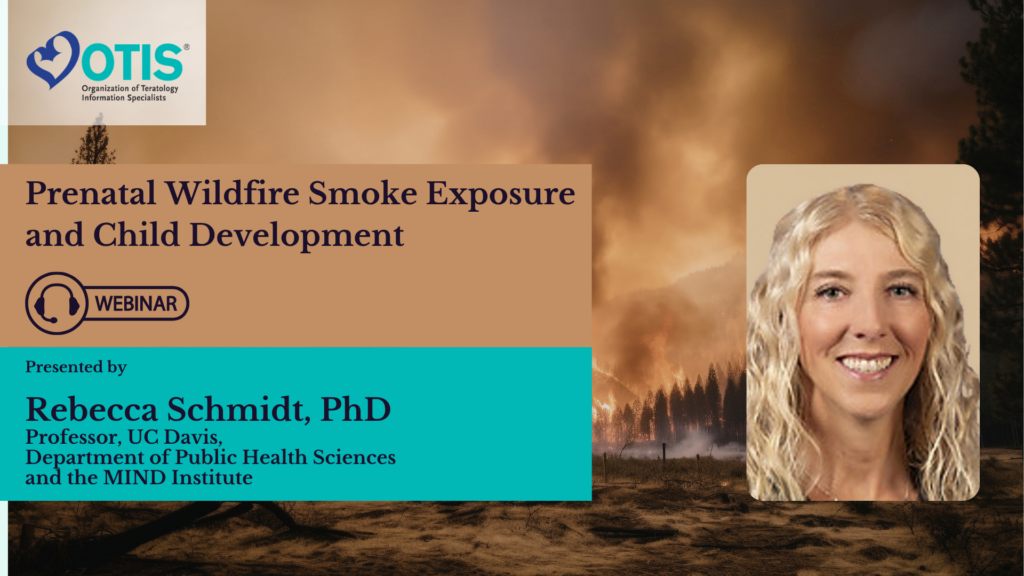
As wildfires continue to occur each year, often sending smoke and ash across long distances, vulnerable populations including pregnant women have a higher chance of experiencing adverse health effects. Understanding the possible effects of prenatal wildfire smoke exposure on child neurodevelopment is critical to efforts around prevention and early intervention.      

This webinar will outline the possible exposures associated with wildfire smoke, review current data from ongoing studies around child neurodevelopment following prenatal wildfire smoke exposure, and discuss ways to reduce and potentially mitigate these risks during pregnancy.

Rebecca Schmidt, PhD, is a tenured full professor at UC Davis and a molecular epidemiologist with over 20 years of research experience in epidemiology, gene-environment interactions, epigenetics, maternal and child health, and a primary emphasis on neurodevelopment and autism. Her pioneering research focuses on how prenatal environmental and nutritional exposures interact with genomics, molecular mechanisms, and developmental programming to influence the neurodevelopmental outcomes of children. She leads a large biorepository and several child development cohort studies, including the MARBLES autism pregnancy cohort, the B-SAFE wildfire pregnancy cohort, and the PEACH cohort site for the national Environmental Influences on Child Health Outcomes (ECHO) Program.


FASD In The Spotlight: MotherToBaby Experts Featured On CTV

Having measles during pregnancy can increase the chance of serious problems for mom and baby – but can pregnant women receive the measles vaccine? The Measles Protection Decision Tree is an easy-to-use resource designed to help individuals determine if they are protected against measles and understand what steps to take if they need to get an MMR (measles, mumps, and rubella) vaccine. The decision tree provides specific guidance for women who are planning pregnancy, pregnant, postpartum, or breastfeeding. It walks users through checking their vaccine records, reviewing the number of MMR vaccine doses they need, and understanding when to get vaccinated if needed. This resource is provided by MotherToBaby in collaboration with the Society for Maternal-Fetal Medicine.

If you have further questions about measles or the MMR vaccine, contact a MotherToBaby specialist.


FASD In The Spotlight: MotherToBaby Experts Featured On CTV

In this session, Christina Chambers, PhD, MPH, a perinatal epidemiologist from UC San Diego and Principal Investigator of MotherToBaby Pregnancy Studies, reviews what is known and what still requires further study on the use of alcohol, cannabis and other substances by breastfeeding women, and how this translates to clinical practice. Participants should leave this session with a better understanding of the potential effects of substance use on infant growth and development, how knowledge gaps in this area are being addressed, and how to translate current knowledge into clinical situations in midwife practice.

Participants will gain a clearer understanding of the potential short- and long-term impacts of maternal substance use on infants and learn how ongoing research is addressing current knowledge gaps. The session will also focus on translating this evidence into practical clinical guidance, including strategies for counseling breastfeeding women, supporting informed decision-making, and integrating risk assessment into midwifery care.

This webinar is designed to enhance the knowledge and clinical skills of midwives and other healthcare providers involved in maternal-child health.

Continuing Education (CE) credits are available for ACNM members and non-members who view this session via the ACNM Online Learning Center.


FASD In The Spotlight: MotherToBaby Experts Featured On CTV

“Sometimes I forget I am adopted,” exclaims my amazing son as he grabs his backpack to head off to college. I had just let him know that his birthday this year falls on National Adoption Day. “So cool! We will need to do something special this year on my birthday, to celebrate both my birthday and my adoption! See ya, mom!” To Shaun, adoption is as easy as one, two, three, and just a part of everyday life. As anyone who’s been through adoption knows, this is simply not the case much of the time. While adoption helped us complete our family, the process can be exciting, thrilling and scary all at the same time! When another woman is carrying the baby that will become your child, you worry. Was she drinking alcohol? Taking a pain killer? What if she was using illegal drugs?! It can literally lead to countless anxious days and sleepless nights. I understand these concerns as I shared the same worries.

National Adoption Day, started in the United States in 1999, is celebrated each year on the Saturday before Thanksgiving. This year it happens to fall on Shaun’s birthday and reminds me of when we adopted him, many years ago. That time in my life was so powerful, but it was easier for me than it is for others as I was part of MotherToBaby and already knew where to find the answers to my pregnancy exposure questions.

My adoption journey has helped shape who I am today – a genetic counselor and a teratogen information expert who specializes in understanding exposures that can cause birth defects. The non-profit I work for provides this crucial service all across North America and I’m proud that my journey has brought me into a position to ease the minds of other prospective parents starting down the wonderful path of adoption. It reminds me of Austin and Drew, a prospective adoptive couple whom I helped in their adoption journey, “My partner and I did a lot of research as we started exploring adoption. After we started working with an agency, there were lots of questions about prenatal exposures, birth parent medical histories, etc. A lot of the information we found on these topics seemed to be contradictory and some of it was downright scary.”  My job allows me to be on the other end of the line talking to this couple, and others like them, helping fill out intake forms and providing evidence-based answers to some of their questions. “Luckily for us, our adoption agency suggested we reach out to Lori. After our conversation we felt much more at ease, and we felt like we had the information we needed to make informed decisions.”

My own journey has come full circle, utilizing my training to help those going through what I went through years ago. MotherToBaby specialists are here to help you too! As Rory Hall, Executive Director of Adoption Advocates, states, “couples approach the adoption process with so many myths about prenatal exposures and health concerns that might affect a baby. MotherToBaby experts help them approach adoption with relevant, scientific backed information so they can make informed decisions about the children they are hoping to adopt.”

Just before Shaun shuts the door to drive to school, he pauses. Sometimes wise beyond his years, he turns and says, “Mom, adoption is so wonderful because your birth parents gave you up so you could have a better life. Love you!” And just like that, the anxiety, and struggle during the adoption process go back to their place of being a very distant memory. #WorthIt.

More about National Adoption Day

National Adoption Day has been celebrated across the United States since 1999, helping to raise the awareness of the more than 100,000 children who are in foster care each year in the U.S. waiting for permanent families. For more information, see www.nationaladoptionday.org. And when you are going through your adoption journey, and have questions about exposures during pregnancy, contact an expert at MotherToBaby. You can reach us by phone at 866-626-6847 or by text at 855-999-3525.

Originally published 11/3/16, Updated 8/31/2025