Metoprolol

This sheet is about exposure to metoprolol in pregnancy and while breastfeeding. This information is based on published research studies. It should not take the place of medical care and advice from your healthcare provider. 

What is metoprolol? 

Metoprolol is a medication that has been used to treat high blood pressure, fast heart rate, and migraines. It is part of a class of medications known as beta-blockers. Some brand names for metoprolol are Lopressor®, Toprol®, Apo-Metoprolol®, Betaloc®, Novo-Metoprolol®, and Minimax® 

Sometimes when women find out they are pregnant, they think about changing how they take their medication, or stopping their medication all together. However, it is important to talk with your healthcare providers before making any changes to how you take your medication. Having high blood pressure can increase the chance for preterm delivery and low birth weight. In addition, high blood pressure in pregnancy can increase the chance of developing pre-eclampsia (high blood pressure and problems with organs, such as the kidneys) that can lead to seizures (called eclampsia). Your healthcare providers can talk with you about the benefits of treating your condition and the risks of untreated illness during pregnancy. 

I take metoprolol. Can it make it harder for me to get pregnant? 

It is not known if taking metoprolol can make it harder to get pregnant.  

Does taking metoprolol increase the chance of miscarriage? 

Miscarriage is common and can occur in any pregnancy for many different reasons. Studies have not been done to see if metoprolol can increase the chance of miscarriage. 

Does taking metoprolol increase the chance of birth defects?  

Birth defects can happen in any pregnancy for different reasons. Out of all babies born each year, about 3 out of 100 (3%) will have a birth defect. We look at research studies to try to understand if an exposure, like metoprolol, might increase the chance of birth defects in a pregnancy. 

It is not known if metoprolol increases the chance of birth defects. Animal studies have not reported an increased chance of birth defects. A large study in humans found that beta-blockers in general did not increase the chance of heart defects.  

Does taking metoprolol in pregnancy increase the chance of other pregnancy-related problems? 

Metoprolol has been associated with intrauterine growth restriction (less growth of the fetus than expected). It is hard to know if a medication, the medical condition being treated, or other factors (such as age, health, other exposures) could be the cause of the growth restriction.  

Metoprolol use in late pregnancy might cause the baby to have symptoms such as slowed heart rate and low blood sugar. Talk with your healthcare providers about your use of metoprolol so that if symptoms occur your baby can get the care that is best for them. 

Does taking metoprolol in pregnancy affect future behavior or learning for the child? 

Studies have not been done to see if metoprolol can increase the chance of behavior or learning issues for the child. 

Breastfeeding while taking metoprolol: 

Metoprolol passes into breast milk in small amounts. Studies on the use of metoprolol during breastfeeding have not reported side effects in breastfed infants. If you suspect the baby has any symptoms (such as slow heart rate, being too sleepy, having trouble with feeding, or pale skin), contact the child’s healthcare provider. Be sure to talk to your healthcare provider about all your breastfeeding questions. 

If a man takes metoprolol, could it affect his fertility or increase the chance of birth defects? 

It is not known if metoprolol could affect male fertility (ability to make healthy sperm) or increase the chance of birth defects. In general, exposures that fathers or sperm donors have are unlikely to increase risks to a pregnancy. For more information, please see the MotherToBaby fact sheet on Paternal Exposures and Pregnancy at https://mothertobaby.org/fact-sheets/paternal-exposures-pregnancy/. 

Please click here for references.  


Metoprolol

This sheet is about exposure to magnetic resonance imaging (MRI) in pregnancy and while breastfeeding. This information is based on available published literature. It should not take the place of medical care and advice from your healthcare provider.

What is magnetic resonance imaging (MRI)?

Magnetic resonance imaging, known as MRI, is a medical procedure that has been used to create pictures of the inside of the body to diagnose some diseases or conditions. An MRI can also create images of a pregnancy and give healthcare providers a view of the placenta (the organ that grows in the uterus during pregnancy), and organs in the fetus, like the brain, lungs, and abdomen (belly).

MRI does not use ionizing radiation like an x-ray or computer-assisted tomography (CT) scan. Instead, MRI uses a magnetic field and radio waves. A typical MRI scan lasts from 20 to 90 minutes. MRIs are painless and are not expected to cause any tissue damage.

Can having an MRI make it harder for me to get pregnant?

It is not known if MRIs can make it harder to get pregnant.

I am pregnant. What if I need an MRI?

If you are pregnant or think that you could be pregnant, tell your healthcare provider and the radiologist or MRI technologist before having an MRI done. The American College of Obstetricians and Gynecologists (ACOG) and the American College of Radiology (ACR) have stated that women who are pregnant can have an MRI done during any trimester of a pregnancy.

Does having an MRI increase the chance of miscarriage?

Miscarriage is common and can occur in any pregnancy for many different reasons. Studies have not been done to see if having an MRI could increase the chance of miscarriage.

Does having an MRI increase the chance of birth defects?

Every pregnancy starts out with a 3-5% chance of having a birth defect. This is called the background risk. One study that looked at more than 1,700 pregnancies exposed to MRI during the first trimester did not find an increased chance of birth defects.

The MRI machine makes loud sounds. There has been interest in knowing if the MRI could affect fetal hearing. Several small studies have not reported hearing damage with exposure to MRI during pregnancy.

Would having/getting an MRI increase the chance of other pregnancy-related problems?

Some studies have reported that having an MRI in pregnancy is not expected to affect the growth (size) of a fetus. MRI has not been well-studied to see if it can increase the chance for other pregnancy-related problems, such as preterm delivery (birth before week 37).

Does an MRI in pregnancy affect the future behavior or learning for the child?

Studies have not been done to see if an MRI during pregnancy can increase the chance of behavior or learning issues for the child.

Breastfeeding and MRIs:

Because the MRI only uses magnetic fields and radio waves to get images, there are no concerns about having this procedure done while breastfeeding. Breastfeeding can resume after the MRI.

If a man has an MRI, could it affect fertility or increase the chance of birth defects? 

Studies have not been done to see if an MRI could affect a man’s fertility (ability to get a woman pregnant) or increase the chance of birth defects. In general, exposures that men have are unlikely to increase risks to a pregnancy. For more information, please see the MotherToBaby fact sheet Paternal Exposures at https://mothertobaby.org/fact-sheets/paternal-exposures-pregnancy/.

Please click here for references


Metoprolol

What is a MotherToBaby Pregnancy Study? Who is MotherToBaby?

A MotherToBaby Pregnancy Study is a research study that collects information from a woman during her pregnancy along with information about her baby’s health after the pregnancy is over. MotherToBaby Pregnancy Studies are conducted by the non-profit Organization of Teratology Information Specialists (OTIS) and are coordinated by the University of California, San Diego.

Will I be asked to take any additional medications? Or to stop taking a medication?

No. Our studies are strictly observational, which means we will never ask you to take any new medicines, experimental drugs or to change any part of your healthcare routine. If you enroll, you’ll simply be followed by our team through the remainder of your pregnancy, and your baby will be followed for a period of time after birth.

Why are pregnancy studies important?

Pregnant women are typically excluded from clinical trials that occur when a drug is being developed. This means that once a medication is approved by the US Food & Drug Administration (FDA), it starts being prescribed to patients with little to no information on the safety of the drug if used during pregnancy. Yet 9 out of 10 pregnant women in the U.S. take medication. Our studies provide critical information on the safety of medication use by observing pregnant women and their babies. Our findings are used by healthcare providers and may be listed on drug labels that come with prescription medications.

How does a MotherToBaby Pregnancy Study work?

After you let us know that you are interested, the first thing that will happen is that we will contact you to get some information and to see if you are eligible to participate. The 3 groups of women we’re looking for are:


Steps of Participation

If you’re eligible to join one of these groups, we’ll tell you exactly what is involved in the study so you can decide if you want to participate. All of our studies include:


Schedule a time to participate

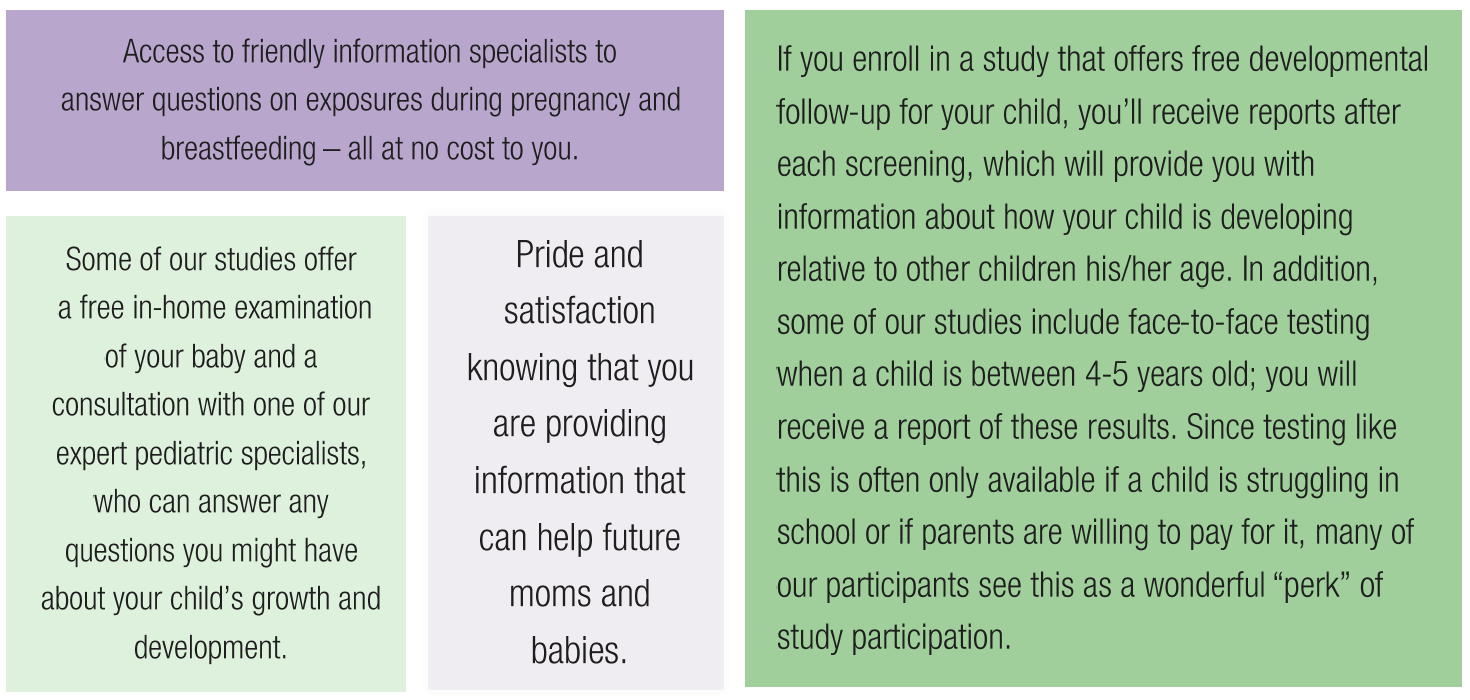
Depending on the study you join, you may also be eligible for a free in-home examination of your baby by one of our pediatric specialists and/or free neurodevelopmental follow-up until your child is 5 years old.

Visit our website (https://mothertobaby.org/studies/) for a list of our ongoing studies and to watch a video of a past participant describing her experience being in a MotherToBaby study.

Will the information I share with MotherToBaby be kept private?

All the information we request will be kept confidential. Your privacy is important to us. We comply with strict regulations and laws set forth by state and federal agencies as well as the Institutional Review Board (IRB) at the University of California, San Diego, who oversees and monitors our research. Since we ask for your permission to obtain medical records, we will also give you detailed information on how this data will be used and how we will protect your privacy.

What types of questions will you ask me?

We’ll ask you questions about your health history, your pregnancy and the birth of your child. You’ll be asked about exposures to medications, illnesses, pregnancy related tests, previous pregnancies, medical condition symptom control (if participating in group 1 or 2), and questions about demographics. After your baby is born, we may also ask you questions about your breastfeeding practices (should you choose to nurse your baby) as well as questions about your child’s development.

What are the benefits of participating?

Benefits

Will I find out the results of the study?

Yes! We send all participants and their health care providers the results of the study. This information might prove useful to you in a future pregnancy, or be used by your provider when treating other patients.

What if I agree to participate and later change my mind?

Because your participation is voluntary, you can withdraw from the study at any time.

I have more questions. Who can I contact?

Contact MotherToBaby Pregnancy Studies by:


Metoprolol

This sheet is about exposure to the varicella vaccine in pregnancy and while breastfeeding. This information is based on published research studies. It should not take the place of medical care and advice from your healthcare provider.

What is varicella (chickenpox)?

Varicella, commonly called chickenpox, is a viral infection that usually happens in childhood, but can happen anytime in life. Chickenpox is very contagious, meaning it can spread easily from person to person. The best way to prevent getting the chickenpox infection is by getting the vaccine. For more information on chickenpox, see the MotherToBaby fact sheet at: https://mothertobaby.org/fact-sheets/varicella/.

What is the varicella (chickenpox) vaccine?

The varicella vaccine is an injection (shot) that contains varicella virus that is live but weakened (also called a live-attenuated vaccine). It is given in two doses. The varicella vaccine causes your body to make antibodies to the virus that will protect you from getting sick from the virus in the future.

Can the varicella vaccine make it harder for me to get pregnant?

It is not known if the varicella vaccine can make it harder to get pregnant.

I just got the varicella vaccine. How long should I wait before trying to get pregnant?

The American Academy of Pediatrics and the Advisory Committee on Immunization Practices of the Centers for Disease Control and Prevention (CDC) recommends that the varicella vaccine series is completed at least one month or more before pregnancy. There are reports of becoming pregnant one month or sooner after getting the varicella vaccine and healthy babies being born.

I am pregnant. Can I get the varicella vaccine?

The American Academy of Pediatrics and the Advisory Committee on Immunization Practices of the CDC do not recommend getting live virus vaccines during pregnancy due to theoretical (not proven) concerns.

Does getting the varicella vaccine increase the chance of miscarriage? 

Miscarriage is common and can occur in any pregnancy for many different reasons. It is not known if getting the varicella vaccine can increase the chance of miscarriage.

Does getting the varicella vaccine increase the chance of birth defects?

Birth defects can happen in any pregnancy for different reasons. Out of all babies born each year, about 3 out of 100 (3%) will have a birth defect.  We look at research studies to try to understand if an exposure, like getting the varicella vaccine, might increase the chance of birth defects in pregnancy. The vaccine manufacturer collected information about pregnancy outcomes for 966 women who received the vaccine. No increased chance of birth defects was reported. Other studies have not shown an increased chance of birth defects.

Does getting the varicella vaccine in pregnancy increase the chance of other pregnancy-related problems?

It is not known if the varicella vaccine can increase the chance of other pregnancy-related problems, such as preterm delivery (birth before week 37) or low birth weight (weighing less than 5 pounds, 8 ounces [2500 grams] at birth). No complications of pregnancy have been reported in studies of people who were pregnant who have received the varicella vaccine.

Does getting the varicella vaccine in pregnancy affect future behavior or learning for the child? 

Studies have not been done to see if the varicella vaccine can affect future behavior or learning for the child.

I am pregnant and have never had chickenpox. Is it okay for my child to get the varicella vaccine?

The American Academy of Pediatrics states that living in the same household with a pregnant woman is not a reason for a child or other household member to avoid getting the varicella vaccine.

Some people get a rash after they get the varicella vaccine. When a rash is present, there is a chance to infect someone else with varicella. Children with weakened immune systems (e.g., from cancer therapy) can pass the virus on to others, who can then develop a mild case of chickenpox. Talk with your healthcare provider and your child’s pediatrician about the best time for your child to get the varicella vaccine.

Breastfeeding after getting the varicella vaccine: 

Breastfeeding is not usually a reason to avoid getting the varicella vaccine. Be sure to talk to your healthcare provider about all your breastfeeding questions.

If a man gets the varicella vaccine, could it affect fertility or increase the chance of birth defects?

Studies have not been done to see if the varicella vaccine could affect men’s fertility (ability to get a woman pregnant) or increase the chance of birth defects. In general, exposures that fathers or sperm donors have are unlikely to increase risks to a pregnancy. For more information, please see the MotherToBaby fact sheet Paternal Exposures at https://mothertobaby.org/fact-sheets/paternal-exposures-pregnancy/.

Please click here for references.



Metoprolol

This sheet is about exposure to lysergic acid diethylamide (LSD) in pregnancy and while breastfeeding. This information is based on published research studies. It should not take the place of medical care and advice from your healthcare providers. 

What is LSD? 

Lysergic acid diethylamide (LSD) is a drug that can change how a person thinks and sees the world around them. It can cause intense thoughts and emotions, seeing things that are not there (hallucinations), and believing in things that are not real (delusions). Physical effects of LSD include increased blood pressure, fast heart rate, and dilated pupils (when the black centers of the eyes are larger than usual). LSD has many common names, including “acid”, “blotter paper”, “Kool-Aid”, “Lucy” “micro dot”, and “pane”.  

LSD has also been used in small doses to treat conditions such as depression and anxiety. This sheet will focus on the use of LSD without medical supervision. 

I use LSD, and I would like to stop using it before getting pregnant. How long does the drug stay in my body? 

The time it takes the body to process (metabolize) medication is not the same for everyone. In healthy adults, it takes up to 2 days, on average, for most of the LSD to be gone from the body.   

I use LSD. Can it make it harder for me to get pregnant?  

It is not known if using LSD can make it harder to get pregnant.  

Does using LSD increase the chance of miscarriage?  

Miscarriage is common and can occur in any pregnancy for many different reasons. It is not known if LSD can increase the chance of miscarriage. Two studies on LSD use from the early 1970s reported an increase in miscarriage. However, the authors of these studies could not confirm that LSD use caused the miscarriages.  

Does using LSD increase the chance of birth defects?  

Birth defects can happen in any pregnancy for different reasons. Out of all babies born each year, about 3 out of 100 (3%) will have a birth defect. We look at research studies to try to understand if an exposure, like LSD, might increase the chance of birth defects in a pregnancy. It is not known if using LSD can increase the chance of birth defects. Some small studies of LSD use in pregnancy did not find an increased chance of birth defects. There are reports of babies being born with birth defects after exposure to LSD, but there is little evidence that LSD caused those birth defects. No pattern of birth defects has been reported with LSD use during pregnancy.  

Does using LSD in pregnancy increase the chance of other pregnancy-related problems? 

Studies have not been done to see if using LSD can increase the chance of pregnancy-related problems such as preterm delivery (birth before week 37) or low birth weight (weighing less than 5 pounds, 8 ounces [2500 grams] at birth). 

Does using LSD in pregnancy affect future behavior or learning for the child?   

Studies have not been done to see if using LSD can increase the chance of behavior or learning issues for the child.  

Breastfeeding while using LSD: 

LSD has not been studied for use during breastfeeding. Breastfeeding is not recommended while LSD is present in the body. If you have used LSD while breastfeeding and you suspect the baby has any symptoms (such as dilated pupils, fast heartbeat, or unusual eye movements or behaviors) contact the child’s healthcare provider. Be sure to talk with your healthcare provider about all your breastfeeding questions. 

If a man takes LSD, could it affect his fertility or increase the chance of birth defects? 

Studies have not been done to see if using LSD can affect male fertility (ability to make healthy sperm) or increase the chance of birth defects. In general, exposures that men have are unlikely to increase risks to a pregnancy. For more information, please see the MotherToBaby fact sheet Paternal Exposures at https://mothertobaby.org/fact-sheets/paternal-exposures-pregnancy/.  

Please click here for references.