
Taking Vedolizumab in Pregnancy Did Not Increase the Risk of Birth Defects or Adverse Pregnancy Outcomes

LA JOLLA, CA – Vedolizumab (sold under the trade name Entyvio®) is a medication that is used to treat Crohn’s disease and ulcerative colitis, which are two forms of inflammatory bowel disease (IBD). For women who became pregnant while taking vedolizumab, there are limited data on whether this medication could affect the pregnancy and the developing baby. Our study sought to examine this question by evaluating the safety/risk of vedolizumab use in pregnant women who were participating in MotherToBaby Pregnancy Studies.

What did we study? From 2015 to 2022, we enrolled 275 pregnant women in the United States and Canada; 99 of the women had IBD and reported taking vedolizumab sometime during their pregnancy, 76 women had IBD but were being treated with other biologic medications, and the remaining 100 women did not have IBD and were not exposed to vedolizumab or other biologic medications.

We interviewed the mothers up to three times during their pregnancy and once at the end of their pregnancies. We also collected information from the medical records of both mom and baby. Finally, a subset of the babies was examined by one of our study doctors. We then compared the three groups of women by looking at several pregnancy and birth outcomes, including pregnancy loss, preterm birth, and birth defects.

What did we find? We found no meaningful differences in the rates of pregnancy loss, preterm birth, or birth defects between the groups. There were also no meaningful differences between the groups on infant growth measures at birth and at 1 year of age.

What’s the takeaway? Taking vedolizumab in pregnancy did not increase the chance of birth defects or other adverse pregnancy outcomes. Our study provides additional reassuring evidence for women with IBD who take vedolizumab during pregnancy.

Reference:

Chambers CD, Johnson DL, Luo Y, Xu R, Adam MP, Braddock SR, Jones KL; OTIS Collaborative Research Group. Birth Outcomes in Women Who Have Taken Vedolizumab in Pregnancy: Results from the Vedolizumab Pregnancy Exposure Registry. Am J Gastroenterol. 2025 Jun 11. doi: 10.14309/ajg.0000000000003593. Epub ahead of print. PMID: 40498121.

# # #

Media Contact: Nicole Chavez, 619-368-3259, nchavez@MotherToBaby.org.


Taking Vedolizumab in Pregnancy Did Not Increase the Risk of Birth Defects or Adverse Pregnancy Outcomes

PRESS RELEASE

Brentwood, TN — MotherToBaby, a service of the Organization of Teratology Information Specialists (OTIS), today announced the launch of two brand new resource hubs—a dedicated webinar repository and a collection of downloadable infographics—to equip healthcare providers with evidence-based tools for patient education and clinical practice. The announcement coincides with National Birth Defects Awareness Month (NBDAM), observed every January.

Each year, approximately 1 in 33 babies in the United States is born with a birth defect. Birth defects are a leading cause of infant mortality. National Birth Defects Awareness Month, led by the National Birth Defects Prevention Network (NBDPN), underscores the importance of prevention, education, and support for families.

The new MotherToBaby Webinar Repository houses on-demand presentations featuring nationally recognized experts discussing timely topics related to exposures during pregnancy and breastfeeding, from medication safety to infectious disease risks. All webinars are free to view, evidence-based, and designed for providers who counsel patients on exposure risks and benefits.

In addition, the MotherToBaby Infographics Library offers visually engaging, easy-to-share graphics covering common questions about exposures—from vaccines and radiation to environmental concerns. These materials can be shared directly with patients, used in presentations, or integrated into community outreach.

“Healthcare providers are often the first line of support when families have questions about exposures during pregnancy or breastfeeding,” said Lorrie Harris-Sagaribay, MPH, President of OTIS/MotherToBaby. “We created these webinars and infographics to make their jobs easier—delivering evidence-based information in formats that are quick to access, simple to share, and easy for patients to understand. Our goal is to help prevent birth defects and improve outcomes by ensuring accurate, trusted information reaches the providers and families who need it most.”

By aligning this launch with National Birth Defects Awareness Month, MotherToBaby highlights the critical role of healthcare providers in advancing prevention and education. The organization encourages providers to explore the webinars and infographics, and to share them with patients and colleagues.

More about MotherToBaby

MotherToBaby, a service of the non-profit Organization of Teratology Information Specialists (OTIS), is dedicated to providing no-cost evidence-based information to pregnant and breastfeeding people, healthcare professionals, and the general public about medications and other exposures during pregnancy and while breastfeeding. Talk directly to the experts behind the most up-to-date research by calling (866) 626-6847, texting (855) 999-3525, or via live chat and email on www.MotherToBaby.org. MotherToBaby is recommended by many agencies, including the Centers for Disease Control and Prevention (CDC).

MotherToBaby is supported by the Health Resources and Services Administration (HRSA) of the U.S. Department of Health and Human Services (HHS) as part of an annual award totaling $1,200,000 with zero percentage financed with non-governmental sources. MotherToBaby is also supported by the Centers for Disease Control and Prevention (CDC). The contents of this release are those of the author(s) and do not necessarily represent the official views of, nor an endorsement, by HRSA, CDC, HHS or the U.S. Government. To learn more about MotherToBaby and OTIS, please visit www.MotherToBaby.org

Media Contact: Nicole Chavez, 619-368-3259, nchavez@mothertobaby.org

Taking Vedolizumab in Pregnancy Did Not Increase the Risk of Birth Defects or Adverse Pregnancy Outcomes

FOR IMMEDIATE RELEASE                                                 

BRENTWOOD, TN With 1 in 33 U.S. babies affected by birth defects each year, MotherToBaby, in partnership with the National Birth Defects Prevention Network (NBDPN), is kicking off National Birth Defects Awareness Month by unveiling a new digital pregnancy tool as well as a special podcast series that offers listeners continuing education credits.

MotherToBaby’s new and interactive critical periods of pregnancy tool aims to help pregnant people better understand the different stages of prenatal development and when exposures can impact different organ systems. By entering a last menstrual period (LMP) or estimated due date (EDD), as well as when an exposure (such as alcohol or medication use) took place, the user can see how far along they are in the pregnancy and visualize when important development events, such as the formation of the heart and lungs, are estimated to take place. Interactive popups on the chart provide more detailed definitions and information to effectively reach people of all health literacy backgrounds.

“The critical periods chart has been around for some time in the field of teratology,” shared project lead Kirstie Perrotta, MPH. “However, our team really wanted to add more detail and make the tool as interactive as possible.” When people have questions about an exposure in pregnancy, they can call MotherToBaby to receive a one-on-one assessment. This new tool is a nice complement to the personalized information service, allowing individuals to modify the chart with just a few clicks to reflect their specific dates. “The end goal was always to increase education on the topic of prenatal development,” added Perrotta. “With better information available to the public, individuals can make the best choices possible for their developing baby.”

Also, just in time for Birth Defects Awareness Month, The MotherToBaby Podcast announces a three-part series on Fetal Alcohol Spectrum Disorders (FASD) in collaboration with the Centers for Disease Control and Prevention (CDC) and FASD United. For the first time ever for The MotherToBaby Podcast listeners, they can earn continuing education credits if they listen to the three-episode series. “We know that exposure to alcohol during pregnancy can cause serious birth defects and FASD. Many people may be unfamiliar with how to recognize FASD, which often goes undiagnosed,” said Lorrie Harris-Sagaribay, MPH, MotherToBaby President. “We are thrilled to reach more healthcare providers and members of the public to educate them about FASD through our popular podcast platform.” Continuing education credit details are provided in the show notes of each episode. The MotherToBaby Podcast is available on Apple Podcasts, Amazon Music, Spotify, and anywhere podcasts are played.

To complement the FASD podcast series, a free Birth Defects Awareness Month webinar about FASD aimed at healthcare providers will take place on January 31, 2025 at 9a PT/12p ET. The webinar will be presented by Dr. Noemi Spinazzi of the American Academy of Pediatrics. It is a free webinar, but advanced registration is required at the following link:  https://momtobaby.org/FASDwebinar2025   

Every January during Birth Defects Awareness Month, MotherToBaby, in partnership with the National Birth Defects Prevention Network (NBDPN) and other health organizations, aims to raise awareness about birth defects, their effects on the community and prevention efforts. Please share the tools found in the NBDPN education and awareness packet that can be accessed online at https://nbdpn.org/national-birth-defects-awareness-month/.

More about MotherToBaby

MotherToBaby, a service of the non-profit Organization of Teratology Information Specialists (OTIS), is dedicated to providing no-cost evidence-based information to pregnant and breastfeeding people, healthcare professionals, and the general public about medications and other exposures during pregnancy and while breastfeeding. Talk directly to the experts behind the most up-to-date research by calling (866) 626-6847, texting (855) 999-3525, or via live chat and email on www.MotherToBaby.org. MotherToBaby is recommended by many agencies, including the Centers for Disease Control and Prevention (CDC).

MotherToBaby is supported by the Health Resources and Services Administration (HRSA) of the U.S. Department of Health and Human Services (HHS) as part of an award totaling $6,000,000 with zero percentage financed with non-governmental sources. The contents of this release are those of the author(s) and do not necessarily represent the official views of, nor an endorsement, by HRSA, HHS or the U.S. Government. To learn more about MotherToBaby and OTIS, please visit www.MotherToBaby.org

Media Contact: Nicole Chavez, 619-368-3259, nchavez@mothertobaby.org


Taking Vedolizumab in Pregnancy Did Not Increase the Risk of Birth Defects or Adverse Pregnancy Outcomes

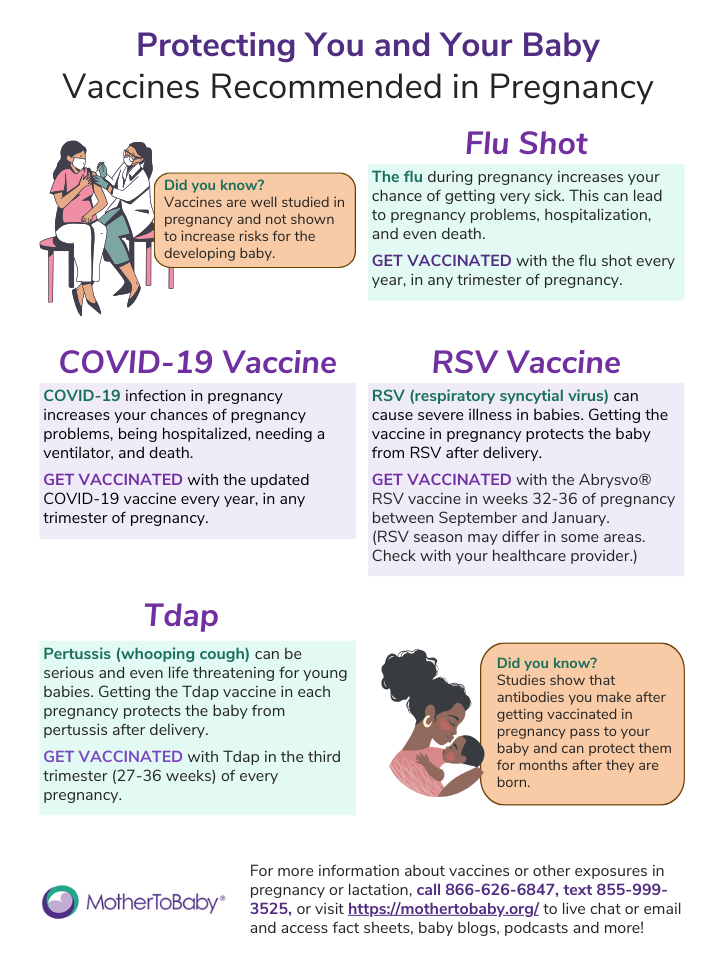
As we enter the 2024-2025 respiratory virus season, MotherToBaby wants to highlight the importance of vaccinations during pregnancy. All pregnant people are recommended to receive the annual flu shot and an updated 2024-2025 COVID-19 vaccine. Tdap, and the Abrysvo® RSV vaccine are recommended in the third trimester. These vaccines are well studied in pregnancy and not expected to increase risks for the developing baby. Furthermore, by protecting the pregnant person from diseases like the flu, COVID-19, pertussis, and RSV, vaccinations can help reduce the risk of pregnancy complications and ensure babies are born with protection against serious illnesses.

MotherToBaby knows that people who are pregnant have a lot to remember. Between taking a prenatal vitamin every day, getting blood work done, attending prenatal visits, and preparing for baby’s arrival, the pregnancy to-do list can feel never-ending. In an effort to provide a simplified reminder about the four vaccines recommended in pregnancy and why they are each so important, MotherToBaby has created a helpful infographic available for download below.

“This infographic is a great reminder of the many benefits vaccinations offer during pregnancy” shared Kirstie Perrotta, MPH, co-chair of MotherToBaby’s Emerging Issues Task Force. “Getting these vaccines on time is one of the most important things a pregnant person can do for their health and the health of their baby.”

For a PDF version of the infographic, click here.

MotherToBaby also has other resources available on the topic of vaccination in pregnancy.

Be sure to subscribe to The MotherToBaby Podcast so you don’t miss our upcoming episode series on vaccination. The podcast is available on iTunes, Amazon Music or wherever you listen to podcasts. 

Past vaccine-related podcast episodes:

RSV Vaccine in Pregnancy

Vaccine Questions during Pregnancy Answered

Vaccine Questions during Breastfeeding Answered

COVID-19 Vaccine in Pregnancy

Read our recent Baby Blogs discussing vaccination here:

And check out our vaccine fact sheets here:

Still have more questions? MotherToBaby specialists are happy to assist you further. Please feel free to call, chat, text, or email for more information: https://mothertobaby.org/contact/


Taking Vedolizumab in Pregnancy Did Not Increase the Risk of Birth Defects or Adverse Pregnancy Outcomes

The National Maternal Mental Health Hotline Provides 24/7 Support Before, During, and After Pregnancy

BRENTWOOD, TN – MotherToBaby, a no-cost service of the non-profit Organization of Teratology Information Specialists (OTIS) that educates the public about exposures during pregnancy and breastfeeding, proudly announces a new partnership to further support maternal mental health with the National Maternal Mental Health Hotline (NMMHH).

NMMHH provides perinatal mental health support through their toll-free phone line, 1-833-TLC-MAMA (1-833-852-6262). The hotline was established in 2022 on Mother’s Day, during May’s Maternal Mental Health Awareness Month. Over the course of the first year of operation, the hotline reports that the top reasons people contacted its service included depression, anxiety, feeling overwhelmed, issues related to pregnancy, and relationship conflict. “From our vantage point, the data resonates as the day-to-day experiences individuals have before, during and after pregnancy,” explained Tiffany J. Williams, project director for NMMHH. “We know that early intervention, trauma-informed support, and resources/referrals establish individuals for continued success in their maternal mental health journeys – this is why it is imperative to prioritize seeking support and professional help,” she added.  

MotherToBaby has become the leader in birth defects research, and has been available to the public for more than 30 years. During that time, MotherToBaby specialists have answered questions from the public about medications, vaccines, beauty products, herbal supplements, workplace exposures and much more during pregnancy and breastfeeding via its helpline 866-626-6847, text line 855-999-3525, email and live chat on MotherToBaby.org.

MotherToBaby and NMMHH have partnered by establishing a bidirectional referral and warm transfer process specifically to address the growing demand for perinatal mental health support. “It’s a win-win for those we serve,” said Lorrie Harris-Sagaribay, MPH, a bilingual teratogen information specialist and the OTIS/MotherToBaby President-Elect. “Regardless of whether a person reaches out first to MotherToBaby about specific medications for mental health, or to NMMHH about emotional support for mental health, they can be assured of greater access to personalized information from highly trained experts from both services, free of charge.”

Both NMMHH and MotherToBaby services are available in English and in Spanish. To learn more about NMMHH, please visit https://mchb.hrsa.gov/national-maternal-mental-health-hotline.  To learn more about MotherToBaby and browse its library of fact sheets, blogs and podcasts, please visit www.MotherToBaby.org.

MotherToBaby is supported by the Health Resources and Services Administration (HRSA) of the U.S. Department of Health and Human Services (HHS) as part of an award totaling $6,000,000 with zero percentage financed with non-governmental sources. The contents of this release are those of the author(s) and do not necessarily represent the official views of, nor an endorsement, by HRSA, HHS or the U.S. Government. To learn more about MotherToBaby and OTIS, please visit www.MotherToBaby.org.  

Media Contact: Nicole Chavez, 619-368-3259, nchavez@mothertobaby.org