
Battling Obesity Ahead of Pregnancy is ‘Beautifully Individual’

The year of the pandemic has not been easy. It has left most doctors and essential workers drained from the added stress. But I just got off a telehealth visit (sadly, a part of my new normal) with my long-standing patient and I am so excited! My patient (and myself) has struggled to lose weight for most of her life, but considering some of her chronic medical conditions, she was so motivated to lose weight prior to her pregnancy. I am so ecstatic because I love my patient! My patient, beautiful inside and out, has just made some lifestyle changes that will make her pregnancy that much safer for her and her baby.

Obesity and Its Impact during Pregnancy

Based on a large US survey, close to 60% of women are either overweight or obese. Unfortunately, obesity increases risks for both mom and baby during pregnancy. In early pregnancy, obese women have an increased risk of miscarriage and later in pregnancy an increased risk of stillbirth. There is also an increased risk of birth defects, most notably defects of the spinal cord, heart, face and limbs. Additionally, detecting these anomalies poses a greater challenge. Accounting for how ultrasound scientifically works, it is difficult for ultrasound detection of fetal abnormalities in obese women.  The higher the body mass index of a patient, the lower the anomaly detection rate. Compared to non-obese women, obese women also have higher risks of heart complications, diabetes in pregnancy, sleep apnea, blood pressure disorders such as preeclampsia and heart dysfunction. Our obese patients need to be closely monitored for possible complications throughout pregnancy.

At time of delivery, studies and clinical practice tell us that obese women have an increased risk of a cesarean section. After their delivery, they are more apt to struggle with an infection of the womb or infection of the cesarean incision.

Prepping Before Pregnancy

January is Birth Defects Prevention Month and this year’s theme is “5 Tips for Birth Defects Prevention,” which includes the following tip: Before you get pregnant, try to maintain a healthy weight.
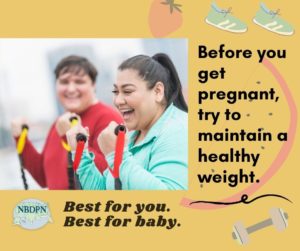
Due to all the potential complications, the best time to address obesity is before becoming pregnant. This is where mom-to-be may need the greatest support in helping to optimize health and the health of baby. Weight loss is the one thing we can do to help change our health. I often tell my patients that we cannot change our genetics, our family or personal medical history, but we can make lifestyle changes that can make a lasting difference in our baby’s health and ours. Achieving optimal weight, or even just starting to work toward it, can be achieved through so many avenues such as nutrition and exercise, help with medication, or even surgery. The many approaches should be personally customized to mom-to-be.

During pregnancy, we recommend less weight gain for our overweight patients. Overweight and obese patients should gain between 15-25 lb (6.8-11.3 kg) and 11-20 lb (5.0-9.1 kg) respectively. Increased testing and monitoring in pregnancy is often recommended. A healthy diet in protein, fats and carbohydrates as well as exercise should be discussed with your doctor. What works for me may not work for some of my patients and that is important to know – Each of us are beautifully individual!


Battling Obesity Ahead of Pregnancy is ‘Beautifully Individual’

Lately, it seems like every few months a new infectious disease makes the headlines. The COVID-19 pandemic dominated the news cycle for some time, but as more and more people get vaccinated and the number of severe cases starts to decrease, the media’s focus has shifted to other known or emerging threats. From the flu and respiratory syncytial virus (RSV), to mpox and syphilis, infections seem to be spreading like wildfire. Most recently, measles has made yet another comeback, prompting many women who are planning pregnancy, currently pregnant, or breastfeeding to make sure they are taking steps to avoid infection.

When I logged into our live chat service at www.mothertobaby.org on Tuesday morning, a chat from Alyssa popped up right away. “I’m currently 18 weeks pregnant and there was a measles case reported at my son’s preschool. Do I need to be worried?”

It’s understandable that Alyssa would be concerned. Measles (also known as rubeola) is a highly contagious respiratory disease caused by a virus. According to the Centers for Disease Control and Prevention (CDC) the measles virus can live for up to two hours in an airspace where the infected person coughed or sneezed. If people breathe the contaminated air or touch the infected surface, then touch their eyes, nose, or mouth, they can become infected. Measles is so contagious that if one person has it, up to 90% of the people close to that person who are not immune will also become infected.

Symptoms of measles generally appear about 7-14 days after a person is infected, and can include high fever, dry cough, runny nose, red watery eyes, and a rash all over the body. To date, studies have not identified an increased risk for birth defects when pregnant women get infected with measles during pregnancy. However, research suggests that a measles infection can be associated with an increased risk for miscarriage, premature delivery (having the baby before 37 weeks), and stillbirth.

The first question I asked Alyssa on chat was if she had ever received the Measles, Mumps, and Rubella (MMR) vaccine. Just one dose is about 93% effective at preventing measles, while two doses is close to 97% effective, so it’s the best way to prevent this disease. These vaccines are routinely given in childhood, so Alyssa couldn’t remember if she had received both, but after texting her mom she was able to confirm that she was fully vaccinated. Whew, that was good news. Next we discussed the date of exposure. I asked Alyssa when the positive case was reported at daycare, to which she answered that it was about two weeks ago. More good news. Since neither Alyssa nor her son had experienced any symptoms yet, infection was unlikely.

Since measles doesn’t seem to be going away anytime soon, knowing how to best protect yourself against the illness at all reproductive life stages is important.

Pre-Conception: Women who are planning a pregnancy in the future should make sure they are up to date with their MMR vaccines BEFORE they get pregnant. If you can’t find your vaccine record, call your healthcare provider who may know. If they don’t have a record, a blood test (titer) can be done to determine if you have immunity to measles. If it turns out you are not immune, you’ll want to get two doses of MMR vaccine for optimal protection. Just make sure you wait at least one month after getting the last shot before attempting to get pregnant.

Pregnancy: Since pregnant women shouldn’t receive live vaccines (like MMR), the best thing you can focus on during pregnancy is prevention. Good hand washing is always a good idea. If there is a confirmed measles outbreak near you, consider avoiding crowded public places and steer clear of any locations that have been identified as a known risk.

Breastfeeding: Once you are no longer pregnant, the MMR vaccine can be administered. The CDC considers the MMR vaccine compatible with breastfeeding and side effects for the breastfed baby are not expected.

If you have any questions about measles infection or the MMR vaccine while planning a pregnancy, during pregnancy or while breastfeeding, MotherToBaby is here to help. Give us a call at 866-626-6847, text, or chat with one of our information specialists today.


Battling Obesity Ahead of Pregnancy is ‘Beautifully Individual’

FOR IMMEDIATE RELEASE                                                 

BRENTWOOD, TN With 1 in 33 U.S. babies affected by birth defects each year, MotherToBaby, in partnership with the National Birth Defects Prevention Network (NBDPN), is kicking off National Birth Defects Awareness Month by unveiling a new digital pregnancy tool as well as a special podcast series that offers listeners continuing education credits.

MotherToBaby’s new and interactive critical periods of pregnancy tool aims to help pregnant people better understand the different stages of prenatal development and when exposures can impact different organ systems. By entering a last menstrual period (LMP) or estimated due date (EDD), as well as when an exposure (such as alcohol or medication use) took place, the user can see how far along they are in the pregnancy and visualize when important development events, such as the formation of the heart and lungs, are estimated to take place. Interactive popups on the chart provide more detailed definitions and information to effectively reach people of all health literacy backgrounds.

“The critical periods chart has been around for some time in the field of teratology,” shared project lead Kirstie Perrotta, MPH. “However, our team really wanted to add more detail and make the tool as interactive as possible.” When people have questions about an exposure in pregnancy, they can call MotherToBaby to receive a one-on-one assessment. This new tool is a nice complement to the personalized information service, allowing individuals to modify the chart with just a few clicks to reflect their specific dates. “The end goal was always to increase education on the topic of prenatal development,” added Perrotta. “With better information available to the public, individuals can make the best choices possible for their developing baby.”

Also, just in time for Birth Defects Awareness Month, The MotherToBaby Podcast announces a three-part series on Fetal Alcohol Spectrum Disorders (FASD) in collaboration with the Centers for Disease Control and Prevention (CDC) and FASD United. For the first time ever for The MotherToBaby Podcast listeners, they can earn continuing education credits if they listen to the three-episode series. “We know that exposure to alcohol during pregnancy can cause serious birth defects and FASD. Many people may be unfamiliar with how to recognize FASD, which often goes undiagnosed,” said Lorrie Harris-Sagaribay, MPH, MotherToBaby President. “We are thrilled to reach more healthcare providers and members of the public to educate them about FASD through our popular podcast platform.” Continuing education credit details are provided in the show notes of each episode. The MotherToBaby Podcast is available on Apple Podcasts, Amazon Music, Spotify, and anywhere podcasts are played.

To complement the FASD podcast series, a free Birth Defects Awareness Month webinar about FASD aimed at healthcare providers will take place on January 31, 2025 at 9a PT/12p ET. The webinar will be presented by Dr. Noemi Spinazzi of the American Academy of Pediatrics. It is a free webinar, but advanced registration is required at the following link:  https://momtobaby.org/FASDwebinar2025   

Every January during Birth Defects Awareness Month, MotherToBaby, in partnership with the National Birth Defects Prevention Network (NBDPN) and other health organizations, aims to raise awareness about birth defects, their effects on the community and prevention efforts. Please share the tools found in the NBDPN education and awareness packet that can be accessed online at https://nbdpn.org/national-birth-defects-awareness-month/.

More about MotherToBaby

MotherToBaby, a service of the non-profit Organization of Teratology Information Specialists (OTIS), is dedicated to providing no-cost evidence-based information to pregnant and breastfeeding people, healthcare professionals, and the general public about medications and other exposures during pregnancy and while breastfeeding. Talk directly to the experts behind the most up-to-date research by calling (866) 626-6847, texting (855) 999-3525, or via live chat and email on www.MotherToBaby.org. MotherToBaby is recommended by many agencies, including the Centers for Disease Control and Prevention (CDC).

MotherToBaby is supported by the Health Resources and Services Administration (HRSA) of the U.S. Department of Health and Human Services (HHS) as part of an award totaling $6,000,000 with zero percentage financed with non-governmental sources. The contents of this release are those of the author(s) and do not necessarily represent the official views of, nor an endorsement, by HRSA, HHS or the U.S. Government. To learn more about MotherToBaby and OTIS, please visit www.MotherToBaby.org

Media Contact: Nicole Chavez, 619-368-3259, nchavez@mothertobaby.org


Battling Obesity Ahead of Pregnancy is ‘Beautifully Individual’

The air we breathe matters and often we do not have control over what is in it. For many, the Spring season brings beautiful flowers and a most welcome warming of temperatures, as well as spending more time outside. It also marks the explosion of pollen, which can irritate both those with allergies and people with asthma. Being outside to engage in outdoor activities also means we are exposed to any air pollution that may be present.

Pregnancy is a sensitive time for both the parent and the developing baby. Preventing issues related to allergies, asthma and air pollution is important for a few reasons. If you do have issues with asthma and it affects your breathing, the amount of oxygen in your blood can drop; this can create problems for baby as you are their source of oxygen while pregnant. The baby may have trouble growing as much as they should or may be born at a low birth weight. This can put the baby at higher risk for several health issues.

There has been increasing research on the possible effects of air pollution on pregnancies. Some studies suggest that higher amounts of pollution in the air are related to babies being born too small or too early. Air pollution also can make asthma symptoms worse. There are some ways to lower the amount of air pollution you are exposed to, and this may be even more important for those that live near highways or high traffic areas, or near landfills. Some clear ideas from the American Pregnancy Association include:

  • Buying an air purifier to use in your home
  • Checking the air quality before planning outdoor activities to see if it is dangerous for groups sensitive to air pollution or pollen. Simply visit this website and enter your zip code: https://www.airnow.gov/
  • Choosing to spend more time indoors when air quality is low
  • Buying some plants to have in your home that are known to improve air quality. Some common household plants known to help with this include Peace Lilies, Snake plants, Philodendrons, Spider plants, or Rubber Trees

Other important things to consider are checking in with your healthcare provider about any types of medications you may use to treat your asthma or allergies. Quitting your medications as soon as you become pregnant is often not the best choice for you or baby and managing your symptoms is important for the reasons discussed above. MotherToBaby has a landing page on asthma that includes resources: https://mothertobaby.org/pregnancy-breastfeeding-exposures/asthma/ and one about allergies: https://mothertobaby.org/pregnancy-breastfeeding-exposures/allergies/  These pages have links to fact sheets on many medications that are used to treat symptoms related to both topics. 

As you move through the Spring months into Summer, try to appreciate the seasons while also being aware of how air quality can affect your health. As the saying goes, when you are pregnant you are “breathing for two.” As a reminder, our fact sheets also have breastfeeding information near the bottom of them that you can check out. We also encourage you to remember air quality can affect young children as well – especially ones with asthma.  Finding a healthcare provider you and your family can see routinely to manage asthma related issues is important in order to avoid emergency room visits.

Take a deep breath and remember, whatever your concerns are, experts at MotherToBaby will do our best to give you useful information based on research, or to point you in the right direction if we are unable to help.


Battling Obesity Ahead of Pregnancy is ‘Beautifully Individual’

MotherToBaby Connects Public with Health Experts through Unique New Website, Live Chat

woman typingBRENTWOOD, TN – As January’s National Birth Defects Prevention Month continues to be recognized around the country, MotherToBaby, a service of the international non-profit Organization of Teratology Information Specialists (OTIS), launches new digital ways for expectant moms and health care providers to get free expert information about the risks of medications and other exposures during pregnancy and breastfeeding – through instantaneous, private live chat on www.MotherToBaby.org.

The digital initiative comes just a few short months after the service launched a first-of-its-kind texting component where the public can receive free expert answers by texting questions to 855-999-3525. “It’s our experience that all moms-to-be want the best information possible in order to have a healthy baby,” said Kenneth Lyons Jones, MD, MotherToBaby Past-President and world-renowned pediatrician at UC San Diego. “No matter what their income level or socio-economic situation, we feel every woman should have access to the best, expert health information possible. We’re making it easy for them to accomplish this through our new digital services.”

Expectant moms, as well as those who are breastfeeding, will simply need to visit www.MotherToBaby.org on their computer or phone to be connected to a bilingual (English/Spanish) specialist in the field of teratology – the study of exposures that cause birth defects. The newly-revamped website includes options to chat live through private, instant messaging or to email-an-expert. The MotherToBaby website also houses a library of free downloadable fact sheets in both English and Spanish on a variety of exposures. The digital counseling components complement the services’ traditional, phone counseling service (available toll-free at 866-626-6847) which has been available for more than 30 years.

Dr. Jones, a health care provider himself, expects this new way of delivering evidence-based information about the risks of exposures like medications, vaccines, chemicals, environmental agents and diseases, will also be convenient for his busy colleagues who see patients. “Oftentimes, a health care provider may only have a few minutes in-between patient appointments to get the latest teratogen information they need quickly. This will be a great option for them as well,” he said.

Sonia Alvarado, a bilingual teratogen information specialist who’s been based at MotherToBaby’s California affiliate for more than a decade, is leading the online live chat initiative. “The risk to the developing baby from exposures like medications during a mom’s pregnancy can vary greatly depending on timing of the exposure, mom’s metabolism and much more,” she said. “To be able to provide her with information tailored to her personal circumstance allows her to make informed decisions along with the guidance of her doctor. To be able to empower her with that kind of knowledge is extremely rewarding.”

About MotherToBaby
MotherToBaby, which consists of 14 services housed at universities, hospitals and government institutions across the country, provides free, evidence-based, personalized risk assessments, education and counseling regarding the effects of exposures like prescription and over-the-counter drugs, alcohol, smoking, illicit substances, vaccines, beauty products, herbal supplements, chemicals and more during pregnancy and while breastfeeding.

More than 100,000 women and their health care providers seek information about birth defects prevention from MotherToBaby every year. MotherToBaby has been able to launch new outreach efforts to reach underserved populations, including new communication technologies, through a cooperative agreement with the U.S. Health Resources and Services Administration.

About National Birth Defects Prevention Month
Roughly 120,000 babies are affected by birth defects each year in the United States, according to the National Birth Defects Prevention Network (NBDPN). The NBDPN established the nationally-recognized Birth Defects Prevention Month in order to raise public awareness of the problem that can sometimes lead to lifelong challenges and disability. To learn more about the NBDPN, visit www.nbdpn.org.

# # #
Media Contact: Nicole Chavez, 619-368-3259, nchavez@MotherToBaby.org. Interviews in Spanish can also be arranged.