Request Materials

Resources for Healthier Families

Welcome to MotherToBaby’s information center! We offer free patient education materials and provider resources about both our information service and our pregnancy studies.

Please note that MotherToBaby teratogen information services are available only for residents of the United States and Quebec, Canada. In addition, only residents of the United States and Canada (all provinces) are eligible to participate in MotherToBaby Pregnancy Studies. For pregnancy and breastfeeding exposure information materials and services that are available in other regions of the world, please visit: https://mothertobaby.org/international/

Use the form below to order patient education materials and provider resources about our teratogen information service and observational pregnancy studies. If this is your first order and you would like a sample packet to introduce you to our available materials, please note this in the comments below. Please allow 1-2 weeks for order processing and shipment/delivery time.

We invite you to explore our Other Educational Tools for infographics that can be used in education in addition to our promotional materials listed below. We take pride in being your partner in pregnancy and breastfeeding health – please let us know if you need help requesting materials.

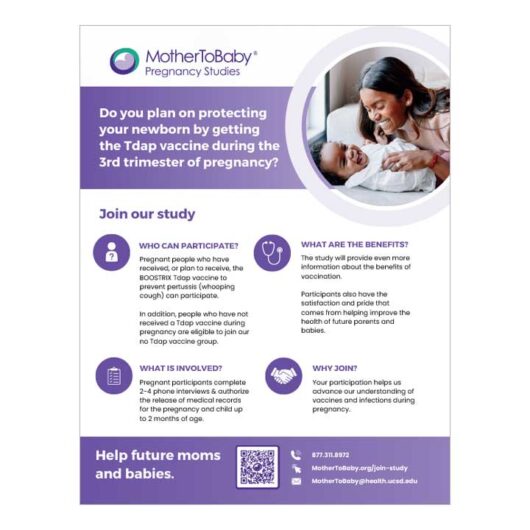
  • BOOSTRIX Vaccine in Pregnancy Study Flyer

    BOOSTRIX Vaccine in Pregnancy Study Flyer

    A double-sided, bilingual (English and Spanish) flyer for patients that covers the Boostrix Tdap Vaccine Pregnancy Study. (8.5 x 11in)

    Clear


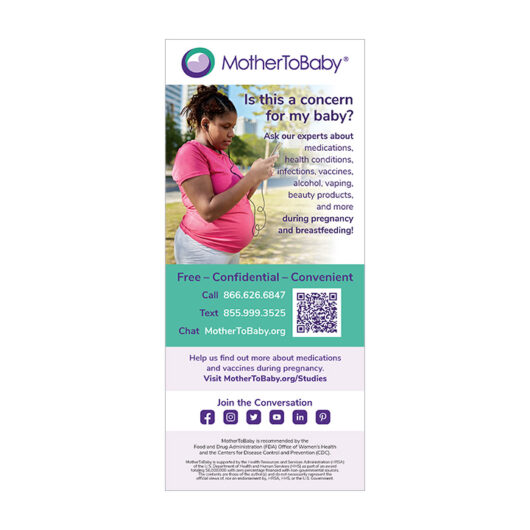
  • MotherToBaby Rack Card

    MotherToBaby Rack Card

    A double-sided, bilingual (English and Spanish) rack card for patients that covers the ways to contact MotherToBaby’s free information service. (3.75 x 8.5in)

    Clear


  • MotherToBaby Brochure - Overview of Exposure Service & Studies

    MotherToBaby Brochure – Overview of Exposure Service & Studies

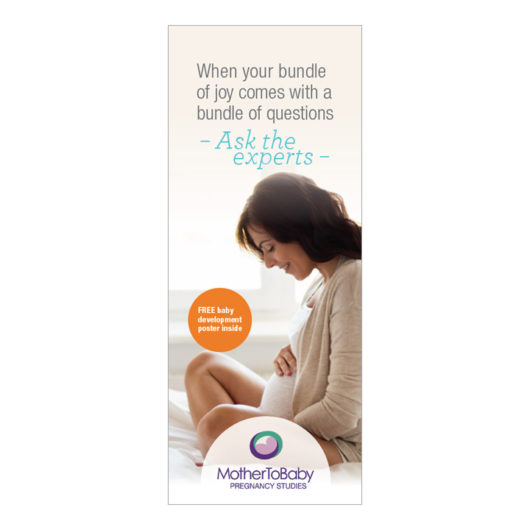
    brochure for general outreach that describes MotherToBaby’s free information service and observational pregnancy studies. (3.5 x 8.5in folded)

    Please see the Patient Brochure (below) for an alternate version of the MotherToBaby Brochure specifically designed for in-clinic and hospital use to refer patients to our pregnancy studies.

    Clear


  • Patient Referral Card

    Patient Referral Card

    Referral cards for patients that share contact information for MotherToBaby’s observational pregnancy studies. Available in English and Spanish. (3.5 x 2in)

    Clear


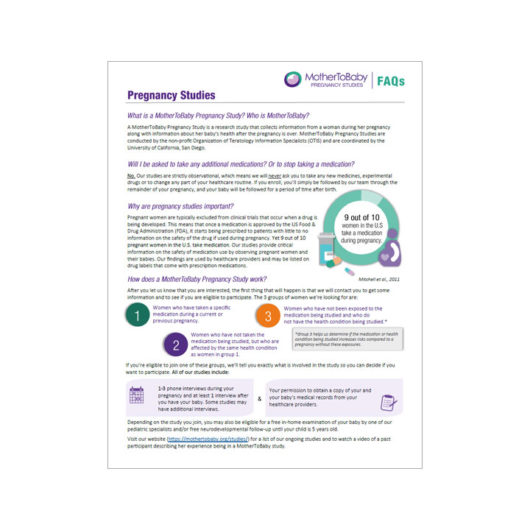
  • Pregnancy Studies FAQ

    Pregnancy Studies FAQ

    A flyer for patients that covers common questions and the process of participating MotherToBaby’s observational pregnancy studies. Available in English and Spanish. Available in shrink-wrapped packs of 50, please specify the total number of flyers requested (If you are requesting 2 packs of 50 write ‘100’ below). (8.5 x 11in)

    Clear


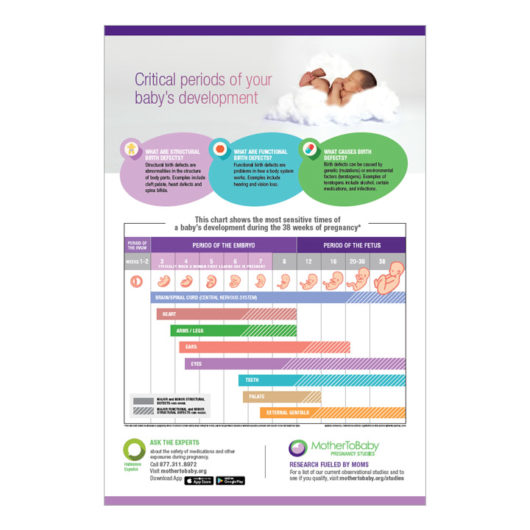
  • Fetal Development Poster

    Fetal Development Poster

    An adhesive poster that includes a chart providing an overview of the critical periods of a baby’s development during pregnancy. Ideal for doctor’s offices and reproductive health centers. A handout version of this poster is in the Patient Brochure, which is available in English and Spanish (see below). This poster-sized chart is English only, limit 5 per customer. (16 x 24in)

    Clear


  • Healthcare Provider Brochure

    Healthcare Provider Brochure

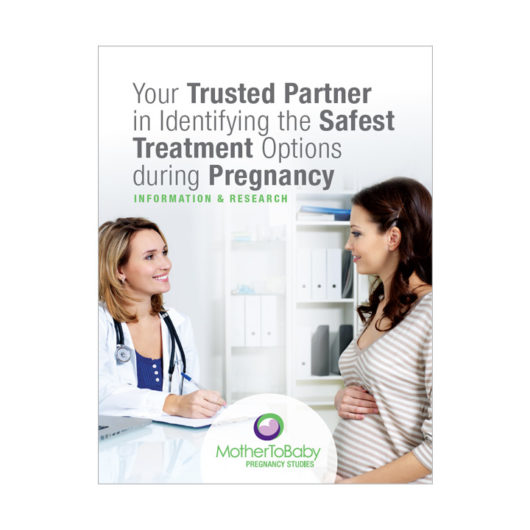
    A brochure for healthcare providers that covers MotherToBaby’s information services and observational pregnancy studies. Available in shrink-wrapped packs of 25, please specify the total number of brochures requested (If you are requesting 2 packs of 25 write ’50’ below). Optional inserts can be included for the following specialists listed below, brochures with inserts do not come shrink-wrapped. (5.75 x 7.5in folded)

    Clear


  • Patient Brochure - MotherToBaby Pregnancy Studies

    Patient Brochure – MotherToBaby Pregnancy Studies

    The MotherToBaby Brochure (above) for patients that describes MotherToBaby’s free information service and observational pregnancy studies. This brochure can be ordered in bulk to connect patients to our study team. Available in shrink-wrapped packs of 25, please specify the total number of brochures requested (If you are requesting 2 packs of 25 write ’50’ below). (3.5 x 8.5in folded)

    Clear


  • Patient Referral Tear Pads

    Patient Referral Tear Pads

    Tear pads for healthcare providers. Each tear pad includes 25 sheets that can be given out to patients interested in MotherToBaby’s observational pregnancy studies. Specialty-specific tear pads are also available for the following: Allergists & Immunologists, Dermatologists, Gastroenterologists, Neurologists, and Rheumatologists. (3.5 x 5in)


    Clear


Request Materials

teratology logo

Birth Defects Insights

a blog by our partners at the Teratology Society

By Sarah Običan, OBGYN, Teratology Society Council Member and member of the MotherToBaby Board of Directors

See Dr. Obican’s blog on Linkedin and share it with your professional networks here

Where should I even begin? As a physician, I’m concerned. As a scientist, I’m concerned. As a woman in her childbearing years, I’m concerned. While

the vast majority of babies are born healthy and free of birth defects, the prevalence of certain birth defects are on the rise and the bottom line is – it’s concerning.

Just in the past few days, new evidence of increasing rates of gastroschisis has emerged. Gastroschisis is a serious birth defect where the intestines and sometimes other organs poke through an opening in the abdomen near the belly button. We don’t understand why this birth defect occurs. There’s only one consistent risk factor identified in studies – moms who are younger are more likely to have a baby with this problem. But in recent years, the rate of this problem has been increasing and we don’t know why.

How about antidepressants during pregnancy? That’s always a hot button issue that seems to gain a lot of press attention, from jumping to conclusions of its potential link to autism, to premature birth and everything in between. We still do not have concrete answers. What we do have is mounting evidence of the growing use of antidepressants among childbearing women. According to a study published just last week, about 15 percent of women aged 15–44 years filled at least one prescription for an antidepressant in a single year. Since much is not known about the safety of antidepressants in pregnancy, coupled with the known fact that about half of pregnancies are unplanned, research on the effects of antidepressants during pregnancy needs to be prioritized so women and their doctors have the information they need to make informed choices.

And then there’s Zika. It’s on the nightly news. It’s a discussion around the water cooler. It’s real and appears to not be going away anytime soon, especially as women all over the world prep to travel and cheer on their home countries in this Summer Olympic games in Brazil. The association between Zika virus during a woman’s pregnancy and microcephaly in her baby is rapidly evolving. Microcephaly is a life-threatening neurodevelopmental birth defect characterized by an affected infant’s smaller-than-normal head.

Science is Hope
As a Council member of the Teratology Society, a society of scientists dedicated to researching birth defects and developmentally-mediated disorders, and Board member of the Organization of Teratology Information Specialist’s (OTIS) MotherToBaby program, it goes without saying that I look forward to our annual conferences. One of the advantages of the conferences, held jointly, is that they bring together experts from many fields. Some are laboratory scientists who do genetic studies, others do animal research, some focus on epidemiology studies, while others see patients and talk to parents. All these smart minds at the same meeting — both in the formal meeting rooms and in the conversations that happen in the hallway between sessions — can come up with new ideas on how to tackle these important issues causing so much concern. These are groups that don’t get the opportunity to exchange ideas on a regular basis. Submit your research abstract online (deadline: February 15th), take part in our annual meeting, and visit www.Teratology.org

I hope that by having the leaders in the studies on Zika virus from Brazil and the United States presenting to our group of researchers leads to an improved understanding of this association and improved care for mothers and their babies. I hope that by bringing the world’s leaders on antidepressant research together in one session will lead to new ways to study its use in pregnancy. I hope our scientists help answer that young mom left wondering what she could have done differently to avoid having her baby deal with the complications of gastroschisis. Bottom line – From hope comes motivation, which, as scientists, can lead to answers. Join the hope.

Scientists interested or are already involved in research related to topics mentioned in this blog are encouraged to join the Teratology Society, the premier source for cutting-edge research and authoritative information related to birth defects and developmentally-mediated disorders, as well as the Organization of Teratology Information Specialists (OTIS), the non-profit society that provides the MotherToBaby service. Members include those specializing in cell and molecular biology, developmental biology and toxicology, reproduction and endocrinology, epidemiology, nutritional biochemistry, and genetics, as well as the clinical disciplines of prenatal medicine, pediatrics, obstetrics, neonatology, medical genetics, and teratogen risk counseling. The Teratology Society publishes the scientific journal, Birth Defects Research. Learn more at www.Teratology.org.
Find the Teratology Society on Linkedin
Facebook
Twitter

Find MotherToBaby on Linkedin
Facebook
Twitter

About The Author
Sarah G. Obican, MD, is an OBGYN, Maternal Fetal Medicine specialist at the University of South Florida. She’s currently a Councilor of the Teratology Society. She’s also on the Board of Directors of the Teratology Society’s sister organization, MotherToBaby, which provides evidence-based answers to questions about exposures during pregnancy and breastfeeding.


Request Materials

BRENTWOOD, TN – May 13, 2015 – MotherToBaby Aims To Curb Trend Through New Partnership With ‘Healthy Teen Network’

Drug and alcohol abuse during pregnancy that leads to serious birth defects is something health care providers have often warned the general public about, but the message often struggles to reach pregnant teens – until now. MotherToBaby, a service of the international non-profit Organization of Teratology Information Specialists (OTIS), announces a new initiative to reach this especially vulnerable population.

Many studies, including one recently published in the Spring 2015 issue of Addictive Behaviors, suggest substance abuse among pregnant teens is a notably disturbing problem, one that often continues even after they find out they’re pregnant. “Illicit substances, alcohol, these are all exposures that can do irreversible damage to a developing baby,” said Kenneth Lyons Jones, MD, MotherToBaby past president and one of two doctors who first identified Fetal Alcohol Syndrome (FAS) in 1973. “Evidently, pregnant teens are particularly vulnerable when it comes to unhealthy behaviors. It’s a huge problem that can only be solved by connecting them with the support they need in order to make healthier decisions,” he added.

In an effort to reach more pregnant and breastfeeding teens, MotherToBaby has partnered with the Healthy Teen Network to provide evidence-based information about exposures, such as drugs and alcohol, during pregnancy through its 866-626-6847 help-line. The Healthy Teen Network is a national non-profit that promotes better outcomes for adolescents and young adults by advancing social change, cultivating innovation, and strengthening youth-supporting professionals and organizations.

“To improve outcomes, including reducing teen pregnancies and births, we need to recognize the complex interrelated factors, or social determinants—such as access to quality education and health services, life goals and aspirations for the future, or healthy relationships—that influence health outcomes,” explained Gina Desidario, director of Marketing and Communications for the Healthy Teen Network.

Dr. Jones hopes by encouraging more youth-centered organizations to educate pregnant teens about MotherToBaby’s judgment-free, evidence-based counseling service, many birth defects will be prevented. Desidario says it’s a service pregnant teens need. “All adolescents and young adults, including teen parents, have a right to comprehensive, developmentally and culturally appropriate, confidential support and services, including contraceptive services, and if pregnant, to full options counseling and services,” she said.

This year, as part of May’s National Teen Pregnancy Prevention Month, Healthy Teen Network is highlighting a holistic Youth 360° frame as a way to positively, inclusively promote adolescent health for all young people. It’s launched a series of activities and resources to promote adolescent health and well-being. See the Healthy Teen Network website for more information: www.HealthyTeenNetwork.org.

MotherToBaby, which consists of 14 services housed at universities and hospitals across the country, provides FREE, evidence-based, personalized risk assessments, education and counseling regarding the effects of exposures like prescription and over-the-counter drugs, alcohol, smoking, illicit substances, vaccines, beauty products, herbal supplements, chemicals and more during pregnancy and while breastfeeding. The public can be connected with a bilingual (English/Spanish) MotherToBaby expert by calling toll-free 1-866-626-6847. The MotherToBaby website also houses a library of fact sheets located at MotherToBaby.org.

More than 100,000 women and their health care providers seek information about birth defect prevention from MotherToBaby every year. MotherToBaby has been able to launch new outreach efforts to reach vulnerable populations through a cooperative agreement with the U.S. Human Resources and Services Administration.

# # #
Media Contact: Nicole Chavez, 619-368-3259, nchavez@MotherToBaby.org. Interviews in Spanish can also be arranged.


Request Materials

ATLANTA, GA- A new OTIS/MotherToBaby affiliate providing expert answers about medications and other exposures during pregnancy and breastfeeding, is giving expectant moms in Georgia a peak into the service it provides.

Patricia Olney, MS, board certified genetic counselor and teratogen information specialist at MotherToBaby Georgia, was featured in a news segment on Fox Atlanta this week.

“We feel like we empower the couple or the woman with information that’s reliable that they can actually use to benefit from a healthy pregnancy,” said Olney. View the entire news spot by playing the video below.

Atlanta News, Weather, Traffic, and Sports | FOX 5

MotherToBaby GA is a free statewide counseling service that connects experts in the field of birth defects research with expectant moms, health care providers, and the general public. All it takes is a simple phone call to a toll-free number, 866-626-6847. MotherToBaby GA is funded by the Georgia Department of Behavioral Health and Developmental Disabilities and is in partnership with Emory University.


Request Materials

By Rogelio Perez D’Gregorio, MD, MS, MotherToBaby UR Medicine

Not many people know this, New York is the only state that requires that every pregnant woman have her risk of lead exposure assessed at the first prenatal visit. As a doctor seeing pregnant patients regularly, this is unbelievable to me! Highlighting this topic is particularly appropriate during October as this month we’ll celebrate National Lead Poisoning Prevention Week. This awareness week was created because lead exposure can have such serious consequences, for pregnant women and particularly for developing children.

What is lead?
Lead is a heavy metal found in many different places, like dust, air, soil, water, food and inside our homes. For generations, lead has been used in many products, like paint. People didn’t even realize it was there and that is could be harmful. It was also used in gasoline, and continue to be used in batteries, electronics, pipes, solder, ceramics, glass, toys and jewelry among many other things. In 1978, lead was removed from the manufacture of household paints. But even today the remodeling of homes with old lead paint that had been applied years before continues to be a common source of lead exposure, especially when the paint is peeling or chipping off of the walls.

What is lead poisoning?
Lead poisoning may result in one symptom or many vague symptoms that sometimes are overlooked by health care providers. They can sneak up on an exposed person and he/she may not even realize he/she’s sick. Symptoms of lead poisoning can include abdominal pain, constipation, diarrhea, aggressiveness, anxiousness, hyperactivity, shortened attention span, muscle pain, weakness, weight loss, learning disabilities, convulsions, and (with significant lead exposure) even death. Someone with lead poisoning might also develop anemia (low blood iron).

It can be devastating for developing babies and kids.
In pregnancy, lead can cross the placenta and reach the baby; so if a pregnant woman is lead-exposed, so is her baby. In addition, young children tend to put everything in their mouths, so their risk for possible exposure is high. Low doses of lead can do lasting damage to infants and young children, as well as babies developing in mom’s womb. Potential effects include:

  1. Lower IQ
  2. Distractibility and hyperactivity
  3. Hearing loss
  4. Anemia
  5. Growth and behavioral problems
  6. Kidney and brain damage
  7. Bone weakness/osteoporosis

So what can you do to reduce your and your child’s exposure to lead?

  • All pregnant women should consider being tested for lead exposure. It is a simple and inexpensive test that can be included with the blood tests being done at your first prenatal visit. If your obstetric health-care provider does not suggest testing, ask your provider to order a blood lead test.
  • Have your child tested for lead starting before age 1, with regular testing occurring until age 6. Children under 6 are especially at risk, and the long-term effects of lead in a child can be severe!
  • Keep your house clean. Dust contaminated with lead that is accessible to young children can cause an increased blood lead level. Help young children wash their hands with soap and water frequently and discourage them from putting their fingers in their mouths. Use a wet mop to dust, clean windowsills regularly and wash toys frequently.
  • Lead in soil does not break down with time; it remains there forever. Don’t allow children to play in areas of bare soil.
  • Don’t burn painted wood, as it may contain lead.
  • If you work with lead, shower and change your clothes before going home.
  • Don’t remove lead paint yourself; it’s a job best left to the professionals.
  • Run the cold water in your kitchen faucet at a high rate for at least 30 seconds before drinking it, using it for mixing infant formula or for cooking, especially if it hasn’t been used in several hours.
  • Don’t store food or drink in lead crystal glassware or old pottery.
  • Beware of herbal products that are not certified because a range of heavy metals have been found in uncertified herbal products.
  • Make sure children have adequate amounts of calcium, iron and Vitamin C in their diets. If their diets are low in these minerals or vitamins, they can potentially absorb more lead if they ingest it.

As much as I am discouraged to see the lack of testing required nationwide for lead exposure, I am still filled with hope. My hope is that awareness, like this blog, will prevent one more child from being exposed to lead. Spread the word, share this info and remember, lead poisoning is entirely preventable! #kNOwLEAD this month and every month!

Rogelio Perez D’Gregorio, MD, MS is an Assistant Director of MotherToBaby UR Medicine and Assistant Professor of Obstetrics and Gynecology at the University of Rochester.

Other blog contributions were made by:

Stanley Schaffer, MD, Director of the Western New York Lead Resource Center in Rochester and an Associate Professor of Pediatrics, at U of R.

Richard K. Miller, PhD, Director of MotherToBaby UR Medicine and Co-Director of the Finger Lakes Children’s Environmental Health Center. He also Professor of Obstetrics/Gynecology, of Environmental Medicine and of Pathology and Clinical Laboratory Medicine at U of R.

About MotherToBaby
MotherToBaby is a service of the Organization of Teratology Information Specialists (OTIS), suggested resources by many agencies including the Centers for Disease Control and Prevention (CDC). If you have questions about exposures during pregnancy and breastfeeding, please call MotherToBaby toll-FREE at 866-626-6847 or try out MotherToBaby’s new text information service by texting questions to (855) 999-3525. You can also visit MotherToBaby.org to browse a library of fact sheets about dozens of viruses, medications, vaccines, alcohol, diseases, or other exposures during pregnancy and breastfeeding or connect with all of our resources by downloading the new MotherToBaby free app, available on Android and iOS markets.

References