
Working with X-rays (Ionizing Radiation)

This sheet reviews working around ionizing radiation, particularly working with or near X-ray machines. This information is based on published research. It should not take the place of medical care and advice from your healthcare providers. 

What is ionizing radiation?  

Radiation waves are usually invisible (can’t be seen) and have no weight nor odor. Radiation is grouped into 2 categories: 1) non-ionizing and 2) ionizing.  

  1. Non-ionizing radiation has less energy than ionizing radiation. Non-ionizing radiation does not carry enough energy to produce ions (molecules or atoms that are charged). Sources of non-ionizing radiation include light bulbs, computers, Wi-Fi routers, cell phones, Bluetooth devices, FM radio, GPS, airport body scanning units, and broadcast television.  
  2. Ionizing radiation refers to X-rays, gamma rays, and some of the higher ultraviolet electromagnetic spectrum. X-rays are used in diagnostic imaging and in therapeutics. Gamma radiation is used in therapeutics as well. Ionizing radiation can have enough energy to produce ions.  

How is radiation measured? 

The amount of radiation absorbed by the body is called the ‘effective dose’. The international unit of measurement for effective dose is the milli-sievert (mSv), and in the United States you may also read or hear about milli-rem (mrem). 

However, radiation is also measured in other ways, such roentgen, joule, gray, or rad. Therefore, the information below is included to help convert between different types of measurements, if needed. In general: 

  • 1 milli-sievert (mSv) is about the same as 0.1 rems. 1 sievert (Sv) is about 100 rems 
  • 1 rad is about the same as 1 rem 
  • 1 gray (Gy) is around the same as 100 rads. 1 Gy is around the same as 1 sievert (3,000 mSv) 

It is also important to remember that we are surrounded by ionizing radiation every day. Ionizing radiation is in our soil, water, and air. These sources of radiation are called background radiation. Most people are exposed to about 3 milli-sieverts (mSv) of background radiation every year (300 mrem). This estimate can change based on where a person lives. During pregnancy, a fetus is exposed, on average, to around 1 mSv of background radiation (about 100 mrem).  

What work settings might have ionizing radiation? 

Ionizing radiation can be found in some work settings, such as healthcare facilities, research institutions, air travel (pilot, flight attendant), baggage X-ray screening, construction, nuclear reactors and nuclear support facilities, the transportation industry, and nuclear weapon production facilities, to name a few.  

In a medical work setting, ionizing radiation can be produced by X-ray machines, CT machines, and radiation therapy machines (for example: assisting in fluoroscopy procedures and working in nuclear cath labs). Exposure to ionizing radiation could also occur with the use of radioactive isotopes (radionuclides). This fact sheet will focus on working around X-ray machines. 

X-rays / X-ray Machines: 

X-ray machines are not radioactive, which means they are not giving off radiation when not in use. X-ray machines are designed to make radiation, and the radiation is controlled by the person who runs the machine (turned on and off by the press of a button or the flip of a switch). 

X-rays travel in straight lines. When X-rays hit an object, most of the energy waves will travel straight into the object. However, some of the energy waves will bounce off and can travel in any direction – this is called “scatter”. X-rays will lose energy as they travel through an object. Since an X-ray is just energy, when the energy is gone, so is the X-ray. This is called “attenuation”. 

How do I know if I work in an area with radiation?

Areas with possible radiation are required to post a sign similar to what you see here.

The sign will distinguish between:
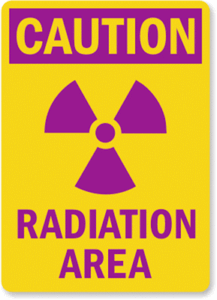
1) Radiation areas (area where the body could receive a dose of more than 5 millirems in an hour, or more than 100 millirem in 5 consecutive days);

2) High radiation areas (area where a body could be exposed to more than 100 millirems in one hour); or

3) An airborne radioactivity area (an area where a person can be exposed to higher than permissible amounts of airborne radioactive material).

In addition, areas that store certain amounts of radioactive materials must also display signs that will state: “Caution, Radioactive Materials”.

How is workplace ionizing radiation measured? 

To measure a person’s workplace exposures, the employer should give workers personal monitoring equipment, which might include film badges, pocket chambers, pocket dosimeters, or film rings. The workplace Health and Safety officer or Radiation Safety officer tracks the results and reports as required. 

What are the occupational limits for ionizing radiation in the workplace? 

There are occupational limits for both non-pregnant and pregnant workers who could be exposed to ionizing radiation at their workplace. When a worker becomes pregnant and informs their employer, the ionizing radiation exposure limit is reduced for the protection of the embryo/fetus. The worker that tells their employer about the pregnancy is called a “declared worker”.  

Most workplaces will have a Radiation Safety Officer who can keep staff up to date on current workplace limits for their job. In general, the occupational limit for ionizing radiation exposure to the whole body is 5 rems (5 rads, 50 mSv) per year. There are also regulations for specific parts of the body, as measured over a calendar quarter (3 months).  

Some regulation agencies have established limits for an embryo or fetus. Some of these agencies recommend that a fetus should not receive more than 500 millirems (500 millirads, 0.5 rads, 0.5 rem, 5 mSv) over the course of the entire pregnancy. Some agencies may have different guidelines. Looking at 1 gestational month (1 month during a pregnancy), the recommendation by some regulating agencies is that exposure should not be more than 0.5 mSv (50 millirem, 0.05 rem, 50 millirads, 0.05 rads) in any one month of the pregnancy. 

If the worker belongs to a professional medical organization, union or other organization, it may be beneficial to consult with them also to learn about protections that might be in place for the pregnant worker. 

I work around ionizing radiation. Can it make it harder for me to get pregnant?  

Remaining within the occupational limit for ionizing radiation of 5 rems (5 rads, 50 mSv) per year is not expected to make it harder for a woman to become pregnant. 

Does working around ionizing radiation increase the chance for miscarriage?  

Miscarriage is common and can occur in any pregnancy for many different reasons. Remaining within the occupational limit for ionizing radiation of 50 mSv (5,000 mrem, 5 rad) per year would not be expected to increase the chance of miscarriage. Radiation doses greater than 50 mSv in the first 2 weeks of the pregnancy, before the egg implants into the uterus, might increase the chance for miscarriage.  

Does working around ionizing radiation increase the chance of birth defects? 

Birth defects can happen in any pregnancy for different reasons. Out of all babies born each year, about 3 out of 100 (3%) will have a birth defect. We look at research studies to try to understand if an exposure might increase the chance of birth defects in a pregnancy. 

In most cases of radiation exposure, the actual dose received by the embryo/fetus is less than the dose received by the woman who is pregnant. This is because some of the dose is absorbed by the body before reaching the inside of the uterus (where the fetus is developing). 

Ionizing radiation exposure of less than 50 mSv (5,000 mrem, 5 rad) has not been associated with an increased chance for birth defects over the background risk. It has been estimated that a woman would need about 125 unshielded pelvic X-rays for a fetus to be exposed to 50 mSv of radiation.  

Does working around ionizing radiation increase the chance of other pregnancy problems? 

Exposure to high doses (around 250 mSv or more (around 25,000 mrem or more) of radiation could be harmful to a pregnancy. These high dose exposures have been associated with small head size and poor growth. Some studies have looked at whether prenatal exposure to X-rays could increase the chance of cancer in children, but risks are unclear. If there is a cancer risk from prenatal X-ray exposure, it would be small. It is not known if working around ionizing radiation can cause other pregnancy problems, such as preterm delivery (birth before week 37).  

Does working around ionizing radiation in pregnancy affect future behavior or learning for the child?  

Remaining within the occupational limits for both pregnant and non-pregnant workers would not be expected to have long-term effects for a pregnancy. Exposure to high doses (more than 500 mSv or 50,000 mrem) of radiation could be harmful to a pregnancy and has been associated with learning difficulties and intellectual disabilities. In addition, exposure to more than 100 mSv (10,000 mrem) of radiation between the 8th week and the 15th week of pregnancy might be associated with learning difficulties and intellectual disability. 

Breastfeeding while working with X-rays:  

X-rays are present only during the time that an image is being taken and leave no radiation or radioactivity in the body or in milk. Diagnostic X-rays have no effect on the breastmilk at the time of a procedure and would not be expected to affect milk production. Be sure to talk to your healthcare provider about all your breastfeeding questions. 

If a man works around ionizing radiation, can it affect fertility or increase the chance of birth defects?   

Several studies have not found an association between low-level occupational radiation exposure to sperm and birth defects or childhood cancer in future children. It is possible that higher radiation exposure to the testes (more than 100 mSv or 10,000 mrems) could cause a temporary reduction in sperm count. As doses go higher, around 3,000 mSV or higher (around 300,000 mrems or higher), permanent male sterility could occur). It would be rare to be exposed to ionizing radiation at these doses. 

In general, exposures that men have are less likely to increase risks to a pregnancy. For more general information, please see the MotherToBaby sheet Paternal Exposures at https://mothertobaby.org/fact-sheets/paternal-exposures-pregnancy/.  

What can workers do to reduce exposure to ionizing radiation?  

Follow the Safe Work Practices outlined for your job by your radiation safety officer or industrial hygienist.  

Below are some general tips: 

  • Keep the time of exposure as short as possible. 
  • Maximize your distance from the source of exposure. 
  • Shield yourself from the source of exposure by:  
  • Using appropriate personal protective equipment (such as lead gloves and aprons);  
  • Standing the appropriate distance from the machine, or be out of the room or behind the appropriate shielding walls; and  
  • Not standing in a direct line from a machine’s beam source.  
  • Wear the personal radiation monitoring badge (dosimeter) as supplied by your employer.  
  • Check to see if equipment is inspected as required; including machines and protective gear, such as lead aprons.  
  • Store lead aprons properly by hanging on an approved hanger (do not fold or crease). 
  • In extreme situations in which you cannot avoid being in the room while X-rays are being taken, use a mobile shield or wear a protective apron that has the appropriate thickness as outlined by your Radiation Safety Officer. Make sure the apron can wrap around the body and has full coverage of the abdomen. In addition, use lead goggles, gloves, and shields.  

For other workplace exposures, MotherToBaby has a general fact sheet on ways to reduce potential exposures to chemicals at https://mothertobaby.org/fact-sheets/reproductive-hazards-workplace/. Your worksite is required to provide the proper personal protection for all parts of your job. Be certain to use them, even when not pregnant. 

Where can I look for more information? / What agencies regulate radiation? 

Listed below are some agencies involved in monitoring or regulating radiation. 

  • Canadian Nuclear Safety Commission
  • The Centers for Disease Control and Prevention (CDC)
  • Conference of Radiation Control Program Directors (CRCPD)
  • Environmental Protection Agency (EPA)
  • Federal Aviation Administration, Office of Aerospace Medicine, Civil Aerospace Medical Institute
  • Health Physics Society
  • International Commission of Radiological Protection (ICRP)
  • International Commission on Radiation Units and Measurements (ICRU)
  • National Council on Radiation Protection and Measurements (NCRP)
  • National Institute for Occupational Safety and Health (NIOSH)
  • Occupational Safety and Health Administration (OSHA) 
  • Radiation Safety Institute of Canada
  • US Department of Energy (DOE)

Please click here for references.


Working with X-rays (Ionizing Radiation)

This sheet is about having X-rays while pregnant or breastfeeding. This information is based on published research. It should not take the place of medical care and advice from your healthcare providers. 

What are X-rays?  

X-rays are a form of energy known as ionizing radiation. X-rays have enough energy to pass through the body. As the X-ray moves through the body, it passes through bones, tissues, and organs differently. This allows an image of the inside of the body to be created. These images are used to help guide medical treatment.  

If you have an X-ray, it will be performed with a standard X-ray machine or with a CT (computed tomography) machine. X-ray machines and CT machines only make radiation when they are turned on and actively in use. X-rays will lose energy as they travel through an object. Having X-rays will not make your body radioactive.  

This sheet will focus on having diagnostic X-rays taken as a patient. For people who work around X-ray machines, MotherToBaby has a fact sheet at https://mothertobaby.org/fact-sheets/ionizing-radiation-workplace-pregnancy/.  

What is radiation?  

Radiation is a type of energy. Radiation waves can’t be seen, felt, or smelled. Radiation comes from our natural environment (called background radiation) and can be made by machines. 

Radiation is grouped into 2 categories: 1) non-ionizing radiation and 2) ionizing radiation. 

  1. Non-ionizing radiation has less energy than ionizing radiation. Non-ionizing radiation includes radio waves, microwaves, and lower-energy ultraviolet (UV) sunlight rays. Common sources of non-ionizing radiation include light bulbs, computers, Wi-Fi routers, cell phones, Bluetooth devices, FM radio, GPS, airport body scanning units, and broadcast television.  
  2. Ionizing radiation refers to X-rays, gamma rays, and some of the higher ultraviolet (UV) sunlight spectrum. A small amount of ionizing radiation is used to make X-ray images. Higher doses of ionizing radiation are used to kill cancer cells with cancer radiation therapy. Gamma radiation has also been used in medical treatment

Could I be exposed to ionizing radiation if I need to go through airport security body scanners?  

In the United States, airport body scanning units do not use ionizing radiation. These machines use millimeter wave technology to scan a person’s body. Millimeter-wave technology is non-ionizing radiation in the form of low-level radio waves. Women who are pregnant or breastfeeding a child can use body scanners at airports. 

How is the dose of ionizing radiation measured? For example, what is milli-sievert (mSv) or milli-rem (mrem)? 

Radiation is measured in several different ways. The international unit of measurement for radiation dose is the milli-sievert (mSv), and in the United States you may also read or hear about “milli-rem”.  

1 milli-sievert (mSv) is about the same 100 milli-rem (mrem). 

People are surrounded by ionizing radiation every day. Ionizing radiation is in our soil, water, and air. These sources of radiation are called background radiation. Most people are exposed to about 3 mSv (300 mrem) of background radiation every year. During pregnancy, a fetus is exposed to around 1 mSv of background radiation (about 100 mrem).  

What is the effective dose of ionizing radiation to me from a diagnostic x-ray? 

This depends on what part of the body is being X-rayed. The table below shows the average estimated dose after an x-ray. These doses have not been associated with increased risks to a pregnancy. 

X-ray  Effective dose in mSv   Effective dose in mrem  
Abdomen  0.6  60 
Chest  0.1  10 
Dental Bitewing   0.005  0.5 
Dental Panoramic   0.026  2.6 
DEXA (whole body)  0.001  0.1 
Mammogram (4 views)  0.7  70 
Pelvis / Hip  0.4  40 

What is the effective dose of ionizing radiation to my fetus if I had a diagnostic x-ray? 

When an X-ray is taken, the actual dose to the embryo/fetus is less than the dose listed in the table above. This is because some of the X-ray is absorbed by the pregnant woman’s body before reaching the inside of the uterus (where the fetus is developing). For typical diagnostic X-rays on a pregnant woman, a fetus is not expected to be exposed to levels that could cause pregnancy complications. This is true even if no shielding (like a lead apron or other barrier) is used during the x-ray. 

I had X-rays taken. Can it make it harder for me to get pregnant?  

If a woman has had X-rays taken, it is not expected to make it harder for them to get pregnant. 

Does having an X-ray increase the chance of miscarriage?  

Miscarriage is common and can occur in any pregnancy for many different reasons. Having typical diagnostic X-rays will not increase the chance of miscarriage.  

Women with exposure to X-ray doses greater than 50 mSv (5,000 mrem) in the first 2 weeks after conception, which is the time before the egg implants into the uterus, might have a higher chance for miscarriage This dose is much higher than the dose from a typical diagnostic X-ray.  

Will having X-rays taken increase the chance of birth defects? 

Birth defects can happen in any pregnancy for different reasons. Out of all babies born each year, about 3 out of 100 (3%) will have a birth defect. We look at research studies to try to understand if an exposure might increase the chance of birth defects in a pregnancy. Having a typical diagnostic X-ray will not increase the chance of birth defects. X-ray exposure of less than 50 mSv (5,000 mrem) has not been linked with an increased chance of birth defects.  

Does having an X-ray increase the chance of other pregnancy-related problems? 

Typical diagnostic X-ray exposure in pregnancy is not expected to increase the chance of other pregnancy-related problems, such as preterm delivery (birth before week 37) or low birth weight (weighing less than 5 pounds, 8 ounces [2500 grams] at birth). Exposure to high doses (around 250 mSv (25,000 mrem)) of ionizing radiation might increase the chance of having a baby with small head size or poor growth. It would be rare for a person to have an exposure that was this high.  

Does having an X-ray affect future behavior or learning for the child?  

Typical diagnostic X-ray exposure in pregnancy is not expected to increase the chance of learning difficulties or behavior disorders in the child. Exposure to high doses (more than 500 mSv or more than 50,000 mrem) of ionizing radiation during a pregnancy could increase the chance of learning difficulties and intellectual disabilities. In addition, exposure to more than 100 mSV (10,000 mrem) of radiation between the 8th week and the 15th week of pregnancy might be associated with learning difficulties and intellectual disability. It would be rare for a person to have an exposure that was this high.  

Breastfeeding after having an X-ray:  

Exposure to diagnostic X-rays only happens when an X-ray image is being taken and leaves no radiation or radioactivity in the body or milk. Diagnostic X-rays do not affect the breastmilk at the time of a procedure and would not be expected to affect milk production. Be sure to talk to your healthcare provider about all your breastfeeding questions. 

If a man has an X-ray, could it affect fertility or increase the chance of birth defects? 

Several studies have not found a connection between diagnostic X-ray exposure and lower fertility (ability to make healthy sperm) or an increased chance for birth defects. In general, exposures that men have are less likely to increase risks to a pregnancy. For more general information, please see the MotherToBaby sheet Paternal Exposures at https://mothertobaby.org/fact-sheets/paternal-exposures-pregnancy/.  

Where can I look for more information?  

  • Health Physics Society: Pregnancy and Radiation page: https://hps.org/hpspublications/articles/pregnancyandradiationexposureinfosheet/ 


Please click here for references.


Working with X-rays (Ionizing Radiation)

Dr. Emily Caffrey, a certified health physicist with the Health Physics Society, joins host Christ Stallman, CGC to talk about different types of radiation and their potential effects on a pregnancy.

Links Mentioned in This Episode:

Health Physics Society’s Ask The Experts

https://HPS.org


Ep. 76 Transcript

 You’re listening to the MotherToBaby podcast, medications and more during pregnancy and breastfeeding. Ask the experts with your host, genetic counselor and mom of four, Chris Stallman.

This episode contains evidence based information that’s current as of the day recorded and may change as more data becomes available. To get the very latest information about this topic or other topics in pregnancy and breastfeeding, please contact a mother to baby specialist at 866 626 6847 by text at 855 999 3525 or through our website at mothertobaby.org.

Welcome to another episode of the mother to baby podcast. My name is Chris Stallman, and I’m a genetic counselor, a mom of four, and a teratogen information specialist. So what that means is that I talk to people, so patients, family members, healthcare providers, the general public, about exposures that can happen before pregnancy, during pregnancy, while breastfeeding, and in cases of adoption.

Thank you And an exposure can be anything. So it could be a medication you take. It could be a vaccine. It could be a hair treatment. And in some cases it could be in the place where you work. Today we’re going to talk about a very specific exposure, radiation. And we have a very special guest to talk with us today.

Dr. Emily Caffrey is the program director and an assistant professor for the master’s in health physics program at the University of Alabama at Birmingham. She is also a certified health physicist that specializes in calculating radiation doses from environmental sources of radiation. Dr. Caffrey, welcome to the show.

Thanks for having me. Excited to be here. Great. So let’s get started today. We’re going to talk about radiation. Can you tell us a little bit about what radiation is and how people are exposed to it? Yeah, absolutely. Um, you know, radiation is just a form of energy. So there’s two types of radiation. There’s non ionizing radiation and ionizing radiation.

So non ionizing radiation are lights, microwaves, your cell phone emits non ionizing radiation, things like that. There’s also ionizing radiation, and that type of radiation is a little bit higher energy, um, that makes charged particles. Um, and that’s the kind of radiation you get when you’re talking about a CT scan or an x ray, something like that.

Um, that’s ionizing radiation. Uh, and I, and I just want to point out that radiation is all around us. It was present when life first evolved on Earth. It was present when dinosaurs lived. It’s still present today. Uh, we live in a radioactive world, and I think a lot of people don’t know that. So I’d like to start with, radiation’s all around you, and it has been your whole life.

Um, natural radiation comes from space, and it comes from living things that are in the Earth. The Earth’s crust is radioactive. You may, if you live in a place that has high radon, um, you may have heard of radon coming from Earth up into your basement. That’s a really common source of exposure. Um, and our human bodies and cells have adapted over time to respond to and repair the small amounts of damage you might get from these low levels of ionizing radiation.

So some of the more common forms of radiation, like you described, light, microwaves, CTs, would that also include mammograms and would that increase risks to a pregnancy? Yeah, that doesn’t include mammograms. The mammogram is again a low energy type of x ray that’s used to image the breast tissue to look for cancer usually.

Um, and You know, just like all other types of, of diagnostic imaging procedures, and I think we’ll talk a little bit more about this as we get into it, um, you really aren’t at risk when you have a low, a low, a diagnostic imaging procedure, those are very low doses, your, your pregnancy is not at risk, the unborn child, not at risk from those types of exposures.

And I’m really glad that we can talk about that and hear about that again, because it is the kind of thing, you know, if. certainly if you need it in pregnancy, it’s a good idea to get your cancer screenings. Absolutely. Dr. Caffrey, can you tell us a little bit about the Health Physics Society? Yeah. And I like to tell people like health physics is a profession you’ve never heard of, but the health physics society is the professional society for health, which are radiation protection professionals.

So we are the profession that is devoted to the safe use of radiation. Um, so anywhere radiation is used, whether that’s a hospital, a nuclear power plant, um, the government and military installations, um, there’s gonna be a health physicist, a radiation safety officer, someone there making sure that the people and the environment are safe from that ionizing radiation.

So you may not see us, but we are there making sure that we’re following regulations and keeping people safe. When you mentioned earlier that radiation comes from space, I got to say, I love hearing that. I think that that’s such a cool and exciting thing. So let’s talk about cosmic ionizing radiation. So what is that specifically?

And does that increase risks to a pregnancy? Yeah, it’s space is always fun, right? And we’re talking about sending astronauts to Mars and things, right? Radiation. So, you know, one component of your natural radiation dose that you get just by living here on Earth is from outer space, and that’s called cosmic radiation.

Um, so particles and electromagnetic magnetic waves from outer space, um, come and hit and impact Earth. So you may have heard of solar flares and things like that. And the sun flings off all these charged particles. So those come and hit Earth. Now, Earth is actually pretty well protected. We have this magnetic field that’s around Earth that deflects a lot of those particles.

Think of it as like a shield around Earth. And then our atmosphere, like a literal atmosphere above us, also protects us from a lot of that radiation, but not all of it. So some of that radiation is going to come in and actually get into Earth, like where you and I are sitting here right now. Um, and, and, and, There’s more at the north and south poles and as you go higher in elevation because at the north and south pole the magnetic field that protects us is weaker and at higher altitudes you’re just physically closer to the radiation coming from space.

So if you’re, um, your background radiation dose, if you’re at the North Pole or if you’re standing on top of a 14 year in Colorado is going to be higher than me sitting here in my office in Huntsville, Alabama, which is basically at sea level, right? So it’s just a small difference, but it does change a little bit.

Um, but you know, cosmic radiation contributes Um, about 5 percent of our average total background dose. So that’s a very low, low number. You and I just living on Earth, which is radioactive, get about 3 millisieverts per year. And a millisievert is just a unit of radiation, uh, dose that we, that we use to count, you know, when we’re talking about radiation doses, that’s just a number we, a unit that we use.

Um, so you and I get about 3 millisieverts per year, and about 5 percent of that 3 millisieverts is from cosmic space radiation. Um, and I, and I want to add to that background radiation doses are too low to increase your risk of pregnancy or cause any harm to your unborn child. We are not worried about background radiation doses or doses that are lower, um, in, in than, especially not background, but lower than three is definitely not a concern.

And we’ll talk a little bit more about what levels you might want to start thinking about, about, you know, where, at what levels you might want to be concerned, but definitely not at background levels. Great. Okay. So thinking about space occupation, what’s out there? What about radiation exposure for someone who’s working as a flight attendant?

I got to tell you, I got this question for the very first time, maybe six or seven years ago. And until then, it never even occurred to me. I was like, yeah, of course, there’s radiation in the atmosphere. So I’m going to stop talking and let you give us this answer. Yeah, and I’m really glad you asked that question because we hear this concern a lot, both from flight attendants, pregnant women that travel for work a lot, uh, pilots, right?

We hear this question a lot. And I think people, uh, I certainly didn’t before I got into this field, didn’t think about flight attendants being, uh, people that are exposed to COVID. More than average, right? Um, but when you fly up high, especially people that fly transcontinental flights that go over those poles where you have a higher radiation dose, they get a higher radiation dose in the background.

They actually, in some cases, get higher radiation doses than workers at nuclear power plants, but higher does not mean there’s a problem. So let’s back up for just a second. Um, so the amount of exposure that you get from flying is significantly lower than, um, The exposure needed to cause any harmful effects to your, to your unborn child or to you, the pregnant, pregnant person, rightly, that we’re not concerned.

Um, and just to give you some context, right, we talked about 3 millisieverts as our background radiation dose. Um, the radiation dose needed to cause harmful effects is roughly, and again, there’s a lot of research on this that’s ongoing all the time as we improve our models, but we’re talking roughly 100 millisieverts.

Um, and again, millisieverts just being a unit of radiation dose, so 3. Is your background radiation dose, and 100 is what we’re talking about for harmful effects. Um, and then to talk a little bit more specifically about flight, so how much radiation do you get in a flight? Well, your radiation exposure during a commercial flight is about 0.

01 millisieverts per hour of flying time. So to get to 100 then right? That means you need if you do some quick division. That means you need about 10, 000 hours during your pregnancy to reach the amount of radiation that might be harmful. I don’t think anyone is even flight attendants, right? You’re not flying in 10, 000 hours.

You really aren’t quite safe from as a as a flight attendant or a pilot or even just someone that travels a lot while you’re pregnant. That’s it’s not of concern. Excellent. And I’m so glad that you mentioned, you know, it could be higher than 100. wherever we start out. But that alone doesn’t necessarily mean that there is a problem.

We have to have more information. We have to have all the pieces and that’s so important for all exposures. But again, certainly for one like this, where you may not have known or you may not have remembered, it’s like, oh, there’s radiation all around us. Oh, wait, it also depends on how much we’re being exposed to.

Now, for my favorite thing to ask all of the guests on the show, when I get the opportunity, what is the most interesting question about radiation and pregnancy that you or the Health Physics Society has received? Yeah. And I’m, and again, this is a great question. We get hundreds of questions from pregnant women and thousands of questions from the general public.

Yeah. Um, and you know, it’s kind of, I didn’t pick something like when I was thinking about this, I didn’t pick something light hearted because this, this particular question that I’m going to throw is one that has stuck with me and it’s the one I that just reminds me of why talking to people and using my knowledge to explain why things are okay or not okay or what you need to be concerned about and what you shouldn’t be concerned about is so important.

Um, and so about, about a year ago, we had a woman right in, um, an Italian woman and she had had a diagnostic x ray of her pelvis before she knew she was pregnant. And her, her gynecologist told her the pregnancy was probably more risky because of the x ray. And she specifically asked us if she should terminate her pregnancy.

And under Italian law, you know, that was very time sensitive because she only had a week to make such a like, insanely impactful life decision. Um, and so I was so glad that she found us because I just want to be really clear here. The answer to that question is absolutely not. A diagnostic x ray, even to the pelvis, um, is not going to cause any harm to your unborn child.

And just the relief that we were able to provide, um, that, that soon to be first time mom was just like overwhelming. She wrote back to us, um, several times over the course of, you over the course of her pregnancy just to check in and she told us she sent us an email saying that her son was born happy and healthy and she was just so grateful and so relieved because she didn’t know right and and so being able to offer that service and being able to help people understand and make massive decisions is just really amazing.

Uh, it gives me the warmth, like, that is amazing. I am not only so glad that the society exists and that folks like yourself are out there giving this information. I’m so glad they found you. I’m so glad that, you know, it seemed like a good outcome for them. That’s wonderful and so important. And it is one of those things where, you know, you don’t know what you don’t know.

The good news is in a lot of cases, there are people, um, again, like you and the health physics society that are out there assisting with some of this information that isn’t as commonly available. So thank you so much. What a great story. So Emily, if someone has a question specific for the health physics society, so radiation.

Or even, you know, concerns in the pre pregnancy or after pregnancy planning stage. How did they get to your organization to find this information? Yeah, thanks for asking that. Um, so you can find us at hps. org, hps. org. That’s the website of the Health Physics Society. And you’ll see a little Ask the Experts button.

And you just click that button and you’ll see our webpage. Um, there’s a webpage specifically for pregnancy and radiation. And on that web page are a couple of videos that the Health Society has produced. There are fact sheets about radiation and pregnancy. There are Q& A’s from, uh, not only some, some basic Q& A’s that we have written, but also, um, some stories that other people have, other questions that people have written in with.

We, we anonymize them, of course, and we post some of those to our website. And we cover everything from, um, background radiation, to pregnancy and flying, to what if I need a medical procedure, to I’m a lactating mom that’s breastfeeding, you know, and I have to have this nuclear medicine procedure, you know, if, am I okay, what should I do?

Um, I think the medical industry does a good job of providing information, but I think people sometimes still want, you’re still overwhelmed, right? When you, you have a child and you are doing something in the medical realm, like those are two very overwhelming things. In and of themselves. And so when you have another question that didn’t get answered, please reach out to us and we’re always happy to help.

That’s awesome. And we are going to put information for the Health Physics Society in the show notes. Something else, um, that I was just thinking of, I, you know, talk to people all day. That’s my job. But if I forget to ask my doctor or healthcare provider something, or if I’m traveling or busy, I might not always have the opportunity to connect with them, and I will say that sometimes I turn to Google.

So it’s great to know where they can find this information. Providers are wonderful. They give good information. Sometimes I do not have it in me to wait 30 minutes on the phone. You know, life is busy. So it’s great to know that we can find this information online as well. Dr. Caffrey, before I let you go for this episode, um, cause I would love to have you come back and talk more about radiation.

Is there a final thought that you would like to leave our audience with? Yeah, I think, you know, I think the thing I want to emphasize is that radiation can be scary. You can’t see it. You can’t feel it. You don’t know it’s there. Like anything you can’t see and you don’t know is there. Can be scary, but I just I want to emphasize that our bodies evolved in this radioactive world.

They have repair mechanisms for low doses. And we know from population studies from epidemiological studies. That the amount of radiation used in these diagnostic procedures, so x ray scans, mammograms. Um, even to the pelvis area are just not are way too small to cause harm to your unborn child. So you don’t need to worry about those types of procedures.

You know, and if you are concerned or you had a specific procedure or you had a nuclear medicine procedure, you know, those are things that experts can talk to you about and counsel you through, um, to make sure that you’re getting up to date information. And it’s so important to remember to ask those questions because diagnostic procedures can prevent a lot of issues that are harmful to your baby, right?

And, or could be harmful to your, to your unborn child and, or yourself, right? As the pregnant woman, like, um, There are actual harms that can be done by not having a CT scan when it’s clinically indicated, and the radiation dose should, should be something that you think about, um, and, and be aware of and educated about, but it should not stop you from getting a diagnostic procedure that could potentially save your life or your unborn child’s life.

So radiation’s scary, but we, um, myself, the Health Physics Society, and all of my topic editors and experts are here to help. Hps. org or through the mother’s baby website, there are links, um, and you can find us online and we are, please reach out. We are happy to help. Absolutely. And thank you. Thank you for the reminder that, you know, these procedures, MRIs, CTs, and so forth are not done lightly.

They are done because someone needs it, especially during pregnancy and you, you probably do need it. So please feel free to contact. The health physics society or mother to baby with any questions that you have. Dr. Caffrey, it was my pleasure to speak with you today. Thank you so much for being on the show, giving us all this great information, and we hope to have you back in the future.

Thank you so much for having me. It’s been a pleasure. And that’s going to do it for this episode of the mother to baby podcast. Be sure to hit that subscribe button. So that way you never miss a new episode and you can go back and listen or relisten to some of those older episodes as well. You can find us on iTunes, Spotify, Audible, or however you like to listen to podcasts.

And if you want to be on the podcast, or if you have an idea for the show, we would love to hear from you. Please feel free to email us at contactusatmothertobaby. org. And Mother 2 Baby is here to answer your questions about exposures before and during pregnancy while breastfeeding, or if you have questions about exposures and adoption, you can reach us by phone at 866 626 6847.

Buy text at 855 999 3525. You can visit us on our website, mothertobaby. org. And there you can chat with an information specialist. You can look at our many blogs, information pages, our hundreds of fact sheets that are available free in English and in Spanish. And you can also listen to our podcast. Or, find out how you can participate in our pregnancy studies.

If you would like to support the MotherToBaby podcast, as well as all of the ways we get critical pregnancy and breastfeeding health information to you at home, we have a new way to do just that. Encircle is our new monthly giving society that helps ensure we can continue to provide our services at no cost.

Join the community today and encircle parents and babies in health. Members will be recognized on the podcast and website. Visit mothertobaby.org/donate today. Until next time, remember, MotherToBaby is here for you. Take care. MotherToBaby is a service of the nonprofit organization of Teratology Information Specialists and supported by the Health Resources and Service Administration of the U.S. Department of Health and Human Services. It’s made possible through generous donations from listeners like you. To learn more about MotherToBaby, please visit mothertobaby. org.


Working with X-rays (Ionizing Radiation)

This sheet is about exposure to iodine-131 in pregnancy and while breastfeeding. This sheet will not cover environmental exposures that might occur due to accidents in nuclear plants or inappropriate handling of radioactive iodine-131. This information is based on published research studies. It should not take the place of medical care and advice from your healthcare providers. 

What is iodine-131? 

Iodine-131 (also known as I-131) is a radioisotope of iodine. Radioisotopes release radiation. Iodine-131 concentrates in the thyroid gland, and has been used in medical diagnostic procedures, to treat thyroid cancer, and to remove the thyroid in people with hyperthyroidism (a condition in which the body makes too much thyroid hormone). Some people refer to this as radioactive iodine therapy or radioiodine treatment. 

The product label for iodine-131 recommends women who are pregnant or breastfeeding not use this medication. 

Some people who receive iodine-131 treatment can have high levels of radiation for a short time after receiving treatment. Talk with your healthcare team about safety precautions to help reduce radiation exposure to other people, such as women who are pregnant and children. The length of time that you will need to follow these precautions will depend on your dose of I-131, among other factors. In general, people might need to follow safety precautions from 3 days to 2 weeks. The American Thyroid Association has an information sheet that includes this information at: https://www.thyroid.org/wp-content/uploads/patients/brochures/Radioactive_iodine_brochure.pdf.  

I received iodine-131. How long does the drug stay in my body? 

The time it takes the body to metabolize (to process) medication is not the same for everyone. In healthy adults, it takes up to 48 days, on average, for most of the iodine-131 to be gone from the body. However, the American Thyroid Association has recommended postponing pregnancy for at least 6 to 12 months after receiving iodine-131. Having your thyroid hormone levels in the appropriate range is important for fertility (ability to get pregnant) and for a healthy pregnancy. 

I received iodine-131. Can it make it harder for me to get pregnant?  

Some women who had radioiodine therapy reported having menstrual cycle irregularities after treatment. Women with menstrual cycle irregularities might have a harder time getting pregnant. 

Does receiving iodine-131 increase the chance for miscarriage in future pregnancies?   

Miscarriage is common and can occur in any pregnancy for many different reasons. One study reported a higher chance of miscarriage in pregnancies that were conceived during the 12 months after treatment with iodine-131. There does not appear to be an increased chance for miscarriage among women who were treated with I-131 at least 12 months before a pregnancy. 

Does receiving iodine-131 increase the chance of having a baby with a birth defect? 

Birth defects can happen in any pregnancy for different reasons. Out of all babies born each year, about 3 out of 100 (3%) will have a birth defect. We look at research studies to try to understand if an exposure, like iodine-131, might increase the chance of birth defects in a pregnancy. 

Most reports on women who received iodine-131 prior to a pregnancy showed no increase in the chance of birth defects.  

It has been recommended to avoid iodine-131 during pregnancy, when possible. The fetus can absorb radioactive iodine into their thyroid starting at about 10 weeks of pregnancy, and this can result in severe thyroid gland damage and thyroid hormone deficiency in the fetus. Thyroid hormones are very important for fetal development. 

Could iodine-131 cause other pregnancy complications?  

Most studies do not show an increase in pregnancy complications such as preterm delivery (birth before week 37) or low birth weight (weighing less than 5 pounds, 8 ounces [2500 grams] at birth) if the iodine-131 is received prior to the pregnancy.  Use of iodine-131 during pregnancy is avoided when possible. 

Does taking iodine-131 in pregnancy cause long-term problems in behavior or learning for the baby? 

It is not known if medical iodine-131 tests and treatments can increase the chance for behavior or learning issues for the child. Iodine-131 is avoided during pregnancy when possible because iodine-131 can affect the baby’s thyroid and thyroid hormone levels. Babies with thyroid hormones that are too low have an increased risk for developmental delays. 

Can I breastfeed while taking iodine-131?  

The product label for iodine-131 recommends women who are pregnant or breastfeeding not use this medication. In addition, the American Thyroid Association (ATA) does not recommend breastfeeding while being treated with I-131 to protect the baby from exposure in breastmilk. Additionally, the ATA recommends stopping breastfeeding 6 weeks before starting I-131 treatment, to reduce the chance of radiation affecting breast tissue. Your healthcare providers can talk with you about what treatment is best for you. 

A breastfed child who is exposed to iodine-131 through milk could develop thyroid problems such as poor thyroid function, damage to the thyroid gland, and an increased chance of thyroid carcinoma.  

When possible, iodine-131 treatments and tests should wait until after the baby is weaned. In some cases, where only small amounts of radioiodine are used, it may be possible to resume breastfeeding when radioactivity counts return to base level. However, this may be several weeks. Be sure to talk to your healthcare providers about all your breastfeeding questions.  

If a man received iodine-131, could it affect his fertility or increase the chance of birth defects? 

Receiving iodine-131 can cause temporary fertility issues (ability to make healthy sperm) in males for up to 2 years after receiving treatment. No increase in birth defects has been found in children whose fathers were treated with iodine-131. In general, exposures that men have are unlikely to increase the risks to a pregnancy. For more information, please see the MotherToBaby fact sheet Paternal Exposures at https://mothertobaby.org/fact-sheets/paternal-exposures-pregnancy/. 

Some people who receive iodine-131 treatment can release radiation for a short time after receiving treatment. Talk with your healthcare team about safety precautions for how you can reduce radiation exposure to other people, such as women who are pregnant and children. The length of time that you will need to follow these precautions will depend on your dose of I-131 among other factors. In general, people might need to follow safety precautions from 3 days to 2 weeks. The American Thyroid Association has an information sheet that includes this information at: https://www.thyroid.org/wp-content/uploads/patients/brochures/Radioactive_iodine_brochure.pdf.  

Please click here for references.  


Working with X-rays (Ionizing Radiation)

This sheet talks about some of the general exposures present in veterinary work settings and outlines some resources available to help create a safe work environment. This information is based on published research studies. It should not take the place of medical care and advice from your healthcare provider. 

What types of hazards might be at my workplace? 

In general, workplace hazards that veterinarians (vets) and veterinary technicians (vet techs) could include:  

  • anesthesia and waste gases  
  • X-rays / ionizing radiation 
  • medications  
  • pesticides 
  • cleaning agents and other chemicals  
  • accidents (bites, falls, needle sticks)  
  • infections from bites or scratches 
  • animal-transmitted diseases and parasites  
  • allergic reactions  
  • heavy lifting and physical strain  
  • shift work  
  • mental stress 

Veterinary staff work in many different environments, and everyone may have different concerns about the hazards in their workplace. Remember that being around a potential hazard does not mean your exposure is high enough to cause harm. There are also safety steps all workers can take to limit and reduce their exposure. 

General Pregnancy Information: 

Birth defects can happen in any pregnancy for different reasons. Out of all babies born each year, about 3 out of 100 (3%) will have a birth defect. We look at research studies to try to understand if a certain exposure might increase the chance of birth defects in a pregnancy. Also, miscarriage is common and can occur in any pregnancy for many different reasons.  

Not all exposures increase the chance of birth defects. If an exposure can cause birth defects, it is most likely to do so during the first trimester (through week 13) of pregnancy. Dose (how much) of an exposure is also important to consider when evaluating workplace hazards. For more information on fetal development during pregnancy, please see the MotherToBaby fact sheet on critical periods of development at: https://mothertobaby.org/fact-sheets/critical-periods-development/.   

I work around anesthetic agents. Can this harm my pregnancy? 

Older studies, which were mostly done before the use of modern scavenging equipment (devices that collect anesthesia from the air to prevent its inhalation by staff), suggested that repeated exposure or exposure to high levels of inhaled anesthetics in an occupational setting might increase the chance of birth defects or miscarriage. However, occupational exposure to inhaled anesthetics with the use of scavenging equipment and proper techniques is not expected to increase the chance of miscarriage or birth defects.  

Anesthetics can be given through injection, IV infusion, intubation, or mask inhalation. For each person, the risk of exposure to inhaled anesthesia will depend on the specific drugs used, how they are given, and the protective measures that are in place. Workers often face their highest chance of exposure during induction and recovery and when filling the vaporizer. Air monitoring can be done to evaluate staff exposure. The Occupational Safety & Health Administration (OSHA) has a document (https://www.osha.gov/waste-anesthetic-gases/workplace-exposures-guidelines) with detailed information on workplace controls and recommended exposure limits for anesthetic gases. 

I am around our x-ray machine. Does this mean that I am exposed to radiation? 

In veterinary work settings, ionizing radiation could also occur with use of radioactive isotopes and radiation therapy machines (for example, assisting in fluoroscopy procedures and I-131 treatments for hyperthyroid animals). Our MotherToBaby fact sheet on working around ionizing radiation has more information on working with x-ray machines: https://mothertobaby.org/fact-sheets/ionizing-radiation-workplace-pregnancy/. 

Should I be worried about handling medications during pregnancy? 

There are some medications that are considered unsafe to directly handle while pregnant without taking proper precautions. A list of some hazardous drugs can be found in Tables 1 and 2 (https://www.cdc.gov/niosh/docs/2016-161/default.html) of this document from the National Institute for Occupational Safety and Health (NIOSH).  

Workers could be exposed to hazardous drugs while handling them during reconstitution, transfer between containers, spiking and unspiking IV containers, priming IV tubing, connecting or disconnecting syringes from injection ports, disposal, and/or with equipment maintenance. Handling body fluids of treated animals such as vomit and urine can expose you to medications. Exposure can also occur when stocking and storing hazardous drugs as surface contamination studies have shown that areas where the drugs were stored and handled were often contaminated. 

Infertility, loss of pregnancy, birth defects, and poor fetal growth have been reported with handling exposure for some medications at work. However, most of these studies were among nurses who spent a lot of time around hazardous drugs. All employees handling medications should have training that covers ways to lower exposure to hazardous medications including opening, handling, administering, storing and disposal. 

NIOSH has a document with tips to prevent occupational exposure to hazardous drugs (https://www.cdc.gov/niosh/docs/2023-130/default.html). If you handle hazardous medications, be sure to wear protective gear. When you are finished handling the drugs, clean the preparation area and wash your hands. Do not eat or drink in the area where these drugs are prepared or administered or when wearing contaminated gloves or other protective clothing. 

Are there animal (zoonotic) or parasitic diseases that I should be concerned about?  

A zoonotic disease is a disease that can be passed between animals and humans. Zoonotic diseases can be caused by viruses, bacteria, parasites, and fungi. Exposure can occur when people come into contact with the saliva, blood, urine, or feces of an infected animal, or when they are bitten by a tick or mosquito. When you are pregnant, your body can have a harder time fighting infections and you have a greater chance of developing serious complications from diseases. If you are pregnant or breastfeeding and think you have contracted a disease, illness, or parasite contact your healthcare provider.  

Some of the diseases that vets and vet techs might be exposed to include Q Fever, Toxoplasmosis, Lymphocytic Choriomeningitis Virus, Rabies, Mites, Scabies, Brucellosis, Leptospirosis, Chlamydophila psittaci, Ringworm, Giardiasis and Helminths (worms). MotherToBaby has fact sheets on several of these exposures at: https://mothertobaby.org/fact-sheets/.   

Veterinary staff who are pregnant and who are responsible for dealing with bodily fluids from the animals, such as cleaning cages, litter boxes, or feces from an infected animal, can consider passing this responsibility to another co-worker. However, all staff members should wear proper protective equipment such as thick disposable gloves, protective clothing, and a mask while handling sick animals and their samples regardless of whether they are pregnant or not. Proper hand washing is critical. Make sure you are up to date on all your immunizations.  

The veterinary infection control committee of the National Association of State Public Health Veterinarians (NASPHV)has a document (http://nasphv.org/Documents/VeterinaryStandardPrecautions.pdf) that outlines protocols for the prevention of zoonotic disease. 

How can I learn more about the pesticides and cleaning chemicals I work with? 

Vet workers use strong cleaning chemicals to sterilize equipment and rooms and could be around pesticides. You can learn about the ingredients in the products that you use by looking at their Safety Data Sheets (SDS). The SDS should be made available in your workplace. These sheets will describe the proper way to use, store, and dispose of these chemicals. Proper workplace practices and precautions will limit your exposure to most of these products. Check to make sure that you are using the correct type of gloves and other personal protective equipment. Make sure the ventilation/air exchange in your workspace is working properly. An occupational health specialist or industrial hygienist can help make sure your worksite has the correct protection in place.  

Can heavy lifting, strain or stress pose a risk for my pregnancy? 

Vet workers have a physically demanding job that involves lifting and restraining animals and long periods of standing as well as long work hours. Ligaments (the tissue that connect bones) start to loosen throughout pregnancy, which makes them more prone to injury. People who are pregnant will be adjusting to a shifted center of gravity. This can make balancing more difficult.  

Some studies suggest that prolonged standing during pregnancy is associated with lower birth weight (weighing less than 5 pounds, 8 ounces [2500 grams] at birth) or preterm labor and preterm delivery (birth before week 37). Some studies showing low birth weight are from developing countries, where poor nutrition and tougher working conditions may also affect the results. There are some published recommendations on occupational lifting related to pregnancy. Talk with your provider about your personal limits. Be sure to request training on proper lifting techniques to reduce chances of personal injury. Consider asking for help when you need to lift or restrain animals. If your job requires you to be on your feet for long periods of time, take regular short breaks of about 5-10 minutes every 2 hours.  

How do I reduce job-related exposures? 

MotherToBaby has a general fact sheet on working during pregnancy and breastfeeding (https://mothertobaby.org/fact-sheets/reproductive-hazards-workplace/) with ways to reduce potential chemical exposures. Your worksite should provide SDS on all chemicals and proper personal protection for all parts of your job. Be certain to use them, even when not pregnant or breastfeeding. 

One of the most important steps you can take is to practice proper hand washing. Wash hands before and after each patient and after contact with any bodily substance or articles contaminated by them. Wash hands before eating or drinking; after cleaning animal cages or animal-care areas, after handling chemicals, and whenever hands are visibly soiled. The NASPHV created a Model Infection Control Plan for Veterinary Practices that outlines hand washing, use of gloves, sleeves, facial protection, and protective outerwear, along with animal-related injury prevention, protective actions to use during veterinary procedures, and environmental controls. This plan is available at https://www.nasphv.org/documentsCompendiaVet.html 

Who can I contact for more information?  

If you have specific concerns regarding your worksite discuss them with your healthcare provider or call MotherToBaby with your questions. You or your employer can contact an industrial hygienist (https://aiha.org/public-resources/consultants-listing) to have your worksite evaluated for ways to keep all workers there as safe as possible. Small businesses can also contact OSHA’s on-site consultation services to help determine whether there are hazards at their worksite: https://www.osha.gov/consultation.  

Some additional web resources:  

Please click here for references