Birth Control and Breastfeeding

Marie called with a question, “My baby is 4 weeks old, and my husband and I love her to death. However, she is a lot of work, and we do not want another little one quite yet. My husband and I are also hoping to resume our sex life, but can I be on birth control while breastfeeding?” 

MotherToBaby is here to help answer some of those questions!  Of course, before you decide, it is best to speak with your medical provider and get their advice.  Since everyone is different, some birth control methods might not be a good match for you.

Can breastfeeding be used as contraception?

There are many benefits to breastfeeding. Breastmilk has antibodies that are passed to the baby and help them build their immune system and protect against illnesses. Breastmilk is also a great source of nutrition. When a woman is breastfeeding, they might experience amenorrhea (when you do not have a monthly a menstrual period). Breastfeeding can be a temporary form of birth control if the person is exclusively breastfeeding (i.e., no formula), they have not had a menstrual period yet, and the baby is less than 6 months old. This method is sometimes called the “lactational amenorrhea method (LAM)”. LAM does not work for everybody and may not be reliable enough for all couples. Some people do not develop amenorrhea when breastfeeding, so another form of birth control would be recommended.

Are there other forms of birth control that I can use when breastfeeding?

Many contraceptive methods do not affect your breastfeeding.  However, options which contain estrogen might reduce your milk supply. Depending on what option you choose, your healthcare team may suggest that you wait up to 4-6 weeks after delivery so that your milk supply is well established, and your body has recovered from childbirth.

Another factor is how serious you are about preventing another pregnancy. Some options such as the IUD, hormonal implant, and Depo-Provera injection are 98-99% effective in preventing pregnancy (this means only 1 or 2 out of 100 women will get pregnant every year using those methods). The birth control pill is around 93% effective in preventing pregnancy (this means around 7 out of 100 women will get pregnant every year using birth control pills). The condom is around 85% effective, depending on how carefully it is used (this means around 15 out of 100 women will get pregnant every year using this method).

The American College of Obstetricians and Gynecologists (ACOG) has a web page that answers frequently asked questions about contraceptives including advantages and disadvantages of each type:  https://www.acog.org/womens-health/faqs/postpartum-birth-control

Hormonal Birth Control Options

There are many kinds of hormonal birth control options including pills taken orally (by mouth), injections, implants, and some IUDs. Some options contain forms of both estrogen and progesterone, and some just contain progesterone. In general, it is expected that only small amounts of the hormones would pass into your breastmilk, and these low levels are unlikely to result in any side effects in your baby. However, some of them can affect your milk supply.

Some estrogen-containing options include “combination birth control pills,” the skin patch, and the vaginal ring. A disadvantage of estrogen is that it can reduce or even stop milk supply. Healthcare providers usually recommend waiting to start estrogen-methods until at least 4 weeks after delivery to allow your milk supply to be well established.

Progesterone-only options include the progestin only pills (“mini pills”), the injection (ex. DepoProvera shot), the implant (ex. Nexplanon), the hormonal intrauterine device (IUD), and emergency contraception. Progesterone only options generally do not reduce your milk supply or affect milk quality. Some professional groups suggest waiting 4-6 weeks after giving birth before getting the Depo-Provera shot because the amount of hormone in your blood and milk from this injection are highest around the time it is given.

Non-Hormonal Birth Control Options

Non-hormonal birth control options include barrier methods like male and female condoms, spermicide, diaphragms, the cervical cap, the sponge, and the copper IUD.  None of these strategies impact milk supply. 

Fertility Awareness Methods/Lifestyle Options

Other birth control options that do not include hormones or barrier items are the calendar tracking option and abstinence. The calendar tracking option is when you track your menstrual cycle and avoid intercourse on the days you are most fertile (most likely to get pregnant). This method is not very reliable following childbirth because a menstrual cycle can be irregular during the first few months. Abstinence is the avoidance of vaginal intercourse and choosing to be intimate in other ways that cannot result in a pregnancy. Abstinence is 100% effective at preventing pregnancy.

Summary

In summary, what is the best birth control option during breastfeeding? Each person will be different, so it is important to talk with your healthcare provider about which option is best for you based on the timing, effectiveness, family planning decisions, and your other personal health factors.

Resources

2023. Postpartum Birth Control; Frequently Asked Questions. American College of Obstetrics and Gynecology. https://www.acog.org/womens-health/faqs/postpartum-birth-control

Berens P, Labbok M; Academy of Breastfeeding Medicine. ABM Clinical Protocol #13: Contraception During Breastfeeding, Revised 2015. Breastfeed Med. 2015 Jan-Feb;10(1):3-12. doi: 10.1089/bfm.2015.9999. PMID: 25551519.

2024. Contraception and Birth Control Methods. Centers for Disease Control and Prevention.  https://www.cdc.gov/contraception/about/index.html

2024. About Breastfeeding. Centers for Disease Control and Prevention. https://www.cdc.gov/breastfeeding/php/about/index.html

Goulding Alison N., Wouk Kathryn, and Stuebe Alison M., Contraception and Breastfeeding at 4 Months Postpartum Among Women Intending to Breastfeed. Breastfeeding Medicine. January 2018, 13(1): 75-80.

Stanton TA, Blumenthal PD. Postpartum hormonal contraception in breastfeeding women. Curr Opin Obstet Gynecol. 2019 Dec;31(6):441-446. doi: 10.1097/GCO.0000000000000571. PMID: 31436540. 

Birth Control and Breastfeeding

By LauraAnne Hirschler, BS, OMS4 with help from Casey Rosen-Carole, MD, MPH, MSEd, FABM and Rogelio Perez-D’Gregorio, MD, MS

As an infant, I received the gift of life in the form of a liver transplant. Growing up, I remember taking a multitude of medications that just became part of my daily life. As the years went on, my immune system became stronger, the transplant check-ups became farther and farther in between. As the years went by, I found myself taking an extremely low dose of one immunosuppressant called tacrolimus. Inspired by my personal journey as a transplant patient, I went to medical school with a passion to care for patients as my healthcare providers had cared for me. During my training as a physician, I began to become interested in how the medicines that a person needs to take can impact pregnancy and breastfeeding.

With this interest in women’s health, I pursued a rotation in Breastfeeding and Lactation Medicine. I worked alongside an amazing team of lactation specialists to help patients achieve their breastfeeding goals. I reviewed the medications that new moms were prescribed to make sure that they would address the medical needs of the mom and also have the lowest risk of impacting their developing baby. With a desire for a family of my own, I wanted to learn more about taking tacrolimus while breastfeeding. I saw firsthand how beneficial breastfeeding was and wondered if taking this medication multiple times per day would pose any risk for my developing baby. Would I ever be able to breastfeed?

Tacrolimus (Prograf®, Envarsus®,  Astagraf®) is a medicine used by people who have had a transplant, like liver, kidney, or heart transplants. It helps prevent the body from rejecting the new organ. It’s usually taken as a pill, but it can also be taken as an IV, as a liquid, or applied to the skin for conditions like eczema.

I found that research studies have shown promising evidence that breastfeeding while taking tacrolimus is most likely not of concern for breastfed children. One study looked at a mom who took tacrolimus twice a day. After one dose, scientists checked her breast milk and found a very small amount of tacrolimus in the milk. The amount was much lower than what is given directly to babies who need the medication.

One study involved a breastfeeding heart transplant patient who took tacrolimus throughout her pregnancy and after birth. When her baby turned one month old, tacrolimus blood levels were measured in both mom and baby. This baby’s tacrolimus levels were extremely low.

Another study examined three exclusively breastfed infants and one partially breastfed infant whose mothers took oral tacrolimus. Researchers measured tacrolimus amounts in these infants between age of 15-27 days of life. None of the babies had detectable tacrolimus levels in their blood. 

One of the largest studies was performed by the National Transplantation Pregnancy Registry. It looked at 68 mothers who had liver or kidney transplants. The study followed 83 babies, some for as long as 16 years. None of the babies had medical problems related to their mother’s use of tacrolimus.

Tacrolimus is also used in cream form for conditions like eczema. The good news is that the risk of this cream affecting a breastfeeding baby is very low because only a small amount of the cream enters the mom’s body. However, if the cream is applied to the nipple, it should be cleaned off before the baby nurses. If a topical nipple treatment is needed, some experts recommend pimecrolimus cream over tacrolimus because it does not contain paraffin. Other treatments such as hydrocortisone ointments are better studied and are usually used first.

Breastfeeding while taking tacrolimus has been shown to be a low risk for breastfed babies. Since breast milk has many health benefits for babies, healthcare providers recommend moms who are taking tacrolimus breastfeed their babies. As with any health condition, a discussion with your healthcare provider is needed to weigh risks and benefits to determine the right choice for your family.

After learning more about the safety of breastfeeding while taking tacrolimus, I feel empowered and encouraged to breastfeed my future children, especially since breastmilk is so healthy and nourishing for babies.

References/Resources


Birth Control and Breastfeeding

For breastfeeding people living in rural areas, it is often difficult to find appropriate breastfeeding and lactation resources as they can be few and far between. According to the Centers for Disease Control and Prevention (CDC), infants in rural areas are less likely to ever breastfeed than infants living in urban areas.

Emma, a new mother to a baby boy, lives in a rural area where the nearest town with a healthcare facility is over an hour away. Even by phone, it was difficult to reach her provider’s office. She was determined to provide the best for her son, including breastfeeding; however, she was concerned about managing her post-partum anxiety and depression. She wasn’t sure where to find out if her medications were something she could take while breastfeeding – which made her more anxious! Emma faced some common challenges living in a rural area:

  • Travel Barriers – Emma struggled with general breastfeeding and medications concerns, all while managing the demands of a newborn; traveling long distances for an appointment was not only exhausting, but also not ideal.

  • Limited Local Support – Emma’s town had no specialized breastfeeding support services. The nearest support group was a two-hour drive away, making it difficult for Emma to access help when she needed it most.

  • Limited Resources – Finding reliable information about breastfeeding was another challenge. Emma felt isolated and unsure where to turn for accurate information.

One day, while searching for answers online and discovering mixed information about the medications she wanted to start, Emma discovered MotherToBaby. Intrigued by our expert support that was available remotely and promptly, she explored our fact sheets, blogs, and podcasts that cover a range of breastfeeding topics. After reviewing our website, she was delighted to see our live chat service!

During our conversation, we addressed Emma’s concerns about breastfeeding while on her medications to treat her post-partum anxiety and depression. We were also able to discuss the recommendations for vaccines while breastfeeding (like the updated COVID-19 and influenza vaccines. We also answered her questions about cold medications, referring her to our specialized blog. She was very relieved to connect with someone so quickly and receive accurate information on the spot.

The flexibility of MotherToBaby’s online services was also a game-changer for Emma. She was now able to access information at times that suited her schedule, as she also could use our text, email, or phone service. This was particularly important for Emma, since her days were unpredictable and often included late-night feedings and other unexpected moments!

MotherToBaby referred Emma to online lactation resources and support groups. Engaging with other breastfeeding parents and experts on an online platform can provide her with emotional support and encouragement. Sharing experiences and hearing from others who faced similar challenges can also help Emma feel less alone and more empowered in her breastfeeding journey. Engaging with the online community and support can provide Emma with a sense of connection and support that was missing in her rural area, which can help her more easily navigate the ups and downs of breastfeeding.

Mental health support was also very important to Emma because she lacked this in her daily life. Resources like Post-Partum Support International (PSI) and the National Maternal Mental Health Hotline are now tools Emma has to support her along the way.

With evidence-based information about her medications and referrals to the appropriate resources, Emma felt much more reassured about treating her anxiety and depression while breastfeeding. She felt more knowledgeable and prepared to continue taking care of herself and her newborn. The convenience of online support and education alleviated much of the stress she had been feeling. She could now focus more on bonding with her baby, knowing she can turn to MotherToBaby should she have more questions or concerns about medications or exposures while breastfeeding.

References:

https://www.ruralhealthinfo.org/toolkits/maternal-health/2/breastfeeding

https://www.cdc.gov/breastfeeding/data/facts.html


Birth Control and Breastfeeding

By Beth Conover, APRN, Beth Kiernan, MPH, and Al Romeo, RN, PhD – MotherToBaby Teratogen Information Specialists

From images of buildings destroyed by high wind to families stranded on roof tops by flooding (and the rising death toll), to say that hurricanes can be devastating would be an understatement. At MotherToBaby, we receive questions from moms and moms-to-be in storm-affected areas regarding the potential exposures they may be experiencing as powerful forces of nature wreak havoc on their homes and communities. We just wanted to let you know – MotherToBaby is here for you, your unborn child and your baby. We can answer your questions about the known facts surrounding these potential natural disaster-related exposures during your pregnancy or while breastfeeding. You can call us toll-free (866-626-6847), text us (855-999-3525), chat with us online or send us an email via MotherToBaby.org. Here are some common questions we’re getting and answers to help provide you with as much information as possible during this difficult time:

I’m pregnant and worried about possible things associated with a hurricane that might harm my baby.

Being pregnant can be a stressful time, without having the additional concerns of a natural disaster like a hurricane! However, remember that many pregnant women have been in similar situations and had normal pregnancy outcomes and healthy babies. There are some common sense things you can do to keep you and your baby safe:

  • Continue to eat nutritious food…even if it is from a can.
  • Drink safe fluids…bottled or boiled water, for example.
  • Rest whenever you can and get the proper amount of sleep.
  • Don’t overdo heavy lifting.

MotherToBaby has a fact sheet on pregnancy during natural disasters: https://mothertobaby.org/fact-sheets/natural-disasters/

I am worried that there might be industrial chemicals released into the air and water after a hurricane. Will this present a risk to my pregnancy?

Local industry may be affected by heavy rain, wind, tornadoes, and flooding from a hurricane. Various chemicals (carbon monoxide, ammonia, chlorine, hydrochloric acid, sulfuric acid) can be released into the air or flood waters from damage to those industrial sites. Local authorities will often notify the public about any chemical spills and explain what the public should do to avoid or reduce exposures (staying indoors, for example). If you think the smell is natural gas, go to a safe area away from the smell and call 911 or the local gas company.

You may want to start taking notes on paper or making some mental notes in case you have questions about how those chemicals might affect your pregnancy or your breastfed baby. Contact your health provider or MotherToBaby and be prepared to answer these questions:

  • The names of the chemicals
  • New or increased symptoms (vomiting, headache, dizziness, etc.)
  • How you came into contact with the chemicals (breathing, touching, in your mouth or eyes, etc.)
  • How long you were in contact with the chemicals

Fortunately, exposures like these are often small enough that they don’t present a risk to the pregnancy. For example, just smelling something may not result in a significant amount being passed to the baby. However, each chemical is different, so be sure to ask about any of your concerns.

I’m worried about whether my drinking water is safe…can I get an infection from it that could harm my pregnancy?

Infections are common after a natural disaster. These can include bacterial infections and parasites from dirty water. Many of these infections are important to treat, and you should contact your obstetrical health provider (Midwife or OB) if you think you have an infection. MotherToBaby has fact sheets on common infections and many medications used to treat them: https://mothertobaby.org/fact-sheets-parent/

All this water is resulting in a lot of mosquitoes! Not only are they unpleasant but can’t they spread infections that may harm my pregnancy? Is insect repellent safe to use in pregnancy?

You are correct that mosquitos can sometimes carry serious infections such as Zika and West Nile disease. MotherToBaby has fact sheets on these diseases and many others: https://mothertobaby.org/fact-sheets/zika-virus-pregnancy/ and https://mothertobaby.org/fact-sheets/west-nile-virus-infection-pregnancy/.

There are also some things you can do to lower your chances of being bitten by a mosquito:

  • Stay indoors with proper screens during peak times of mosquito activity (usually overnight from dusk through dawn)
  • Wear long sleeved shirts and pants when outdoors
  • Consider using insect repellent containing an effective ingredient such as DEET or picaridin. Apply the repellent sparingly to exposed skin and outer clothing, and wash it off when you are back inside and no longer need it. MotherToBaby has a fact sheet on insect repellents at https://mothertobaby.org/fact-sheets/insect-repellents/

I’m just so stressed out by the whole situation! Our home is destroyed and we are staying in a shelter. I’ve heard from my grandmother than stress can harm the baby. Is this true?

Pregnant women often worry that stress can affect the pregnancy and cause miscarriage, premature delivery or low birth weight. Fortunately, most experts agree that moderate levels of stress are unlikely to harm the pregnancy. It’s still best to keep as calm as possible, and try to quit worrying about worrying! It’s normal to feel irritable and out of control, and to be tearful and worried. Stress can make existing medical conditions worse, so it’s important that you take care of yourself even as you are taking care of family members:

  • Pay attention to your blood sugar levels and blood pressure.
  • Do things to relax. Get some exercise, even if it’s just a short walk.
  • Take deep breaths and think positive thoughts about your baby.

If you feel depressed, talk to someone such as your partner, a relative or friend, or a health care provider. If you have been taking medicine for mental health issues, keep taking it unless your doctor tells you to stop. It’s OK to ask for help. Treating depression and anxiety helps your baby. Check out this fact sheet for more information: https://mothertobaby.org/fact-sheets/stress-pregnancy/

The good news is that my home is still standing. The bad news is that the hurricane has caused a real mess in my home! What types of cleaning agents are safe to use while I am pregnant?

First of all, remember that you don’t need to take on everything…you are pregnant after all! Let others do the heavy lifting or handle possibly toxic cleaning chemicals. However, most household cleaning agents are pretty low risk. To help protect yourself and your baby, wear gloves when using cleaning agents and try to keep fresh air moving through your work area (consider a fan and open the windows).

What about mold? Hurricanes involve rain and can cause flooding…and all this water in my house has caused mold in my walls. Will this hurt me or my pregnancy?

After the rain has stopped and flood waters go down, mold may start to grow in damaged homes, cars and businesses. Whether you are young or older, pregnant or not pregnant, mold exposure can make you sick. However, there is no proof that exposure to mold increases risks for birth defects or pregnancy complications. Companies can help with the cleanup, but you can do some on your own if you take the right precautions. MotherToBaby has a fact sheet on mold: https://mothertobaby.org/fact-sheets/mold-pregnancy/

Here’s how to learn about cleaning mold in your home: https://www.epa.gov/mold/mold-cleanup-your-home

If you must live or work in a place where mold is being removed, try to open windows so that your exposure is less to airborne mold spores. If you can sleep somewhere else at night and just return to clean up for a short period each day, that may be best for you.

What if I am breastfeeding my baby? Do I need to worry about exposures or should I use formula?

Breastfeeding is good for you and your baby! It is even more important when there are concerns that the water used to make formula may be contaminated. Be sure to keep yourself well hydrated, and use common sense about your exposures. MotherToBaby has a fact sheet on breastfeeding in a natural disaster: https://mothertobaby.org/fact-sheets/breastfeeding-natural-disaster/

Here is another website to check out:

Centers for Disease Control and Prevention:

https://www.cdc.gov/reproductivehealth/emergency/safety-messages.htm

More about MotherToBaby

MotherToBaby is a service of the Organization of Teratology Information Specialists (OTIS), suggested resources by many agencies including the Centers for Disease Control and Prevention (CDC). If you have questions about exposures resulting from a natural disaster during pregnancy and breastfeeding, please call MotherToBaby toll-FREE at 866-626-6847 or try out MotherToBaby’s new text information service by texting questions to (855) 999-3525. You can also visit MotherToBaby.org to browse a library of fact sheets about dozens of viruses, medications, vaccines, alcohol, diseases, or other exposures during pregnancy and breastfeeding. MotherToBaby has been able to embark on new outreach efforts to reach underserved populations and launch new communication technologies through a cooperative agreement with the U.S. Health Resources and Services Administration, as well as through the generous donations made by the public.


Birth Control and Breastfeeding

We have all heard that breastfeeding is the best way to feed your baby because you can bond with your child and give them the best nutrients and immunity for lifelong health. Besides that, breastfeeding helps moms stay healthy by getting you back to pre-pregnancy weight faster, preventing breast and ovarian cancer, and ensuring heart health. However, sometimes putting baby on the breast is easier said than done – not all moms can breastfeed in the traditional sense of holding your baby to the breast at all times. Moms may not be available if they need to return to work, care for other children, or if their baby stays in the hospital or Neonatal Intensive Care Unit (NICU) after birth.

Enter breast pumps.

Breast pumps have been used for centuries to help moms extract breastmilk to be given later to their baby. There are different pumps to choose from, including manual, battery powered and electric pumps. The best pump for getting milk out are double-electric hospital-grade pumps.

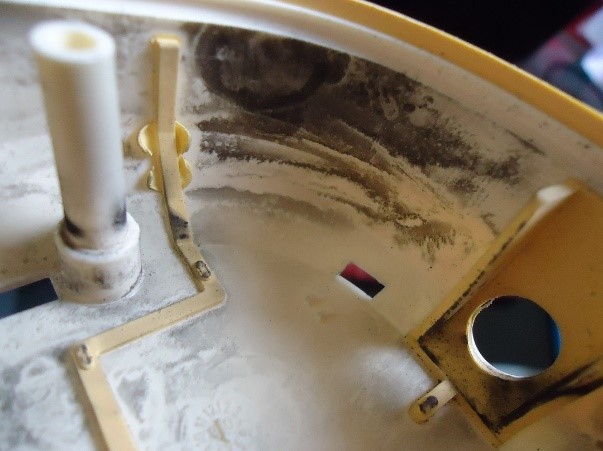
Open system breast pumps may grow mold over time and cannot be completely sterilized.

The type of pump you use also matters in terms of potential contamination (i.e., when foreign material can pass into the milk). What matters the most is whether a pump uses an “open” or “closed” system. A “closed” system breast pump has a physical barrier between the parts that touch your breastmilk (flanges, bottles, valves), and the tubing and pump motor (called the “backflow protector”). This keeps your milk sectioned off from the body of the pump. The parts that can easily be cleaned and sterilized are separate from the parts that cannot be cleaned and sterilized, like the interior of the pump motor. This is why hospital grade breast pumps are safe for multiple users – because they have this barrier.

The type of pump you use also matters in terms of potential contamination (i.e., when foreign material can pass into the milk). What matters the most is whether a pump uses an “open” or “closed” system. A “closed” system breast pump has a physical barrier between the parts that touch your breastmilk (flanges, bottles, valves), and the tubing and pump motor (called the “backflow protector”). This keeps your milk sectioned off from the body of the pump. The parts that can easily be cleaned and sterilized are separate from the parts that cannot be cleaned and sterilized, like the interior of the pump motor. This is why hospital grade breast pumps are safe for multiple users – because they have this barrier.

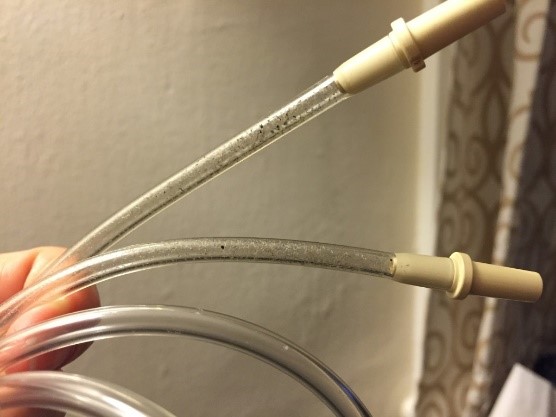
“Open” system breast pumps do not have barriers between the parts that touch your breastmilk and the tubing and pump motor. Because of this, moisture from pumping can enter the tubing and motor. Since mold flourishes in dark, moist places, the open system has a greater risk for mold growth. This means that impossible-to-clean places like the interior of a breast pump motor are very inviting to mold. The most common places to find mold in a breast pump are the tubing, the areas and valves that connect bottles to flanges, and the insides of pumps which have been stored for a long time in a moist basement.

How can I keep mold out of my breast pump and breastmilk?

Prevention of household mold may help prevent mold on your breast pump equipment. Also, a good breast pump should have a protective barrier between the flange (the funnel-shaped part that comes into contact with your breast) and the connected tubing. Pumps without this feature carry extra risk for milk and moisture to get into the tubes and create a breeding ground for mold.

Mold growing in the breast pump tubing.

All breast pump parts that come in contact with breastmilk should be cleaned and fully dried after each use. This includes flanges, bottles, valves and breast shields. You can eliminate possible contaminants by washing them with liquid dishwashing soap and warm water. Rinse each piece thoroughly with hot water for 10-15 seconds. Place the pieces neatly on a clean paper towel or on a clean drying rack and allow them to air dry. A dishwasher with a drying cycle can also be used. Avoid using cloth towels to dry your pump parts because they can carry germs and bacteria that are harmful to your breastmilk and your baby.

It is not necessary to clean breast pump tubing unless it comes in contact with breast milk. If you wash your tubing, make sure you hang it to air dry before attaching it to your breast pump. If small water drops (condensation) appear in the tubing after you have pumped, attach the tubes to the pump before you attach your flanges/bottles and turn the pump on for a few minutes until the tubing is dry.

What if I find mold in my breast milk?

At MotherToBaby UR Medicine, we have developed an algorithm (set of rules) to help people manage breastmilk that is potentially contaminated. It is meant to be used in hospitals for sick children, but can be useful for you and your health care provider. Most full-term, healthy, and older infants do not need the precautions outlined below. If you find foreign material in your breastmilk or pump parts, contact your baby’s pediatrician to get advice on what to do.

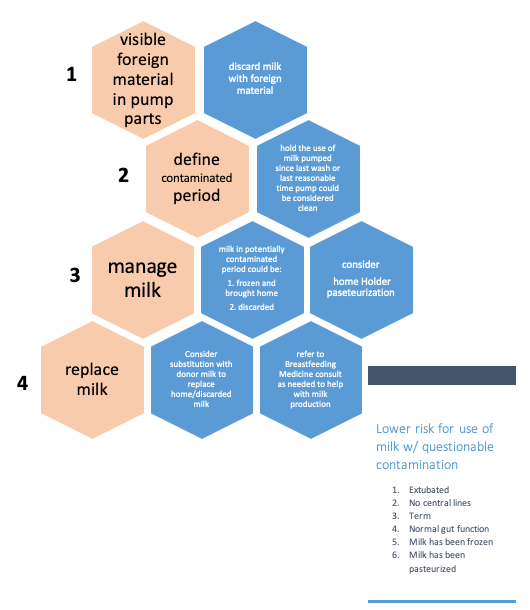
If your baby is sick or premature, consider sharing the information below with your baby’s provider if you find mold in your breastmilk or pump parts. It is meant to be followed in order from step 1, which includes discarding any milk with foreign material in it (like mold.) Step 2 can help to determine when any other expressed milk may have been affected. For instance, if you know you washed your pump 4 days ago and found the material today, any milk you pumped in the past 4 days could have been contaminated. Contaminated milk could be frozen, which is likely to kill most bacteria and many fungi, or it could be pasteurized using home pasteurization (Step 3). You also need to think about what should be fed to your baby in the meantime: do you have older, stored milk? Do you need donor milk? If you need to use formula, should it be “hypoallergenic?” (Step 4). These are good conversations to have with your baby’s doctor. If you don’t have enough breastmilk, some communities will have breastfeeding medicine specialty providers or lactation consultants who can help mothers with milk supply concerns. You can search for these providers online by clicking here.

Algorithm for decision-making when pump parts are found to contain foreign material (potential bacteria or fungus). The box at the lower right reminds providers which babies are at lowest risk from drinking milk that has any foreign material in it.

Last, we want to leave you with words of encouragement because we know breastfeeding isn’t easy. It’s downright hard for most. Having that said, please know that resources like MotherToBaby are here for you and just by reading this blog, you’re taking steps to ensure your milk is pumped and stored safely. You’re doing a great job and we can be certain your baby appreciates all you do.

Rogelio Perez D’Gregorio, MD, MS is an Assistant Director of MotherToBaby UR Medicine and Assistant Professor of Obstetrics and Gynecology at the University of Rochester.

Other blog contributions were made by:

Casey Rosen-Carole, MD, MPH, MSEd, FABM, IBCLC is Medical Director of Lactation Services and Programs, Assistant Professor of Pediatrics and OBGYN, and a Consultant for the Lactation Study Center and MotherToBaby URMedicine

Ruth A Lawrence, MD, DD (Hon) FABM, FAAP is Distinguished Alumna Professor Pediatrics and Obstetrics/Gynecology, Northumberland Trust Chair in Pediatrics, UR School of Medicine and Dentistry. Co-Director of the Finger Lakes Children’s Environmental Health Center.

REFERENCES:

Ameda. Is there mold in your breast pump equipment?

Centers or Disease Control and Prevention. Facts about Stachybotrys chartarum and Other Molds.

Eglash A, Liliana Simon L, et al. (2017). ABM Clinical Protocol #8: Human Milk Storage Information for Home Use for Full-Term Infants, Revised 2017. Breastfeed Med.;12(7):390-395.

FDA. U.S. Food and Drugs Administration. Breast pumps.

Hygela Health. Closed System Breast Pumps vs. Open System Breast Pumps.

Jennai L. Moms ABC. How to clean breast pup tubing mold.

La Leche League International. Pumping Milk.

Labiner-Wolfe J, Sara B. Fein SB, Katherine R. Shealy KR, et al. (2008). Prevalence of Breast Milk Expression and Associated Factors. Pediatrics 2008;122:S63–S68.

Magoha H, Kimanya M, De Meulenaer B, et al. (2014). Association between aflatoxin M1 exposure through breast milk and growth impairment in infants from Northern Tanzania. World Mycotoxin Journal. 7(3):277-284.

Spectra. Mould in your Breast Pump Tubing?

Stöppler MC. What is mold?

Walker M. (2012). Pumps and pumping protocols. Clinics in Human Lactation 10. Hale Publishing L.P.