Marijuana Safety in Pregnancy: Researchers Descend on Denver to Discuss Latest Data

Birth Defects Experts, Colorado Chief Medical Officer to Present at OTIS, Teratology Society, DNTS Annual Meeting

DENVER, COLORADO—“From exposure during pregnancy to a child’s neurological development, it is an understatement to say the legalization of marijuana has the potential to impact Colorado’s children and families,” said Larry Wolk, MD, Chief Medical Officer for the Colorado Department of Public Health and Environment. That “potential impact” is why Dr. Wolk will join top international researchers for a meeting never before held in Denver that brings together world-renowned experts presenting the science behind birth defects research.

The meeting, which is held jointly with the Organization of Teratology Information Specialists (OTIS), the Teratology Society and the Developmental Neurotoxicology Society this week at the Grand Hyatt Denver, will have a special focus on the effects of marijuana exposure during pregnancy. Dr. Wolk will serve as the Keynote Speaker Monday, June 26 at 8am. Then, a “Marijuana and Child Development Symposium,” which features scientists from the University of Colorado at Denver, University of California at San Diego, Yale University and the National Institute on Drug Abuse, takes place Tuesday, June 27 at 3:05pm.

According to MotherToBaby, a service of OTIS that offers information to the public about exposures during pregnancy and breastfeeding through traditional and digital avenues, the growing rate of marijuana use during pregnancy is “deeply concerning.” A federal survey published late last year indicated that almost 4 percent of expecting mothers said they had used marijuana in the past 30 days. This rate is almost twice that for other illicit drugs used in the previous month by pregnant women.
The survey was conducted in 2014. In a survey just 12 years prior, only 2.4 percent had said they used marijuana in the past month.

“As scientists specializing in the effects exposures can have during pregnancy, this trend is extremely worrisome and we’re here to work together to find answers,” said Stephen Braddock, MD, OTIS/MotherToBaby’s president and a professor of Pediatrics at Saint Louis University. “At MotherToBaby, we are frequently contacted by women who want to know if marijuana is safe in pregnancy. New information that will be shared at this meeting will help us to gain a better idea of what the risks are, so that we can better educate expectant and nursing moms as well as healthcare providers.”

“While data are somewhat limited, we know there are risks associated with marijuana use in pregnancy, but we also need to be thinking about the potential impact of cannabis on the adolescent brain,” added Diana Dow-Edwards, PhD, President-elect of the Developmental Neurotoxicology Society, marijuana symposium co-chair, and professor at SUNY Downstate Medical Center. “New and breakthrough science will be presented by some of our speakers and we hope the knowledge stimulates discussion among concerned Denver-area health care providers and the general public alike,” noted Susan Makris, PhD, Teratology Society Public Affairs Committee chair, marijuana symposium co-chair and a U.S. Environmental Protection Agency scientist.

Additional scientific information presented during the meeting includes e-cigarette use in pregnancy and the latest Zika virus findings. More information and the full annual meeting program may be found on the 57th Annual Meeting website. One day registration is available for any local scientists and health care providers interested in attending.

About OTIS/MotherToBaby
MotherToBaby, a service of the Organization of Teratology Information Specialists (OTIS), is a suggested resource by many agencies including the Centers for Disease Control and Prevention (CDC) and the Food and Drug Administration’s (FDA) Office of Women’s Health. OTIS was established in 1987 as a way of connecting world-renowned experts in the field of birth defects research to the general public. Today, MotherToBaby affiliates around the world provide the most cutting-edge and up-to-date information about the risks of medications, chemicals, herbal products, illicit drugs, diseases and much more during pregnancy and while breastfeeding. More than 100,000 women and their health care providers seek information about birth defects prevention from MotherToBaby every year. MotherToBaby has been able to embark on new outreach efforts to reach underserved populations and launch new communication technologies through a cooperative agreement with the U.S. Health Resources and Services Administration, as well as through the generous donations made by the public. To learn more about MotherToBaby, the ways to contact its network of experts via app, text, live chat, email and phone line, or how to support its services, please visit www.MotherToBaby.org.

About the Teratology Society
The Teratology Society is made up of nearly 700 members worldwide specializing in a variety of disciplines, including developmental biology and toxicology, reproduction and endocrinology, epidemiology, cell and molecular biology, nutritional biochemistry, and genetics as well as the clinical disciplines of prenatal medicine, pediatrics, obstetrics, neonatology, medical genetics, and teratogen risk counseling. Scientists interested in membership in the Teratology Society are encouraged to visit www.teratology.org. The society’s official journal, Birth Defects Research, is published by John Wiley & Sons in partnership with the Teratology Society.

About DNTS
The Developmental Neurotoxicology Society (DNTS) is focused on studies of the origins of neurodevelopmental disorders and the long-term effects of chemicals and drugs on health and well-being. We promote scientific research on the developmental origins of brain disorders at all life stages. For more information, please visit us at www.dntshome.org. The society’s official journal, Neurotoxicology and Teratology, is published by Elsevier in partnership with DNTS.
# # #
Media Contact: Nicole Chavez, 619-368-3259, nchavez@mothertobaby.org


Marijuana Safety in Pregnancy: Researchers Descend on Denver to Discuss Latest Data

In this session, Christina Chambers, PhD, MPH, a perinatal epidemiologist from UC San Diego and Principal Investigator of MotherToBaby Pregnancy Studies, reviews what is known and what still requires further study on the use of alcohol, cannabis and other substances by breastfeeding women, and how this translates to clinical practice. Participants should leave this session with a better understanding of the potential effects of substance use on infant growth and development, how knowledge gaps in this area are being addressed, and how to translate current knowledge into clinical situations in midwife practice.

Participants will gain a clearer understanding of the potential short- and long-term impacts of maternal substance use on infants and learn how ongoing research is addressing current knowledge gaps. The session will also focus on translating this evidence into practical clinical guidance, including strategies for counseling breastfeeding women, supporting informed decision-making, and integrating risk assessment into midwifery care.

This webinar is designed to enhance the knowledge and clinical skills of midwives and other healthcare providers involved in maternal-child health.

Continuing Education (CE) credits are available for ACNM members and non-members who view this session via the ACNM Online Learning Center.


Marijuana Safety in Pregnancy: Researchers Descend on Denver to Discuss Latest Data

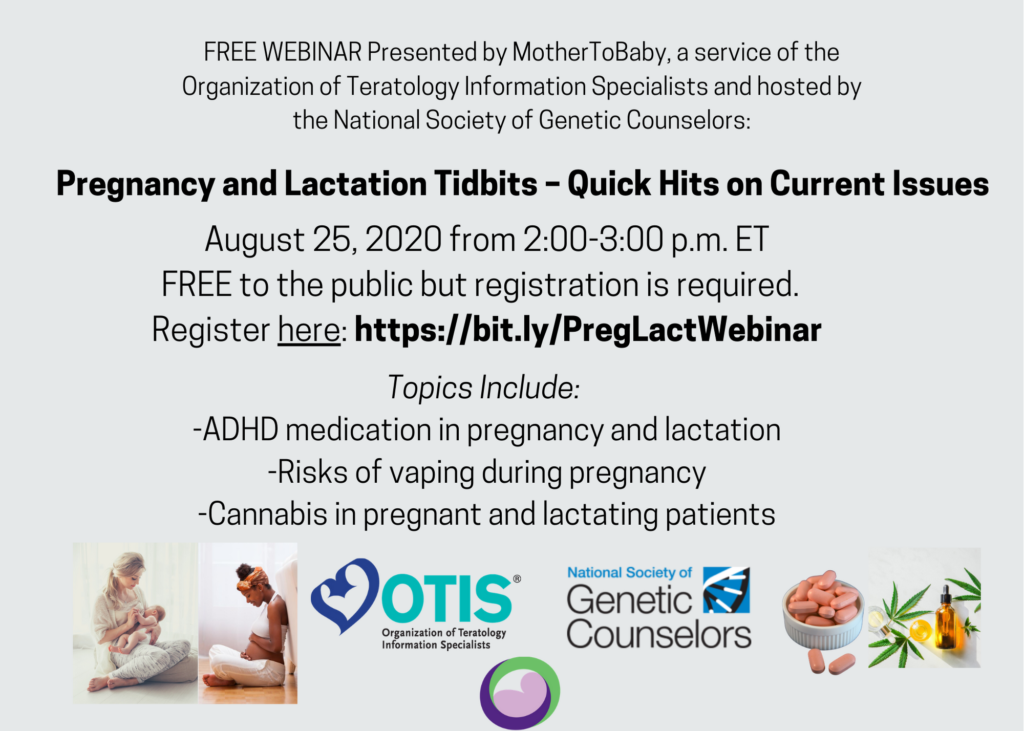
If you have listened to the news lately, you have probably heard of the outbreak of lung injuries and related deaths associated with e-cigarettes and vaping products. Breaking news by health experts have reported that tetrahydrocannabinol (THC) was present in most of the samples of the products and lung tissue collected from the injured individuals, but Vitamin E acetate was present in all of the samples that have been tested to date. While this is a major breakthrough, the experts are not ready to draw any conclusion as of yet, for it is possible that there are other ingredients involved. Here at MotherToBaby we strive to prepare for the questions that may arise from hot topics such as this for the women and providers we serve. Therefore, this seems as good a time as any to ask, “What do we know about vaping and pregnancy?” For the purpose of this blog, I’m going to focus on nicotine vaping.

What are ENDS?

Electronic nicotine delivery systems (ENDS) describe a variety of products that includes vaporizers, vape pens, hookah pens, tank systems, mods and electronic cigarettes (e-cigarettes). Although ENDS were originally developed as an alternative way to inhale tobacco products (like nicotine), the devices are now also used to vape other substances, like cannabis. Each of these devices work by heating a liquid to produce an aerosol that a person inhales into their lungs producing a mist (vape). The liquid in ENDS can contain: nicotine, tetrahydrocannabinol (THC), cannabidiol (CBD) oils, propylene glycol and glycerol.

Are ENDS a safer alternative than cigarette smoking in pregnancy?

ENDS products came on the market in the U.S. in 2007, and their popularity quickly grew. One of the reasons they grew in popularity was due to the belief that they were a safer alternative to cigarettes, and could help smokers quit or reduce the amount of cigarettes they smoke. Cigarettes contain nicotine and many other agents as well as carbon monoxide. Cigarette smoking during pregnancy has been associated with an increased chance of miscarriage, cleft lip or palate, premature birth (before 37 weeks) and SIDS (sudden infant death syndrome). Smoking has also been associated with an increase chance of infertility, ectopic pregnancy (a pregnancy that occurs outside of the uterus) and complications with the placenta (i.e., placental abruption and placenta previa). The issues with cigarette smoking are not only limited to pregnancy but continue after the birth of the child as well. Smoking has been associated with a higher chance for asthma, childhood obesity and behavioral problems.

While pregnancy is a big motivation for women to quit smoking, many struggle and look for a solution during pregnancy. Complicating the issue is the fact that many nicotine replacement therapies have not been well studied, and their effectiveness in helping smokers to quit has been questioned. Therefore, there is a hesitancy to use them. Also, medications to help stop smoking, like bupropion (Wellbutrin) and varenicline (Chantix), while not considered to pose a significant chance of birth defects, have limited data regarding their use in pregnancy. Recently the Food and Drug Administration (FDA) added warnings to the label regarding an increased chance of psychiatric effects including suicidal thoughts. This does not mean these medications should not be used by pregnant women who medically need them, but it shows how complex the issue of choosing an appropriate medication can be when you need to weigh the risks versus benefits. This leads pregnant women to find an alternative that might solve their problem and for some, ENDS seemed like the solution when they came on the market.

The effects of inhaling the substances contained in ENDS are not known, especially when it comes to pregnancy. One study has shown that users of e-cigarettes can obtain a substantial amount of nicotine from e-cigarettes that is comparable to regular cigarettes, and we do know that nicotine can cross the placenta. Animal data shows that exposure to the chemicals found in e-cigarettes can cause various effects on offspring that include impact to the immune system, lung and heart function, and neuro-development (related to the function of brains and nerves); unfortunately, so far there is no data to suggest what the impact in human pregnancy might be. In addition, while ENDS products may reduce exposure to many of the toxins in cigarettes, there is still exposure to nicotine and other toxic chemicals, which can pose an increased chance of harm to pregnancies. Also, some ENDS products that have stated they were free of nicotine have been tested and were actually found to contain nicotine.

There is no evidence to support ENDS as an effective way to stop smoking.

A recent review of the use of ENDS products among non-pregnant patients found no strong evidence that they help in the effort to quit smoking. Regardless of the lung injuries that are currently in the news, health experts recommend that pregnant women avoid all ENDS use. Instead, any pregnant woman who is struggling to quit smoking should talk with their health care provider to discuss a plan that is suitable to them and contact resources such as the National Quitline Network (1-800-QUIT NOW). Quitting is best for you and your child so go ahead and clear the air. Trust me; your baby will thank you.

References:

Whittington J. et al. 2018. The Use of Electronic Cigarettes in Pregnancy: A Review of the Literature. Obstetrical and Gynecological Survey. 73(9): 544-549

Committee on Underserved Women et al. 2017. Smoking Cessation During Pregnancy. 130(4): e200-e204.

Kuehn B. 2019. Vaping and Pregnancy. JAMA. 321(14)

Steenhuysen J. “UPDATE 1-U.S. CDC reports ‘breakthrough’ in vaping lung injury probe as cases top 2,000.” Reuters: Yahoo finance. 8 November 2019. Web 11 November 2019.


Marijuana Safety in Pregnancy: Researchers Descend on Denver to Discuss Latest Data

By Lorrie Harris-Sagaribay, MPH, Teratogen Information Specialist and
Coordinator, MotherToBaby North Carolina

Back in the early 1970s, pregnant women and their health care providers didn’t talk about alcohol and drugs in pregnancy. Birth defects caused by alcohol? Unheard of! Then, along came two pediatric specialists at the University of Washington who changed everything: Drs. David W. Smith and Kenneth Lyons Jones noticed that a group of babies who had been exposed to high amounts of alcohol during pregnancy were all born with a similar pattern of unusual facial features and developmental delay. Their astute observations, along with further research and collaboration, led them to coin the term Fetal Alcohol Syndrome (FAS) in 1973.

The discovery that alcohol was a teratogen (an exposure that can cause birth defects) fueled the research on other exposures and opened up a world of questions. What about other drugs? What about medications? In order to share findings from the limited but ongoing research, Dr. Jones established the first teratogen information service in 1979, housed in a small apartment in San Diego and run by a dedicated staff of three. This service was the beginning of what would later become MotherToBaby.

Fast forward to June 2017, when experts from MotherToBaby and other teratogen information services around the world gathered in Denver, Colorado for the 30th Annual Meeting of the Organization of Teratology Information Specialists (OTIS). There, dozens of experts presented the latest research on exposures during pregnancy. Speakers summarized what we’ve learned, pointed out what we still don’t know, and suggested priorities for future research. Here are a few highlights from the meeting:

Prescription Opioids
At one time, opiates were peddled as remedies for fatigue, menstrual cramps, and even teething in children (search Mrs. Winslow’s Soothing Syrup as an example). Now, more than a century later, we are in the middle of an epidemic of substance use disorders from opioid pain relievers. And according to a 2014 study, more than 14% of pregnant women in the U.S. are prescribed opioids at least once during pregnancy for reasons such as back pain and migraines. Pregnant women who develop opioid use disorders (either before or during the pregnancy) are encouraged to undergo maintenance therapy such as methadone treatment, which is less risky to the baby and more likely to result in successful recovery than sudden withdrawal would be.

Infants with ongoing exposure to opioids during pregnancy can experience withdrawal symptoms at birth, commonly called neonatal abstinence syndrome (NAS). Like Fetal Alcohol Syndrome, NAS was first described in the literature in the 1970s, by Dr. Loretta Finnegan. The syndrome has gotten renewed attention during the current opioid epidemic as providers and researchers consider the best ways to prevent and manage NAS. Studies have shown that hospitalized infants with NAS have better outcomes–less severe symptoms, less need for medication, and shorter hospital stays–when they are breastfed, even if the mothers are still on opioid maintenance therapy. But some health care providers hesitate to encourage breastfeeding in these cases out of concern about baby’s ongoing exposure to the mother’s medication through the milk. Continued funding can help address these concerns by developing consistent standards of care for infants with NAS. If you are using opioids for any reason, be sure to talk to your health care provider as soon as you find out you are pregnant. Together, you can work on a plan for the best possible care for you and baby during and after the pregnancy.

Cocaine
To study the effects of cocaine in pregnancy, researchers have followed a group of young adults, now in their early 20s, since they were born. About half the group was exposed to cocaine before birth. Early on, the researchers observed that those with cocaine exposure had challenges with attention and remembering what they saw when compared to the children who had not been exposed to cocaine. In older years, exposed children had more difficulty with language skills, more behavior problems at school and at home, reported more substance use and risk-taking behavior, and had more difficulty with everyday skills such as staying organized, thinking ahead, and controlling their own behavior. Some dropped out of school. Interestingly, having a positive home environment seemed to help with some, but not all, of these challenges. For example, children in foster or adoptive homes had better language and reasoning skills than children who still lived with their birth mothers who used cocaine, but there was no difference in their behaviors. As the study continues, researchers hope to learn more about how prenatal cocaine exposure affects these individuals into adulthood.

E-cigarettes
E-cigarettes are marketed and often seen as a “safer” option to cigarettes. In fact, the most common users are current and former cigarette smokers who are using e-cigarettes to replace or reduce the number of cigarettes they smoke. In a study of over 1,300 pregnant women, those using e-cigarettes reported doing so because they felt they were less harmful than cigarettes, or to help with smoking cessation. They also preferred the sweeter flavors, and thought they were even less harmful than the tobacco-flavored liquids.

E-cigarettes don’t expose users to the combustion by-products of traditional cigarettes, but even those labeled “nicotine-free” do contain nicotine, and vaporization creates its own potentially harmful by-products. Since e-cigarettes are liquid-filled and can be smoked longer, it’s more difficult to monitor actual exposure to nicotine than it is with traditional cigarettes. Plus, because e-cigarettes are not regulated by the FDA, there is no way of knowing exactly what they contain and what your pregnancy is exposed to when you use them.

Past studies have observed that prenatal exposure to nicotine affects baby’s brain development and increases the chance of later behavior problems and depression in adolescence. It even predicts baby’s own cigarette use in his/her teen years. And recent studies have shown that those adolescents who use cigarettes are more likely to also use e-cigarettes as teens and adults than their peers who don’t use cigarettes. We will learn more about the possible long-term effects of prenatal e-cigarette use as the first generation of children who were exposed to them in pregnancy gets older.

Marijuana
Marijuana is the most common “illicit” drug used in pregnancy. Some health care providers in Colorado, where marijuana is now legal, are seeing more pregnant women who believe that using it is not harmful and might even be beneficial. For example, pregnant women in one survey reported using marijuana to help manage depression or anxiety, help with pain, or ease nausea and vomiting, among other reasons. Without crucial data about exactly how marijuana might be harmful to a pregnancy, some health care providers are hesitant to talk to women about it, even if they know they are using it in pregnancy.

There is little doubt that marijuana can be harmful in pregnancy: THC crosses the placenta and, even in very early pregnancy, can affect the cells that form the baby’s brain. But studies on its effects on overall brain development and pregnancy outcomes have had mixed results so far, and they face challenges such as co-exposures (women using other substances along with marijuana) and, in some cases, relying on self-reporting to know how much of the drug a pregnancy is exposed to (this can skew the data if users do not accurately reveal how much and how often they use.) As researchers forge ahead to provide better answers, the best advice is still to avoid marijuana altogether in pregnancy.

Alcohol
Since those early years, we have discovered that the facial features and developmental delay often seen with FAS are not the only possible effects of prenatal exposure to alcohol. In some children, subtle changes to the brain might not be noticed until the child is older and begins to struggle with learning and behavior problems that can follow them into adulthood. This range of possible effects has been more recently named Fetal Alcohol Spectrum Disorder (FASD). According to Dr. Jones, FASD affects about 2% of babies born in the U.S. each year–more common than autism–despite the fact that it is 100% preventable.

Looking ahead.
The decades ahead require not only continued research, but also increased awareness of what we already know. To that end, each September we observe FASD Awareness Month. MotherToBaby is happy to answer your questions about alcohol and other exposures in pregnancy—in fact, check out our brief YouTube video here. Together, we can continue the work towards the best possible outcomes for future generations.

Lorrie Harris-Sagaribay, MPH is the Coordinator of MotherToBaby North Carolina and a bilingual Teratogen Information Specialist. After working with midwives as a community health educator with the Peace Corps in Honduras, she earned her Master of Public Health at the University of North Carolina at Chapel Hill. She has worked in the field of maternal and child health for over 25 years.

About MotherToBaby

MotherToBaby is a service of the Organization of Teratology Information Specialists (OTIS), suggested resources by many agencies including the Centers for Disease Control and Prevention (CDC). If you have questions about exposures during pregnancy and breastfeeding, please call MotherToBaby toll-FREE at 866-626-6847 or try out MotherToBaby’s new text information service by texting questions to (855) 999-3525. You can also visit MotherToBaby.org to browse a library of fact sheets about dozens of viruses, medications, vaccines, alcohol, diseases, or other exposures during pregnancy and breastfeeding or connect with all of our resources by downloading the new MotherToBaby free app, available on Android and iOS markets.

References:

Bateman BT et al. Patterns of Opioid Utilization in Pregnancy in a Large Cohort of Commercial Insurance Beneficiaries in the United States. Anesthes 2014;120(5):1216-1224.

McQueen K and Murphy-Oikonen J. Neonatal Abstinence Syndrome. N Engl J Med 2016; 375:2468-2479.

Presented at the (joint) Annual Meetings of OTIS (Organization of Teratogen Information Specialists), DNTS (Developmental Neurotoxicology Society), RSA (Research Society on Alcoholism) and the Teratology Society in Denver, Colorado on June 25-27, 2017:

  • From the FAS to OTIS – A Long Strange Trip. Buzz Chernoff, California Environmental Protection Agency (Retired).
  • The Opioid Epidemic and Impact of Prenatal Exposure on Child Development. Lynn Singer, Case Western Reserve University.
  • Project Newborn: What We Have Learned from 20 Years of Research on Prenatal Cocaine Exposure. Sonia Minnes, Case Western Reserve University.
  • Epigenetic Changes Induced by Prenatal Nicotine and Cocaine Exposure. Pradeep Bhide, Florida State University.
  • Effects of Prenatal Nicotine Exposure on Adolescent Dopamine Systems. Frances Leslie, University of California at Irvine School of Medicine.
  • Electronic Cigarette Use in Pregnancy: Patient and Provider Perspectives. Katrina Mark, University of Maryland School of Medicine.
  • Pathways from Prenatal Tobacco Exposure to Electronic Cigarette Use. Natacha M. DeGenna, University of Pittsburgh School of Medicine.
  • Perceptions and Use of Electronic Cigarettes during Pregnancy: Implications for Infant Outcomes. Laura Stroud, Brown Medical School.
  • Pathways from Prenatal Exposures to Tobacco and Cannabis to Adult Electronic Cigarette Use. Natacha De Genna, University of Pittsburgh Medical School.
  • Counseling Women about Prenatal Marijuana Use: Weeding through the Data. Torri D. Metz, University of Colorado-Denver.
  • Introduction: Marijuana and Child Development Symposium. Diana Dow-Edwards, SUNY/Downstate Medical Center.

Marijuana Safety in Pregnancy: Researchers Descend on Denver to Discuss Latest Data

When Your Bundle of Joy Comes with a Bundle of Questions – We’re Your Experts

MotherToBaby is the nation’s most trusted source of evidence-based information on medications and other exposures during pregnancy and while breastfeeding. MotherToBaby Fact Sheets summarize all the available scientific information to determine whether or not parents and their developing babies are at risk because of an exposure. We offer over 300 Fact Sheets on a wide variety of exposure topics that are available to the public 24/7 in English and Spanish. Our Fact Sheets cover many common pregnancy and breastfeeding exposures that a woman may experience, including prescription and over-the-counter medications, recreational substances, cosmetic treatments, maternal health conditions, infections, vaccines, chemicals, and workplace exposures.

Our Fact Sheets are not the only way that MotherToBaby provides information about the benefits or risks of exposures that a woman who is pregnant or breastfeeding may encounter. Our experts also provide personalized information by live chat, text, phone, and email at no-cost to to residents of the United States and its territories. If our database of Fact Sheets does not include the exposure that you are interested in or if you have additional questions about the exposure, please don’t hesitate to contact our information specialists.

Everyone should have access to accurate information to make the best health decisions for themselves and their family.

While our experts are steeped in scientific backgrounds, we focus on communicating information about pregnancy and breastfeeding exposures in an easy to read format through multiple channels, including The MotherToBaby Podcast and our Baby Blog. You can listen to The MotherToBaby Podcast to hear from host, MotherToBaby specialist, and mom-of-four, Chris Stallman, as she takes listeners’ questions on exposures and engages guest experts to address what’s okay and what’s not during pregnancy and breastfeeding. You can also read our Baby Blogs, which provide helpful information on some of today’s most pressing exposure topics.

Our team knows so much about pregnancy and breastfeeding exposures because we are also top researchers in the field of birth defects prevention and medication use in pregnancy and breastfeeding. Our MotherToBaby Pregnancy Studies are observational research studies that aim to answer questions about whether a person’s health conditions and treatments affect their pregnancy. Our research has been instrumental in identifying previously unrecognized exposures that can be harmful to pregnancy, as well as ruling out substantial risk for other medications and vaccines. MotherToBaby Pregnancy Studies provides study opportunities to residents of the United States and Canada. The information yielded by our research gets included on medication labels and can be used by the public and their health professionals to make treatment decisions during pregnancy.

Browse below to find our most popular exposure topics and to access related fact sheets, blogs, podcasts, ongoing observational MotherToBaby Pregnancy Studies, and more. Check back frequently as we are constantly adding new resources and updating existing information!

Immunizations & Vaccine-Preventable Illnesses 

What pregnant and breastfeeding parents need to know.

Antibiotics

Treating Infections while Pregnant or Breastfeeding.

ADD/ADHD

Get more info on treating attention-related disorders during pregnancy and breastfeeding.

Alcohol

More harmful than cocaine, meth or heroin – why you should avoid alcohol if pregnant or breastfeeding.

Allergies

Pregnancy and breastfeeding information for allergy sufferers plagued with a stuffy nose, sneezing and itchy eyes.

Ankylosing Spondylitis

Spine pain? We’ve got info on AS and treatment during pregnancy and breastfeeding.

Anxiety

Feeling anxious about anxiety? Access resources for managing anxiety during pregnancy and breastfeeding.

Asthma

Breathing for two – access info on asthma and its treatment during pregnancy and breastfeeding.

Cannabis

Marijuana, pot, whatever you call it – we’ve got info you need if pregnant or breastfeeding.

Colds & Flu

The 4-1-1 on sniffling, sneezing, coughing, aching, and fever during pregnancy and breastfeeding.

Constipation

Getting relief from constipation should not be a strain – access info for women who are pregnant and/or breastfeeding.

Cosmetics

Get the latest information on cosmetics and treatments for hair, skin, nails & more.

COVID-19

Critical info on the novel coronavirus for people who are pregnant, planning to be, or breastfeeding.

Depression

You are not alone visit our resources for managing depression before, during, & after pregnancy.

Eczema

Access resources for the most common skin condition in pregnant and breastfeeding women.

Foods and Beverages 

Eating and drinking for two can raise a lot of questions – we’ve got your answers! 

High Cholesterol

At the heart of it all – get info for women who are pregnant and/or breastfeeding with high cholesterol.

Inflammatory Bowel Disease

Follow your gut – get info on IBD and its treatment while pregnant or breastfeeding.

Juvenile Idiopathic Arthritis

JIA may be diagnosed in the childhood years, but its impact can be felt in adulthood.

Lead

A heavy metal that can be found in common household objects can affect your developing baby.

Lupus

Nearly 9 out of every 10 people with lupus are women. Will it influence you or your baby’s health?

Mental Health

Managing a mental health condition before, during or after pregnancy? What you need to know.

Morning Sickness

Information on nausea and vomiting that you need to know when your bundle of joy is making you hurl.

Multiple Sclerosis

Important info and resources on MS and its treatment during pregnancy and while breastfeeding.

Natural Disasters

When the unexpected happens, we have the critical information you need to know to safely make it through a natural disaster.

Opioids

In the face of a nationwide opioid epidemic, access our resources for both people who are pregnant and/or breastfeeding and health providers.

Psoriasis

Get comfy with the skin you’re in – explore our resources on psoriasis, pregnancy and breastfeeding.

Psoriatic Arthritis

Flare-up fears? We’ve got skin and joint disease info for pregnant and breastfeeding moms.

Rheumatoid Arthritis

Swelling, stiffness, and pain from RA – could it impact pregnancy or breastfeeding?

Sexually Transmitted Infections

Talking openly about STIs, pregnancy, and breastfeeding.

Tetanus, Diphtheria, & Pertussis Vaccine 

Why Tdap is a vaccine moms-to-be won’t want to miss 

Preparing to hit the road, cruise, or fly the friendly skies when you’re pregnant or breastfeeding

Zika Virus

How can someone minimize their baby’s risk of exposure to the Zika virus through travel or from their partner?