In Your Area


Your browser does not support SVG

Select Your State for MotherToBaby Affiliate Info & Resources


MotherToBaby is a service of the non-profit Organization of Teratology Information Specialists (OTIS), and is dedicated to providing evidence-based information to mothers, health care professionals, and the general public about medications and other exposures during pregnancy and while breastfeeding. Our MotherToBaby affiliates provide localized support to their community and surrounding regions to make sure people and their health providers have accurate and current information about the possible effects of a particular drug or substance on a pregnancy or a breastfed infant.

OTIS-MotherToBaby-Affiliates

Our experts are available through our confidential, free information service via toll-free phone at 866.626.6847 or via text message at 855.999.3525. You can also email an expert or live chat with us. Our trained experts have a variety of backgrounds in the health care field and include doctors, genetic counselors, nurses, and researchers.

MotherToBaby has offices throughout the U.S. that cover all 50 states and U.S. territories. We also have a location in Quebec, Canada that locally supports French-speaking healthcare providers. To find information about your MotherToBaby Affiliate local experts, events, activities and resources, select your state.

MotherToBaby’s pregnancy and breastfeeding exposure information services are available only for residents of the United States and the U.S. territories. MotherToBaby Pregnancy Studies provides study opportunities to residents of the United States, its territories, and Canada. For services that are available in other regions of the world, please visit: https://mothertobaby.org/international/.

MotherToBaby Arizona

MotherToBaby Arizona is located at the University of Arizona in Tucson. It serves residents in the states of Arizona, Colorado, Kansas, Iowa, New Mexico, North Dakota, and South Dakota.

MotherToBaby California

MotherToBaby California is located at the University of California San Diego’s Center for Better Beginnings. It serves residents in the states of Alaska, California, Hawaii, Idaho, Montana, Nevada, Oregon, and Washington, as well as the US Territories of American Samoa, Guam, the Northern Mariana Islands, Puerto Rico, and the US Virgin Islands.

MotherToBaby Connecticut

MotherToBaby Connecticut is located at UConn Health. It serves residents in the states of Connecticut, Delaware, Massachusetts, Maine, New Hampshire, New Jersey, Pennsylvania, Rhode Island, and Vermont.

MotherToBaby Florida

MotherToBaby Florida is located at the University of South Florida College of Medicine. It serves residents of Florida.

MotherToBaby Georgia

MotherToBaby Georgia is located at Emory University’s School of Medicine. It serves residents in the states of Alabama, Georgia, Tennessee, and Mississippi.

MotherToBaby Nebraska

MotherToBaby Nebraska is located at University of Nebraska Medical Center. It serves residents of Nebraska.

MotherToBaby New York

MotherToBaby New York is located at the University of Rochester Medical Center. It serves residents of New York as well as the states of Indiana and Illinois.

MotherToBaby North Carolina

MotherToBaby North Carolina is located at the Fullerton Genetics Center at Mission Hospitals. It serves residents in the of District of Columbia, Kentucky, Maryland, North Carolina, South Carolina, Virginia, and West Virginia.

MotherToBaby North Texas

MotherToBaby North Texas is located at the University of North Texas in Denton. It serves residents in northern Texas as well as those in the states of Arkansas, Louisiana, Michigan, Minnesota, Missouri, Ohio, Oklahoma, Wisconsin, and Wyoming.

MotherToBaby Texas TIPS

MotherToBaby Texas TIPS in located at the University of Texas Health Science Center at Houston. It serves residents of southern Texas.

Centre IMAGe: Info-Medicaments en Allaitement et Grossesse

IMAGe is located at the CHU Sainte-Justine Hospital mother and child university hospital center at the Université de Montréal in Montréal, Quebec, Canada. It serves the province of Quebec, Canada. IMAGe accepts calls from health providers. It does not handle inquiries about diseases and hazardous materials in the workplace.

About Us

For more than 40 years, our team has been providing information on exposures in pregnancy and breastfeeding.

In Your Area

Download Important Resources Today

The educational tools below offer more information about important exposure topics during pregnancy and breastfeeding. Developed in collaboration with partners who are topic experts, these free resources are available for download and sharing. To view or download infographics in your preferred language, click the corresponding button. For additional details about specific exposures, explore our resource hubs, fact sheets, Baby Blog, and the MotherToBaby Podcast.


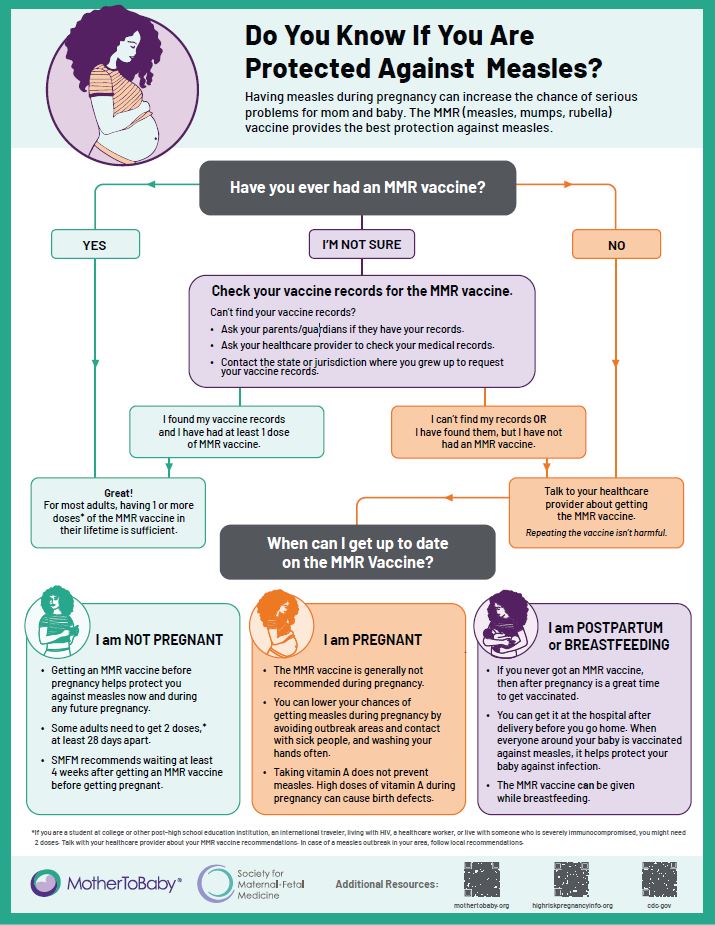
Measles Protection Decision Tree

Please see the Measles Protection decision tree that helps determine if you are protected against measles and suggests next steps for getting vaccinated if needed. This information is provided by MotherToBaby in collaboration with the Society for Maternal-Fetal Medicine.

Visit our additional resources on measles and the MMR vaccine. 


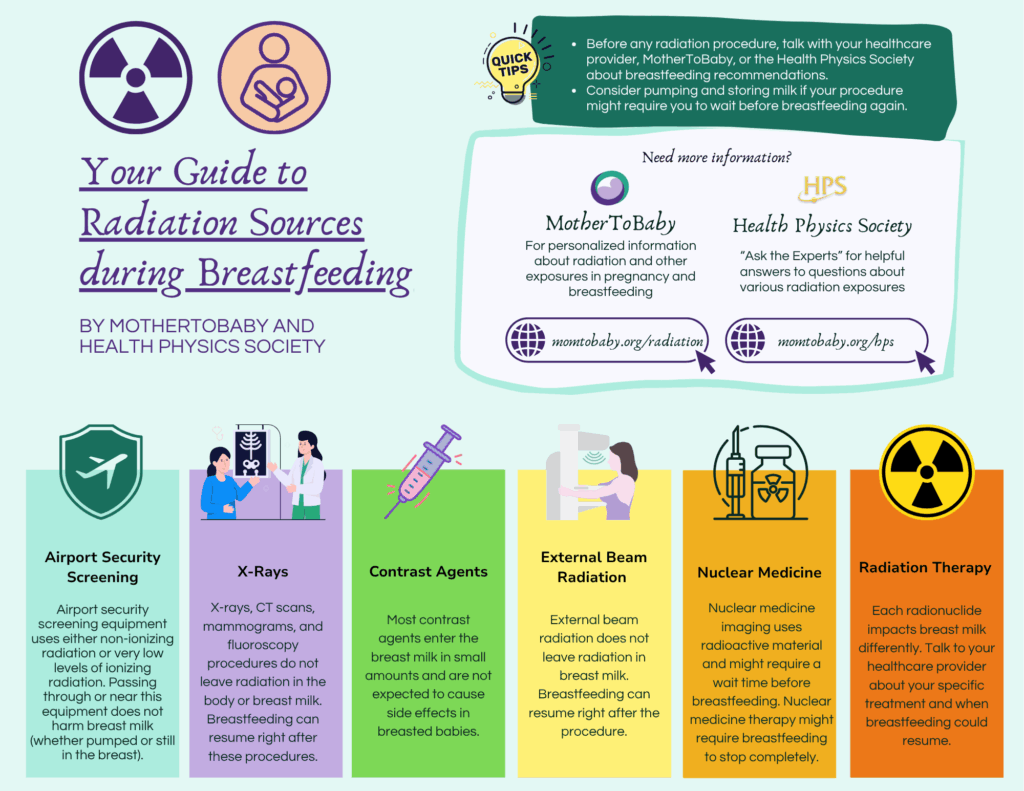
Radiation in Pregnancy and Breastfeeding Infographics

Please see the radiation infographics, developed in collaboration with the Health Physics Society, that describe common sources of radiation exposure. The infographics provide a simple, effective way to communicate a complex topic, and offer clarity about whether or not different sources of radiation might be a concern during pregnancy or while breastfeeding.

Visit our additional resources on radiation during pregnancy and breastfeeding.


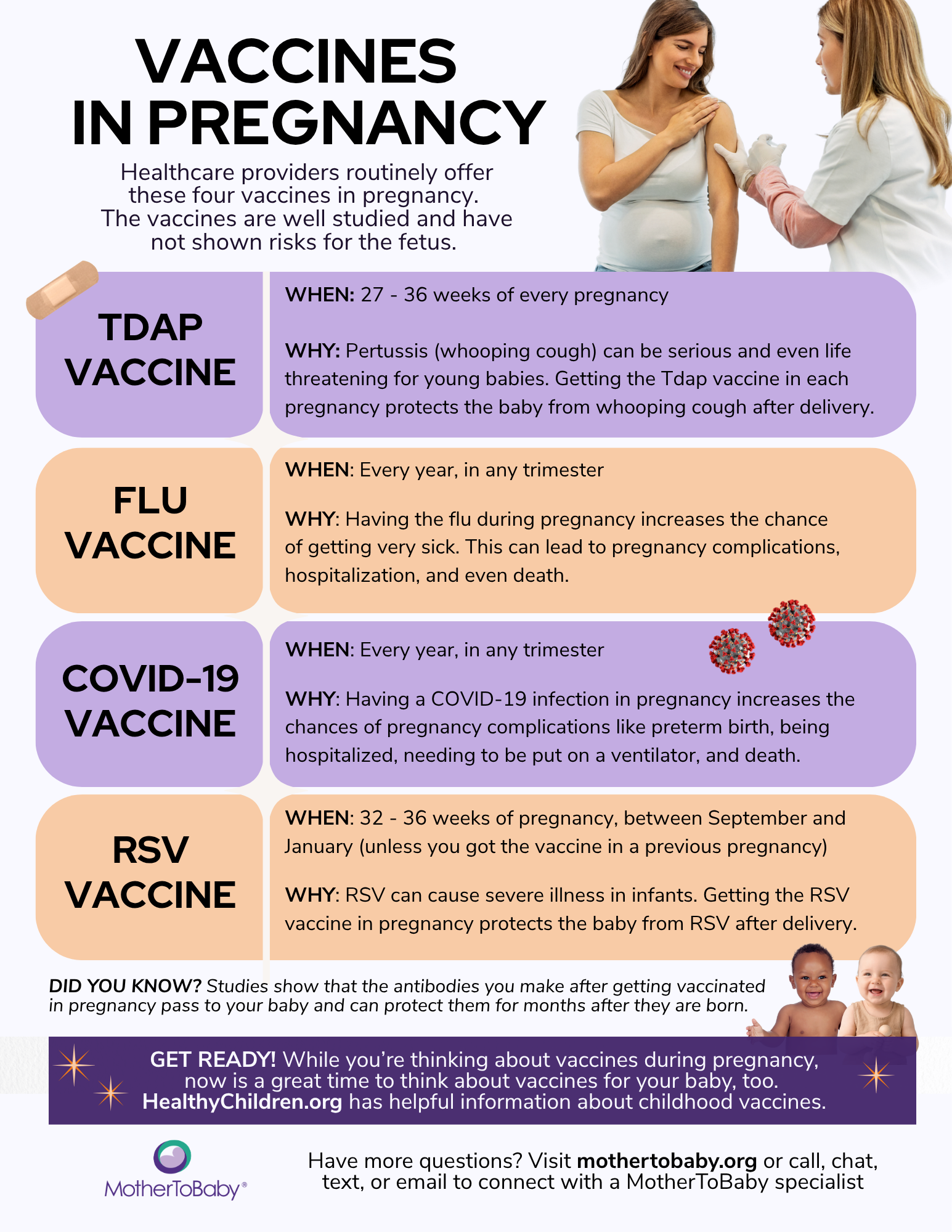
Vaccines In Pregnancy Infographic

Please see the Vaccines in Pregnancy infographic that describes vaccines that are recommended during pregnancy to protect you and your baby from serious illnesses. The infographic provides information in plain language about the risks of respiratory viruses like flu and COVID-19, the benefits of vaccination, and specific timing for when to get the flu shot, COVID-19 vaccine, RSV vaccine, and Tdap vaccine during pregnancy.

Visit our additional resources on vaccines during pregnancy and breastfeeding.


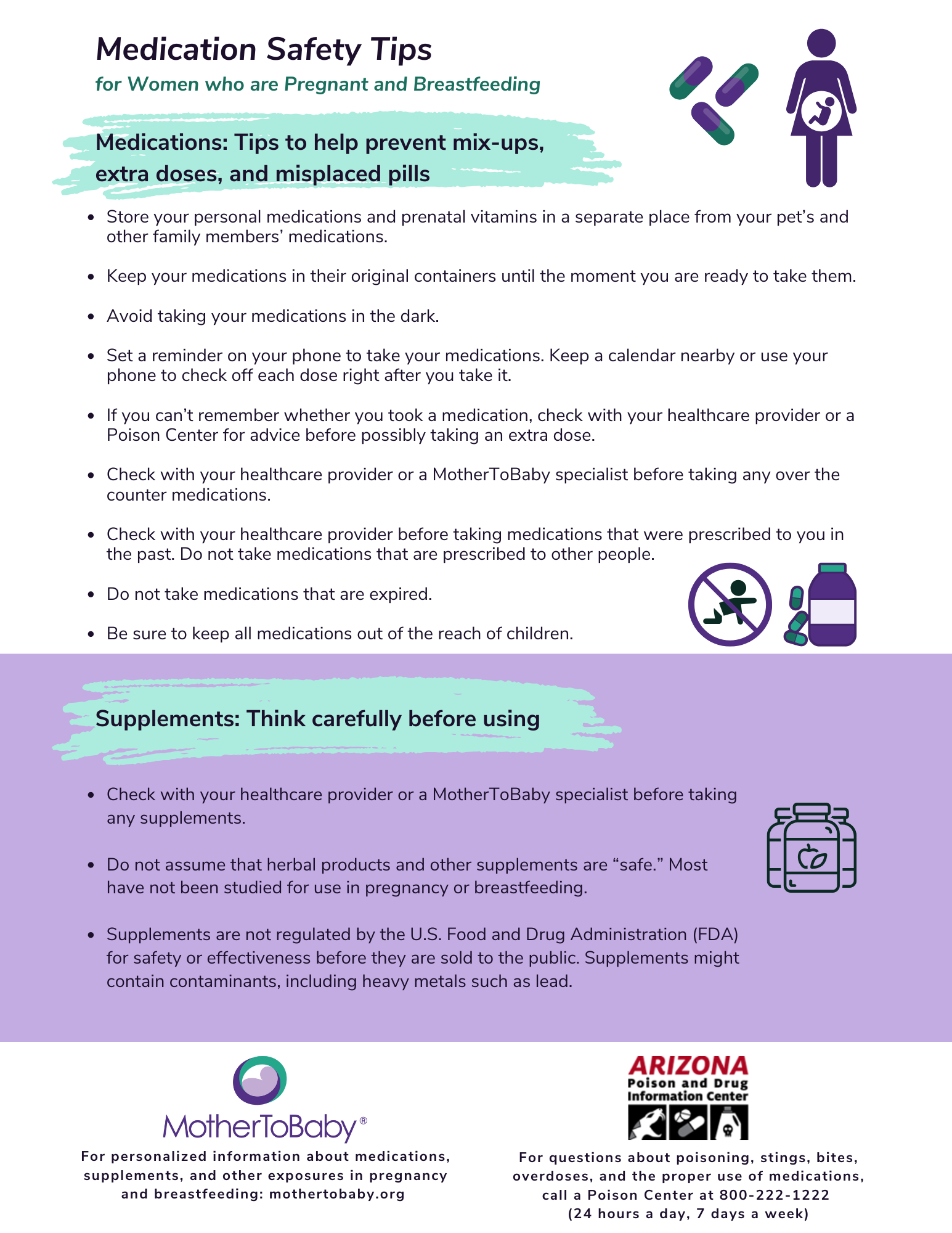
Medication Safety Tips Sheet

Please see the Medication Safety Tips sheet that provides suggestions to help prevent medication mistakes and what to consider before using supplements during pregnancy and while breastfeeding. This information is provided by MotherToBaby in collaboration with the Arizona Poison and Drug Information Center.


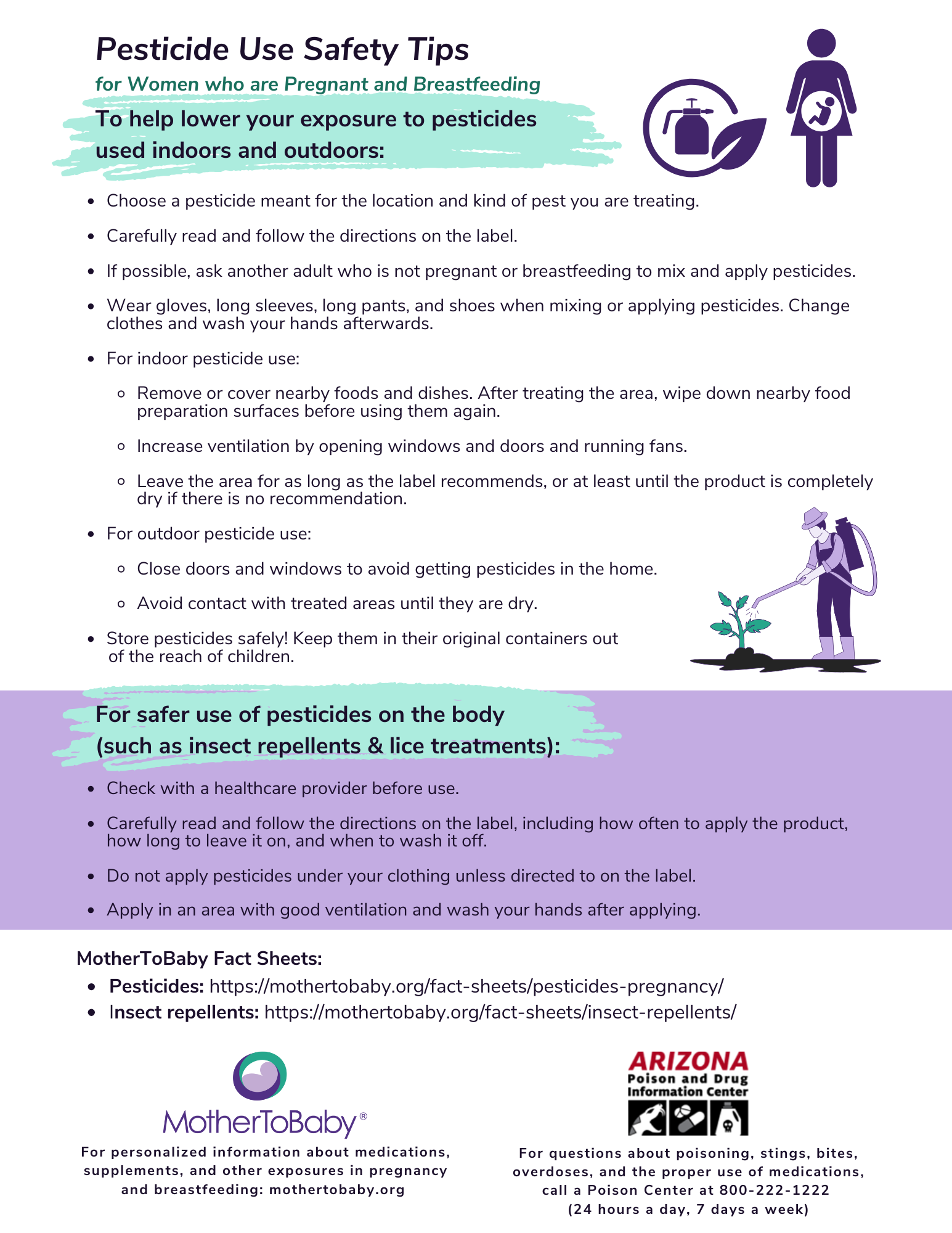
Pesticide Use Safety Tips Sheet

Please see the Pesticide Use Safety Tips sheet that provides suggestions for reducing your exposure to pesticides used indoors and outdoors and tips for safer use of pesticides on the body. This information is provided by MotherToBaby in collaboration with the Arizona Poison and Drug Information Center.


In Your Area

Melissa, pregnant for the first time, live chatted with MotherToBaby through our website: “Hi, I’m 29 weeks pregnant and wondering about vaccines. I have seen so many different things online and I am worried about getting really sick while I’m pregnant. Can you help?”

Melissa is not alone. Many people contact MotherToBaby to find the most up-to-date information about vaccines during pregnancy. Protecting yourself from circulating viruses can also help protect your developing baby. Infections such as influenza, pertussis, rubella, chicken pox, and COVID-19 can cause serious problems in both a pregnant woman and her developing baby. Let’s navigate through the current recommendations.

Plan to Receive Some Vaccines Prior to Pregnancy

You may have heard there are some vaccines, like measles, mumps, and rubella (MMR) and chickenpox (varicella), you should not receive during pregnancy. These “live” vaccines are avoided as they are made from viruses or bacteria that have been weakened, but not killed. Due to the small chance that a live vaccine might cause the disease itself, live vaccines are not routinely given to pregnant women.

So how can you protect yourself and your developing baby from viruses like measles, mumps, rubella (MMR) and chicken pox if it is not recommended (also known as contraindicated) to receive the vaccines during pregnancy? The Centers for Disease Control and Prevention (CDC) consider people who have received one or more doses of MMR vaccine during their lifetime to be protected for life. Adults who never got the MMR vaccine should get at least 1 dose (or 2 doses for some people at higher risk of infection) before pregnancy. Those who have never had chickenpox or received a chickenpox vaccine should get 2 doses of varicella vaccine, at least 4 weeks apart, before pregnancy. If you aren’t sure if you ever got vaccinated for MMR or chickenpox or unsure if you had chickenpox in the past, you can safely receive the necessary live vaccines before that positive pregnancy test! Out of an abundance of caution (small possibility of that infection) it is advised to wait at least one month before becoming pregnant after these vaccines. This is just one reason why it is beneficial to have a pre-pregnancy health checkup and to discuss any future conception plans with your provider!

So, which vaccines should you receive during pregnancy?

CDC recommends all women who are pregnant receive the flu shot and updated COVID-19 vaccine each year, a Tdap (tetanus diphtheria pertussis) vaccine in each pregnancy, and an RSV (respiratory syncytial virus) vaccine (if you have not received one in a previous pregnancy).These vaccines are not live vaccines and have not been associated with an increased chance for birth defects or pregnancy complications. (A nasal spray vaccine is also available against influenza, but it is a live vaccine and not recommended in pregnancy).

Influenza vaccine (flu shot)

The flu shot usually becomes available in September and is offered throughout flu season. CDC recommends getting a flu shot by the end of October despite flu seasons varying in their timing each year. This timing helps protect a pregnant woman before flu activity begins to increase. Protection begins about two weeks after you get the flu shot and lasts at least six to eight months. It is necessary to receive the seasonal flu shot each year to be protected in the current flu season. Getting vaccinated during your pregnancy may also help protect your baby from getting sick during the first 6 months of life! This is especially important because infants less than 6 months of age cannot receive the flu vaccine.

COVID-19 vaccine

It is well known that pregnant women are more likely to get very sick from COVID-19 compared to those who are not pregnant. This is why is so important to receive an updated COVID-19 vaccine every year, any time before or during pregnancy, for the best protection against severe illness. CDC recommends staying up-to-date with COVID-19 vaccines every year: https://www.cdc.gov/covid/vaccines/stay-up-to-date.html.

Tdap vaccine

“I just had a Tdap vaccine a couple years ago – so I don’t need another one, right?” Melissa asked a very common question we receive regarding the Tdap vaccine during pregnancy. Although this vaccine is recommended for adults every 10 years, for women who are pregnant, receiving the shot in the 3rd trimester (specifically 27-36 weeks gestation) can help the baby get as many of the mother’s antibodies as possible. After delivery, these antibodies provide some protection against pertussis, also known as whooping cough (a very contagious respiratory infection), until the baby can receive his/her own dTAP vaccine (starting at 2 months of age). Additionally, if everyone who lives with you and any caregivers get the vaccine, it can lower the chance for the baby to be exposed to pertussis.

RSV vaccine

The RSV vaccine protects both pregnant women and their babies from RSV, a virus that can cause serious breathing problems in babies. CDC recommends a single dose of the Abrysvo® RSV vaccine between 32 and 36 weeks of pregnancy, during the RSV season (September-January). As with the flu and Tdap vaccines, this maternal vaccine helps the pregnant woman create antibodies that can pass to the baby, giving the baby some protection from an RSV infection after birth. By getting this vaccine, pregnant women can help keep their newborns safe from serious health complications. Melissa, being 29 weeks, can now plan an upcoming RSV vaccine appointment!

Pregnant women who receive vaccines can also share their experiences with maternal health researchers, like MotherToBaby. Our studies are published in medical journals and product labels, and can help others like you when navigating vaccine decisions in pregnancy.

There are no Vaccines to Prevent Some Infections

Many people are packing their bags for a getaway during the summer months. If you are considering an upcoming vacation or babymoon, it’s important to protect yourself from viruses and infections with the appropriate vaccines for that area. Where are you headed? Check with your healthcare provider regarding any specific travel vaccines you might need. CDC recommends discussing any travel plans with your provider at least 4-6 weeks before your trip. Contact MotherToBaby to check the information on any vaccines your healthcare provider recommends

Viruses like Zika, malaria, and Oropouche can be spread by mosquitos and biting flies (midges). These infections can increase serious risks in pregnancy. Since there are no vaccines to prevent these infections, the safest approach during pregnancy would be to not travel to areas with any possible level of risk. Should you choose to travel, it’s important to protect yourself using the recommended insect repellents among other ways to help prevent bites while traveling.

Although Melissa didn’t have any trips planned for the rest of her pregnancy, she was happy to know about these other infections she wasn’t even thinking about!

Other Precautions

Although masks are no longer required in most public areas, this is still a great way to reduce the risk for infections while around others!  Good hand washing is also the most simple and effective way to prevent the spreading of germs to keep you healthy.

After chatting with Melissa, she decided to make her appointment for her COVID-19 and Tdap vaccines (you can get them at the same time!) and will go in ASAP when the flu vaccine for this season is available. She felt reassured knowing she had decided to give herself and her developing baby the best protection from these illnesses as possible.  “Thank you for all this info! I just want to make the best choice for me and my baby – I feel so much better.”

Do you have questions about vaccines during pregnancy? Call, chat, text, or email MotherToBaby!

References:

https://mothertobaby.org/fact-sheets/vaccines-pregnancy/

https://mothertobaby.org/pregnancy-studies/

https://www.cdc.gov/vaccines/by-age

https://www.cdc.gov/vaccine-safety/about/pregnancy.html


In Your Area

tiger-mosquito-49141_1920by the MotherToBaby Public Affairs Committee

UPDATED STATEMENT AS OF FEBRUARY 4, 2016

MotherToBaby Experts Offer Evidence-Based Information about Zika Virus during Pregnancy
On February 1, 2016 the World Health Organization (WHO) declared “A Global Public Health Emergency” over the Zika virus, due to its suspected ability to cause microcephaly in unborn babies (1). The Centers for Disease Control and Prevention (CDC) “developed interim guidelines for healthcare providers in the United States caring for women during a Zika virus outbreak.” (2) These guidelines include recommendations for pregnant women considering travel to an area with Zika virus transmission and recommendations for disease testing, ultrasound testing, and management of pregnant women returning to the United States after traveling to areas where the virus is being transmitted. Since some infected, pregnant women will not show symptoms, providers may consider additional ultrasound testing. The CDC states that, in addition to the routine ultrasound testing at 18-20 weeks of pregnancy, “additional ultrasounds might provide an opportunity to identify findings consistent with fetal Zika virus infection and offer pregnant women the option of amniocentesis to test for Zika virus RNA.” (3) These CDC guidelines will be updated as more information becomes available.
MotherToBaby, a service of the non-profit Organization of Teratology Information Specialists (OTIS), is suggested as a resource by many agencies including the CDC and the Food and Drug Administration’s (FDA) Office of Women’s Health. MotherToBaby offers evidence-based information about exposures, such as the Zika virus, during pregnancy and breastfeeding through its toll-free phone line (866-626-6847), text message (855-999-3525) and digitally via email and live chat on www.MotherToBaby.org.

We can cover topics such as:
• Mode of transmission
• Regions where it has been identified
• Symptoms of infection
• Effects of the infection and symptoms on the pregnancy
• Effects of treatment of the infection and symptoms on the pregnancy
• Prevention of infection
• Central nervous system (CNS) malformations
• Information on types of testing depending on when the infection occurred

References:
1) http://www.npr.org/sections/thetwo-way/2016/02/01/465163095

2) http://www.cdc.gov/mmwr/volumes/65/wr/mm6502e1.htm

3) https://www.cdc.gov/zika/hcp/clinical-pregnant/index.html

OFFICIAL STATEMENT AS OF JANUARY 13, 2016

Recently, there have been reports of the Zika virus cases and its possible effect on a pregnancy. While information is currently limited, there are some things we know:

Zika virus was first identified in Africa in 1947. In 2013, there were outbreaks in islands in the Pacific, and now outbreaks are being reported in many Central and South American counties. Isolated cases have been also reported in Puerto Rico and Texas in the last few weeks.

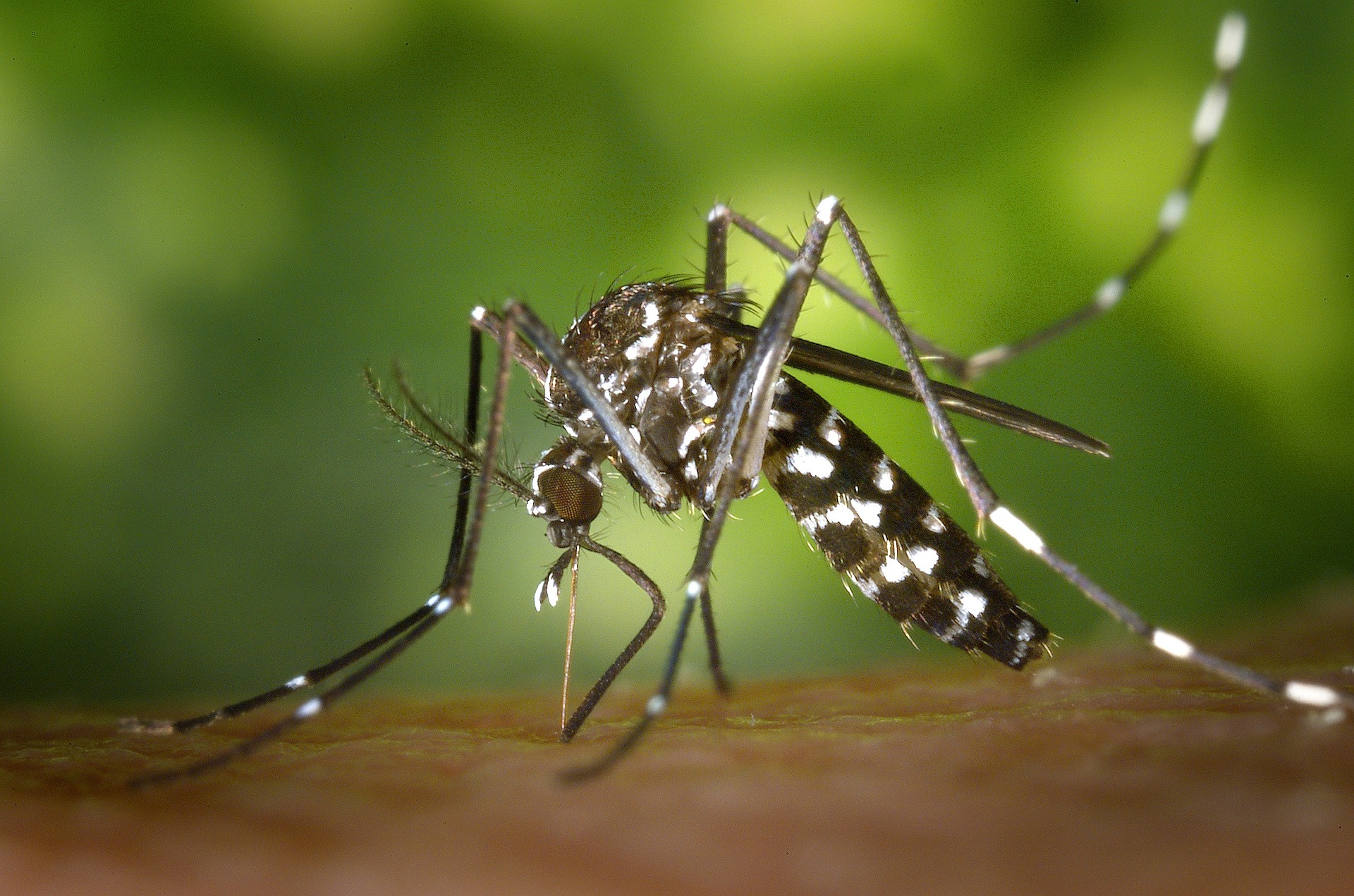
Zika virus is spread by mosquito bites. Symptoms of the Zika virus include fever, headache, joint and/or muscle pain, conjunctivitis (“pinkeye”) and sometimes a rash.

There have been reports of microcephaly (small head and brain) in the babies of pregnant women who were infected with the Zika virus during pregnancy. Research is ongoing to determine if Zika virus is the cause of microcephaly in infants whose mothers were infected with the virus during pregnancy and if the stage of pregnancy plays a role.

There is no vaccine or cure for the Zika virus. Symptoms are treated as they arise (such as using acetaminophen to treat fever and/or headaches). Prevention is the best approach. That includes using bug repellent (including formulas that contain DEET- https://mothertobaby.org/fact-sheets/deet-nn-ethyl-m-toluamide-pregnancy/), wearing protective clothing, and removing standing water where mosquitoes live. For more information, please visit http://www.cdc.gov/zika/prevention/index.html.

If you have questions or concerns about the Zika virus, please contact a bilingual (English/Spanish) MotherToBaby expert by calling 1-866-626-6847 or texting questions to 855-999-3525 (standard text messaging rates may apply). You can also chat live or send an email through www.MotherToBaby.org.

MotherToBaby is a suggested resource by many agencies including the Centers for Disease Control and Prevention (CDC) and the Food and Drug Administration’s (FDA) Office of Women’s Health. More than 100,000 women and their health care providers seek information about birth defects prevention from MotherToBaby every year.


In Your Area

PBS – As many parents struggle with decisions about whether or not they should vaccinate their children, diseases that were once nearly eradicated in many parts of the world are making a comeback. Why is whooping cough now an epidemic? Measles and mumps are back with a fury as well. NOVA’s “Vaccines- Calling the Shots” gives a historical background about vaccines and the threats the once nearly-extinct diseases are posing in today’s society.

Watch the documentary here:

Many pregnant mothers contact MotherToBaby because they are concerned about the risks of flu vaccination to their unborn child. Studies have shown that prenatal exposure to some vaccines, such as the flu shot, is not associated with negative outcome. In fact, diseases like the flu can carry a much greater risk to the mother and her developing fetus than the vaccine that prevents the infection. It is important for mothers and other adults who come in contact with children to be vaccinated against the flu.

If you have questions about specific vaccines during pregnancy or breastfeeding call MotherToBaby toll-FREE at 866-626-6847. You can also browse our Fact Sheets, which cover several common vaccines and their risks during pregnancy/breastfeeding here.

MotherToBaby is recommended by many agencies including the Centers for Disease Control and Prevention (CDC).