Addiction

Considerations for Clients with Substance Use Disorders during Pregnancy and Lactation

Clients who are battling substance use disorder often face many challenges in their battle to achieve sobriety. These challenges can often be compounded when the client is pregnant or breastfeeding. MotherToBaby supports addiction specialists who are working with pregnant and lactating clients. Our resources will help you learn about the risks of maternal substance use during pregnancy and while breastfeeding, so you can counsel your patients accordingly. We also welcome the opportunity to work directly with you and/or your clients by answering questions about pregnancy and breastfeeding exposures; our no-cost, evidence-based information service is available by phone, text, email, and live chat.

The first 1000 days of life, starting at conception, have been established as a critical window of time for long-term health and development. It is therefore crucial to understand the impact substance use has on pregnancy, breastfeeding, maternal–infant bonding, and child outcomes. 

Louw, 2018

Explore how we can help you and your pregnant and breastfeeding patients by providing no-cost exposure risk assessments, patient education materials, and more.

Exposure Information

We provide no-cost, evidence-based info on exposures during pregnancy or breastfeeding by phone, text, email, and chat.

Request Materials

We offer free patient education materials and provider resources for our information service and pregnancy studies.

LactRx App

Download our LactRx app for on-the-go access to the Library of Medicine’s LactMed database for current information on medications for substance use disorders as well as other drugs and vaccinations to which breastfeeding mothers may be exposed.

Partners


Addiction

January is Birth Defects Prevention Month, and it’s a great time to remind ourselves that there are several things that pregnant women can do to reduce their chance of having a baby with a birth defect. Our 5 tips for preventing birth defects include:

  1. Book a visit with your healthcare provider before stopping or starting any medicine.
  2. Be sure to take 400 micrograms (mcg) of folic acid every day.
  3. Before you get pregnant, try to reach a healthy weight.
  4. Become up to date with all vaccines, including the flu shot.
  5. Boost your health by avoiding harmful substances during pregnancy, such as alcohol, tobacco, and other drugs.

Top 5 Tips for Preventing Birth Defects

Reviewing this list of tips reminded me of a call I answered last month as a Teratogen Information Specialist at MotherToBaby North Texas. The woman calling, Beatriz, was upset and concerned. She had just found out that she was about five weeks pregnant. As she suffers from chronic migraine headaches, Beatriz was taking Valproic Acid, a medication that has been shown to be effective in preventing migraines. Beatriz had done a little research on her own and knew that there could be an increased risk for birth defects in women taking this medication while pregnant. She went on to explain that she had been planning to become pregnant, and was trying to do everything right, including reaching a healthy body weight, getting her flu shot a couple of months ago, and taking her daily vitamin with folic acid. But… as often happens, Beatriz got pregnant earlier than she had planned. Hence her panic and many questions!

Tip #1: Talk to Your Healthcare Provider

I explained to Beatriz that I often talk with women in these types of situations. So I started by reminding Beatriz that with every pregnancy there is a small 3-5% background chance for having a baby with a birth defect. As Beatriz had learned from her own research, taking Valproic Acid in the first part of a pregnancy increases the risk for spina bifida by 1-2%. Spina bifida is a birth defect that occurs when a baby’s spine and spinal cord don’t form properly. Upon hearing this confirming information, Beatriz immediately stated that she would stop taking her medication to take away this possible increased risk. I responded that it is always best to talk with your healthcare provider before stopping or starting any medications during pregnancy. They know you and your pregnancy best, and can give you personalized advice, not just general information. I told Beatriz that before making any changes to her medication, she really needs to discuss with her healthcare provider the benefits of taking the medication versus the risk to staying on the medication.

Tip #2: Folic Acid

Beatriz mentioned she has been taking a daily prenatal vitamin with folic acid as she knew that she was planning to get pregnant. Folic acid is the lab-made form of the vitamin folate (vitamin B9). Folate is necessary for making and maintaining healthy cells in your body. Taking recommended amounts of folic acid has been shown to reduce the percentage of babies born with birth defects, including spina bifida, a birth defect that occurs when a baby’s spine and spinal cord don’t form properly. Starting at least one month before pregnancy, the recommended daily amount of folic acid is 400 micrograms (mcg), or 0.4 milligrams (mg). During pregnancy, the recommended daily amount is 600-800 mcg. Many daily and prenatal vitamins already contain the required amount of folic acid. Beatriz checked the vitamin she had been taking and saw that it did contain 800 mcg of folic acid.

Tip #3: Healthy Weight

While planning to become pregnant, Beatriz has also mentioned that she been eating a better diet and had started an exercise program. She was happy to report to me that she has lost 25 pounds over the past six months and is now at a healthy body weight. Now that Beatriz knows she is pregnant, she can continue an exercise program that is appropriate for pregnancy. I told Beatriz she might want to chat with her healthcare provider and ask any questions she may have about appropriate exercise during pregnancy, such as walking and swimming.

Tip #4: Vaccines

I asked Beatriz about vaccinations, and she said she is up-to-date on all her vaccines, including having received her flu vaccine earlier this fall. It is recommended that women who are pregnant (whether in their first, second, or third trimester) or planning to become pregnant get the seasonal flu shot given by injection. The flu shot is a dead, inactive vaccine and there is not a known increased risk for birth defects or other pregnancy problems. Beatriz also mentioned that she plans to talk with her healthcare provider about getting the pertussis vaccine (known as TDaP), as this vaccine can help protect her baby from whooping cough, a potentially serious illness for babies.

Tip #5: Harmful Substances

Beatriz also reported to me that she had already stopped drinking alcohol as she knew there is not a known safe level of alcohol use when pregnant, and she also did not use any tobacco or other drugs. These are critical steps in preparing for a healthy pregnancy, as outlined in another one of our blogs.

After reviewing all of this information with Beatriz, she stated that she would call her healthcare provider in the morning to discuss whether she should stop taking Valporic Acid and determine if there any alternative treatments for her migraines that might be safer in pregnancy. Beatriz was happy to hear that she was well prepared for her pregnancy, having already successfully completed 4 of the 5 recommended tips. Even though Beatriz became pregnant a few months earlier than she had wanted to, she was now excited and thrilled to be pregnant.

So what’s the takeaway from Beatriz’s story? There are things you can do to prepare yourself for a healthy pregnancy and to decrease the chance of having a baby with a birth defect. So if you are pregnant or planning to become pregnant, do yourself and your baby a favor and review the 5 tips. And as always, if you have any questions about an exposure during pregnancy – such as a medication, supplement, vaccine, or recreational substance – our MotherToBaby specialists are here to help!

Recommended Fact Sheets
Abatacept (Orencia®)
ACE Inhibitors
Acetaminophen (Paracetamol)

Related Blogs
Lorem Ipsum Dolor Sit Amet
Consectetur Adipiscing Elit
Ulum Psuere Lorem Ipsum Dolor

Featured Podcasts
Lorem Ipsum Dolor Sit Amet
Consectetur Adipiscing Elit
Ulum Psuere Lorem Ipsum Dolor


Addiction

Download Important Resources Today

The educational tools below offer more information about important exposure topics during pregnancy and breastfeeding. Developed in collaboration with partners who are topic experts, these free resources are available for download and sharing. To view or download infographics in your preferred language, click the corresponding button. For additional details about specific exposures, explore our resource hubs, fact sheets, Baby Blog, and the MotherToBaby Podcast.


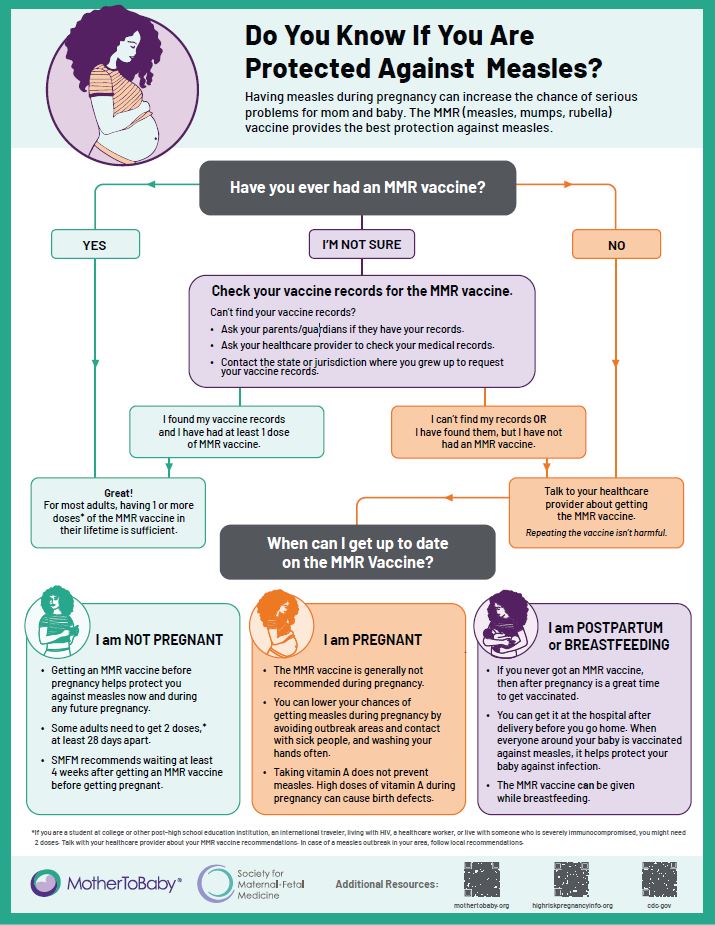
Measles Protection Decision Tree

Please see the Measles Protection decision tree that helps determine if you are protected against measles and suggests next steps for getting vaccinated if needed. This information is provided by MotherToBaby in collaboration with the Society for Maternal-Fetal Medicine.

Visit our additional resources on measles and the MMR vaccine. 


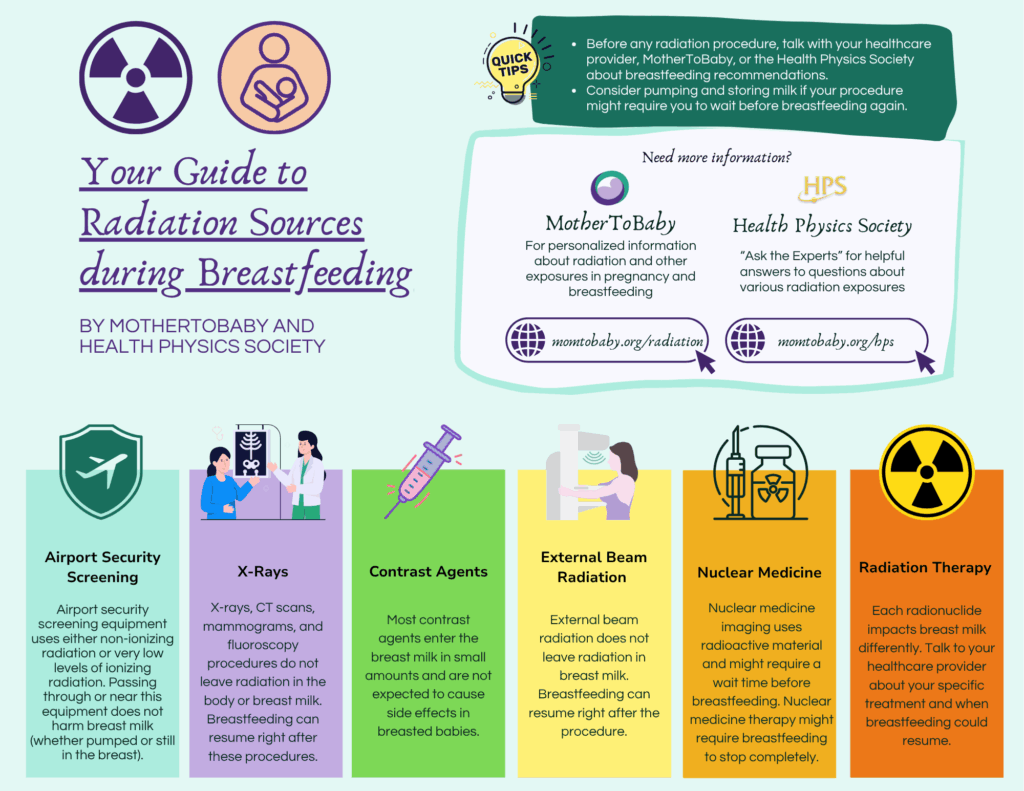
Radiation in Pregnancy and Breastfeeding Infographics

Please see the radiation infographics, developed in collaboration with the Health Physics Society, that describe common sources of radiation exposure. The infographics provide a simple, effective way to communicate a complex topic, and offer clarity about whether or not different sources of radiation might be a concern during pregnancy or while breastfeeding.

Visit our additional resources on radiation during pregnancy and breastfeeding.


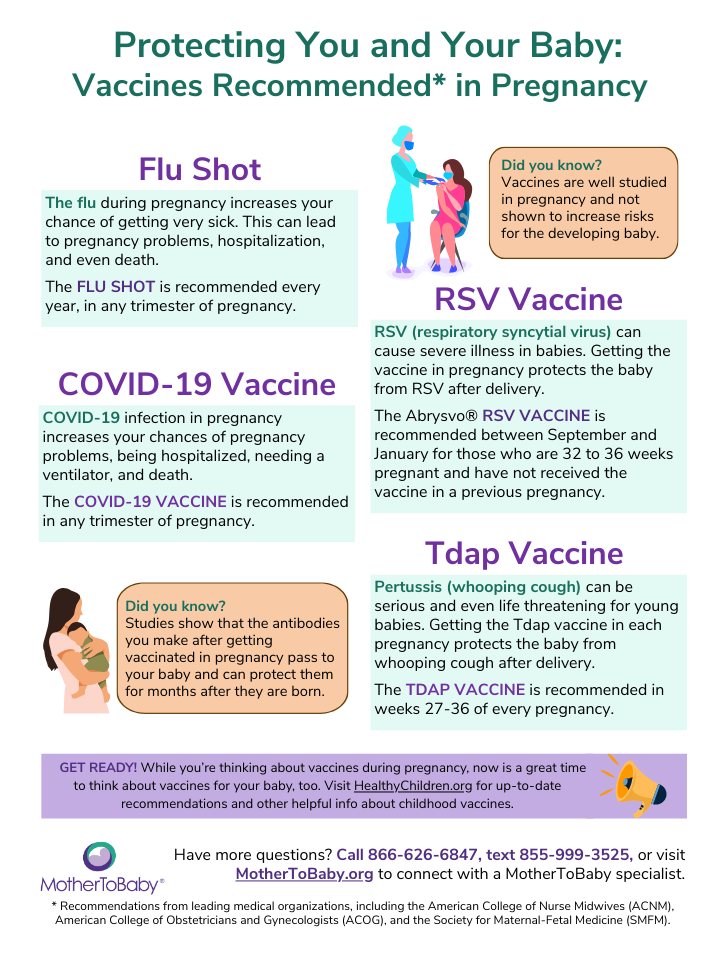
Vaccines In Pregnancy Infographic

Please see the Vaccines in Pregnancy infographic that describes vaccines that are recommended during pregnancy to protect you and your baby from serious illnesses. The infographic provides information in plain language about the risks of respiratory viruses like flu and COVID-19, the benefits of vaccination, and specific timing for when to get the flu shot, COVID-19 vaccine, RSV vaccine, and Tdap vaccine during pregnancy.

Visit our additional resources on vaccines during pregnancy and breastfeeding.


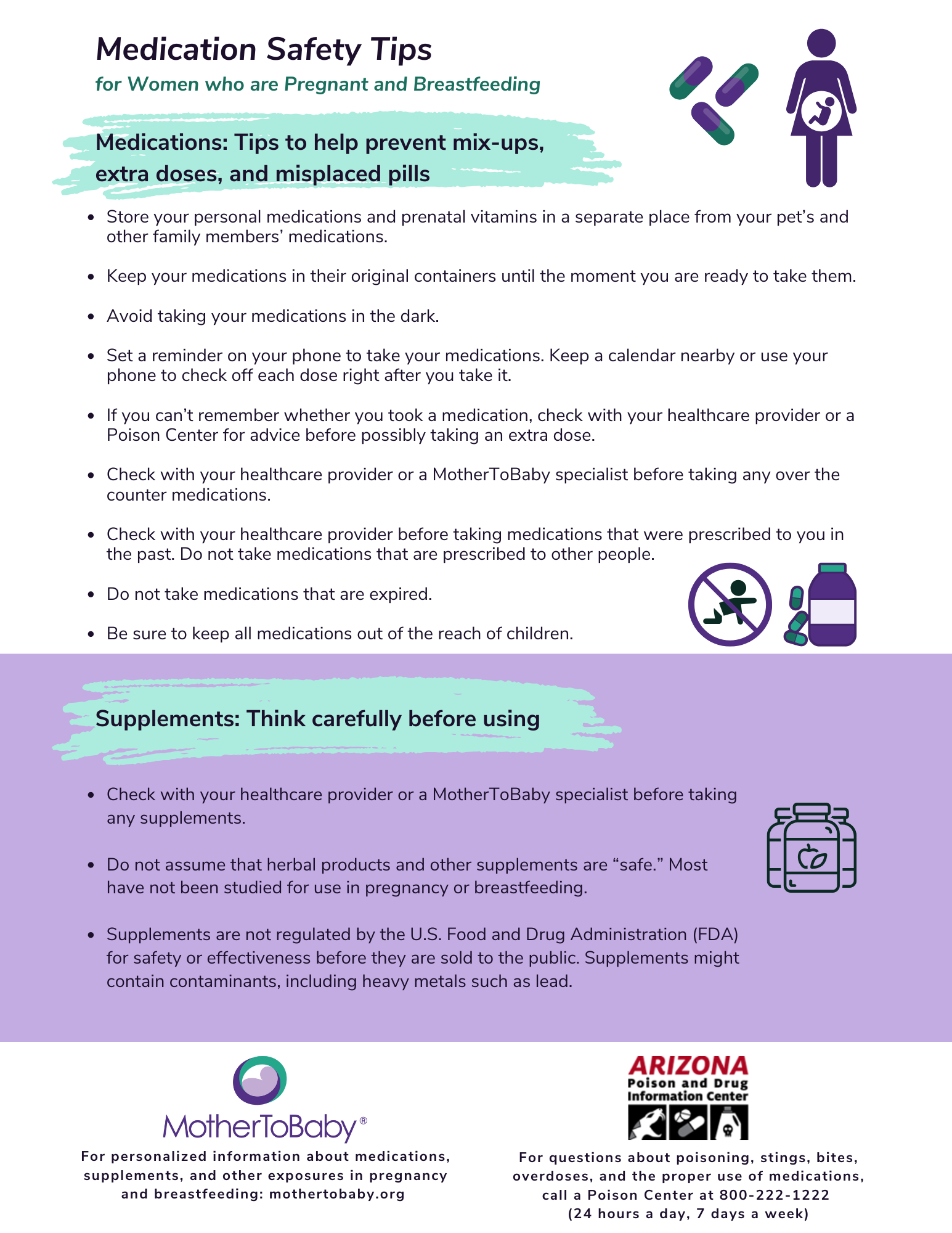
Medication Safety Tips Sheet

Please see the Medication Safety Tips sheet that provides suggestions to help prevent medication mistakes and what to consider before using supplements during pregnancy and while breastfeeding. This information is provided by MotherToBaby in collaboration with the Arizona Poison and Drug Information Center.


Pesticide Use Safety Tips Sheet

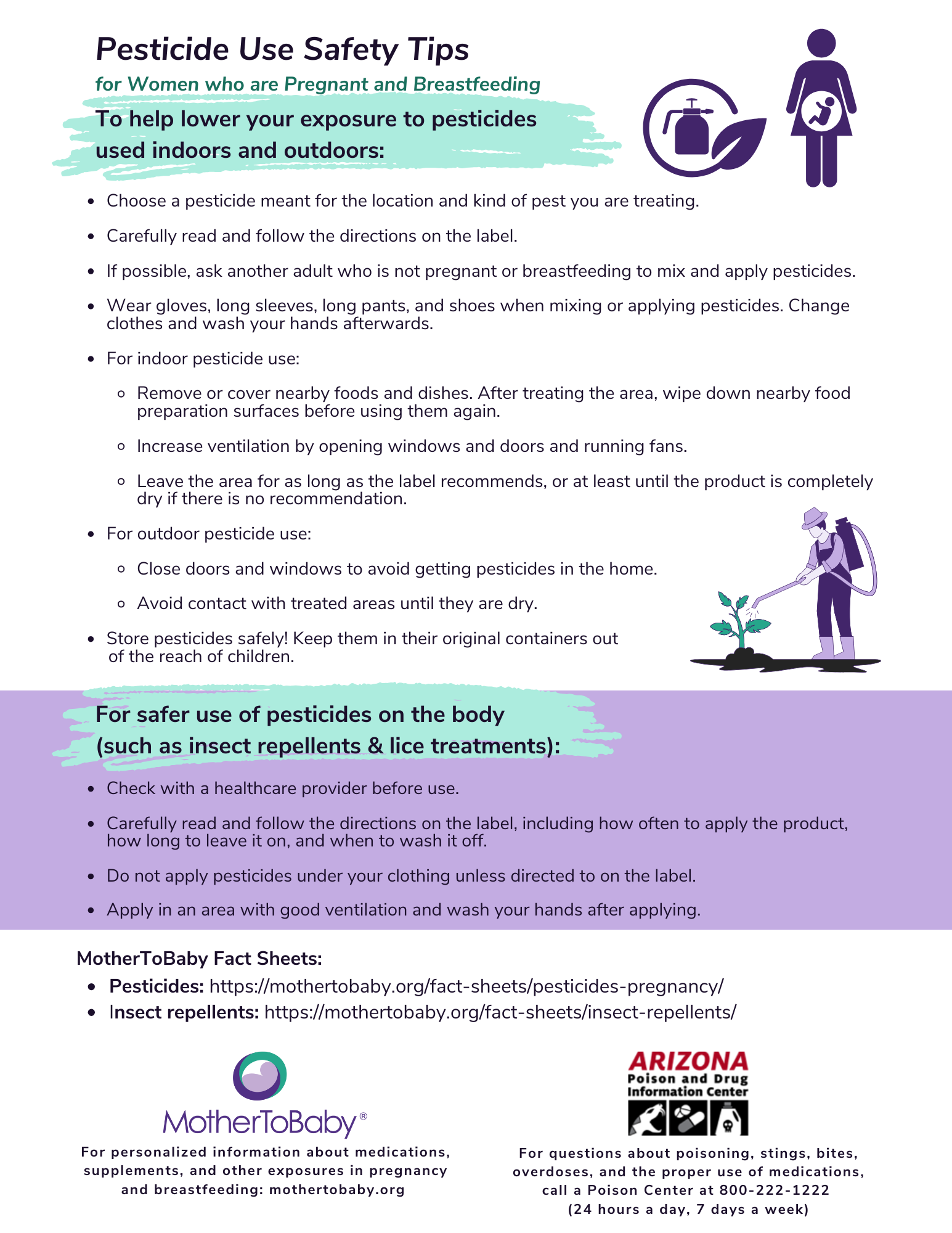
Please see the Pesticide Use Safety Tips sheet that provides suggestions for reducing your exposure to pesticides used indoors and outdoors and tips for safer use of pesticides on the body. This information is provided by MotherToBaby in collaboration with the Arizona Poison and Drug Information Center.


Addiction

MotherToBaby is the Leading National Resource on Exposures during Pregnancy and Breastfeeding

BRENTWOOD, TN – The non-profit Organization of Teratology Information Specialists (OTIS), which provides the MotherToBaby free service, receives new funding aimed at enhancing partnerships to address birth defects, infant disorders and related conditions, and the health of pregnant and postpartum people. The grant is supported by the Centers for Disease Control and Prevention (CDC).

The funding is a five-year award beginning October 1, 2023. “This remarkable funding is a testament to our tireless dedication to staying ahead of the curve when it comes to diseases, infections, and empowering the public with the latest information,” said Alfred Romeo, RN, PhD, President of MotherToBaby. “We are thrilled to collaborate with numerous organizations to amplify the impact of our vital work,” he added.

Great strides will be made under this grant, including collecting and disseminating data, developing and distributing data-driven resources, forging valuable partnerships, and fostering community engagement to raise awareness of the invaluable services provided by MotherToBaby.

“This support is a game-changer, enabling us to further equip pregnant and breastfeeding individuals with crucial information, especially during health crises like the recent COVID-19 pandemic,” Romeo emphasized. “The partnerships we build will help us navigate the next emerging issue affecting people who are pregnant and breastfeeding.”

MotherToBaby provides information on exposures, like medications, vaccines, diseases, herbal supplements, occupational exposures and more before and during a pregnancy as well as while breastfeeding. The service is provided through its no-cost helpline 866-626-6847, texting service 855-999-3525 and website www.MotherToBaby.org, where the public can live chat, e-mail an expert or browse a library of fact sheets in English and Spanish. Additionally, MotherToBaby hosts LactRx, a free app providing current information on the use of medications, vaccines, diagnostic agents, and drugs of misuse during breastfeeding. LactRx is available for iPhone and Android.

More about OTIS and MotherToBaby

The Organization of Teratology Information Specialists (OTIS) is a professional scientific society made up of individuals engaged in assessing and evaluating risks to pregnancy and breastfeeding from environmental exposures. Members include, but are not limited to, specialists in the fields of obstetrics and gynecology, pediatrics, genetics, dysmorphology, perinatal epidemiology, teratology, behavioral teratology, pharmacy, genetic counseling, nursing, midwifery, maternal and child health, public health, and includes experts that provide MotherToBaby services and researchers that conduct MotherToBaby Pregnancy Studies. To learn more about MotherToBaby and OTIS, please visit www.MotherToBaby.org

Media Contact: Nicole Chavez, 619-368-3259, nchavez@mothertobaby.org


Addiction

Question 1: I work in healthcare and received the first dose of COVID vaccine. But after receiving the shot, I found out I was pregnant. I changed jobs so that I am not at significant risk anymore. Should I get the second shot?

Question 2: I’m pumping and supposed to get the COVID vaccine. I know there isn’t much to say on the COVID vaccine but wondering if you would recommend getting it or not?

These are just a sample of the questions that we have received from individuals who are trying to make the best decisions for themselves during pregnancy and breastfeeding. Juggling all of the information can be daunting and concerns about how quickly the vaccine came on the market and the lack of data for pregnant and breastfeeding individuals has caused a great deal of uncertainty. Well, it is for situations like this that MotherToBaby exists. We are here to help, so let’s get to it!

First, is the COVID-19 vaccine safe since it came on the market so fast?

There are many reasons why the vaccine was able to come to the market in a short period of time. One of the reasons is due to medical advances in vaccine development which allowed researchers to develop the vaccine in a shorter period of time than traditional vaccines. The technology used to develop the Pfizer and Moderna COVID-19 vaccines (mRNA) was not new and has been around for some time. While these are the first vaccines on the market using mRNA technology, mRNA was being used to study other viruses. Secondly, due to collaborative efforts, China promptly shared genetic information about the COVID-19 virus, so scientists could start working on vaccines pretty early.

Importantly, the criteria for evaluating vaccine safety did not change and had to be met regardless of the pandemic. According to Dr. Anthony Fauci, a respected infectious disease expert and the director of the National Institute of Allergy and Infectious Diseases, the process has been transparent and independent of the influence of pharmaceutical companies or politics. Each vaccine trial had a safety and data monitoring board of scientists that reviewed the data independent from any influence of the pharmaceutical companies. Once the data satisfied the requirements of the board, the companies submitted the data to the FDA (Food and Drug Administration) and a “premier” group of scientists along with their advisory committee worked together to make sure the data met the required standards. The process was transparent and independent and everyone can take a look at the data. Because COVID-19 is so contagious and widespread, it did not take long to see if the vaccine was effective in those who were vaccinated voluntarily. No corners were cut; it was still a thorough process to bring a vaccine to the market that was safe and effective.

Will it affect my ability to get pregnant?

Concerns about the vaccines’ impact on fertility were generated by false social media reports claiming that the vaccine would cause the body to falsely attack a protein that is needed to attach the placenta to the uterus and then develop properly. This is false because the COVID-19 vaccine triggers the body’s immune system to fight the specific protein on the coronavirus surface. It is a targeted response against the coronavirus and no other parts of the body. Therefore it will not affect fertility including those who go thru in-vitro fertilization methods (IVF). As a matter of fact, 23 women who were involved in the trials became pregnant. Only one individual suffered a pregnancy loss and she did not receive the vaccine but rather the placebo.

Is the vaccine safe for pregnant and breastfeeding women?

While there are no safety data specific to the use of the vaccine during pregnancy and breastfeeding, the American College of Obstetricians and Gynecologists (ACOG) recommend that COVID-19 vaccines should not be withheld from pregnant or breastfeeding individuals who meet the criteria for vaccination based on ACIP-(Advisory Committee on Immunization Practices) recommended priority groups. Based on the history of other similar vaccines (inactivated) in pregnancy and breastfeeding, experts do not believe that mRNA vaccines (like the Pfizer and Moderna vaccines) would increase the risk of harm to the fetus or to infants. It is encouraged that you talk with your healthcare provider about the risks and benefits of getting the vaccine during pregnancy.

Does the vaccine cause serious side effects?

 There have been claims on social media that the virus can cause severe shaking and convulsing from very convincing videos and that the government is not telling the truth about the safety of the vaccines.  The Centers of Disease Control (CDC) and the FDA report that the most common side effects are pain where the vaccine is injected, body aches, headaches or fever. These symptoms generally do not last more than two days. If they last longer, you can call your doctor. In regard to the shakes and convulsions, more than 51 million doses of the vaccine have been given globally so far and the data has not identified these symptoms as side effects of the vaccine.

You can report side effects and reactions using either of two systems:

  • V-safe is a new smartphone-based, after-vaccination health checker for people who receive COVID-19 vaccines.
  • Vaccine Adverse Event Reporting System (VAERS) is the national system that collects reports from healthcare professionals, vaccine manufacturers, and the public of adverse events that happen after vaccination

After receiving the vaccine, it is still important to wear face masks, wash your hands, and socially distance. The vaccine doesn’t make you immune, but it helps your body to fight off the effects to give you a fighting chance if you get infected. So please still follow all the guidelines after receiving the shot.

Myths about the vaccine

I have heard many falsehoods circulating on social media that have had many of my friends and family question getting the vaccine including but not limited to:

  • Getting the vaccine gives you COVID
  • The COVID vaccine enters cells and changes your DNA
  • COVID-19 vaccine was developed with or contains controversial substances such as implants, microchips or tracking devices.
  • More people will die from the side effects of the vaccine than the virus

These claims have no basis in fact; please check out these resources for more information: COVID-19 Vaccine Myths Debunked and COVID-19 Vaccines: Myth Versus Fact.

Please get your information from trusted scientific resources or institutions like the FDA, CDC, ACOG, Mayo Clinic, John Hopkins, Harvard Med or those that end with .org or .edu.

MotherToBaby also has a webpage devoted to COVID and the vaccine filled with information and resources that you can review for pregnant and lactating individuals:COVID 19: What You Need To Know

In addition, MotherToBaby is doing its best to gather information for pregnant and lactating individuals by conducting studies. If you’re pregnant or breastfeeding and tested positive for COVID-19, please consider enrolling in our observational study. You will not be asked to take or change any medications, and you can participate from the comfort of your home.

The Take Away

Overall, whether you are planning for pregnancy, pregnant or breastfeeding, based on the history of other vaccines, you do not have to be afraid to get the COVID-19 vaccine. The data from clinical trials has been reassuring and no corners were cut. Please seek out solid medical advice from trusted resources. The goal of the vaccine is to protect you and not harm you.

So if you make the decision to get the COVID-19 vaccine, roll up your sleeves with confidence and say, “Go ahead, hit me with your best shot!”